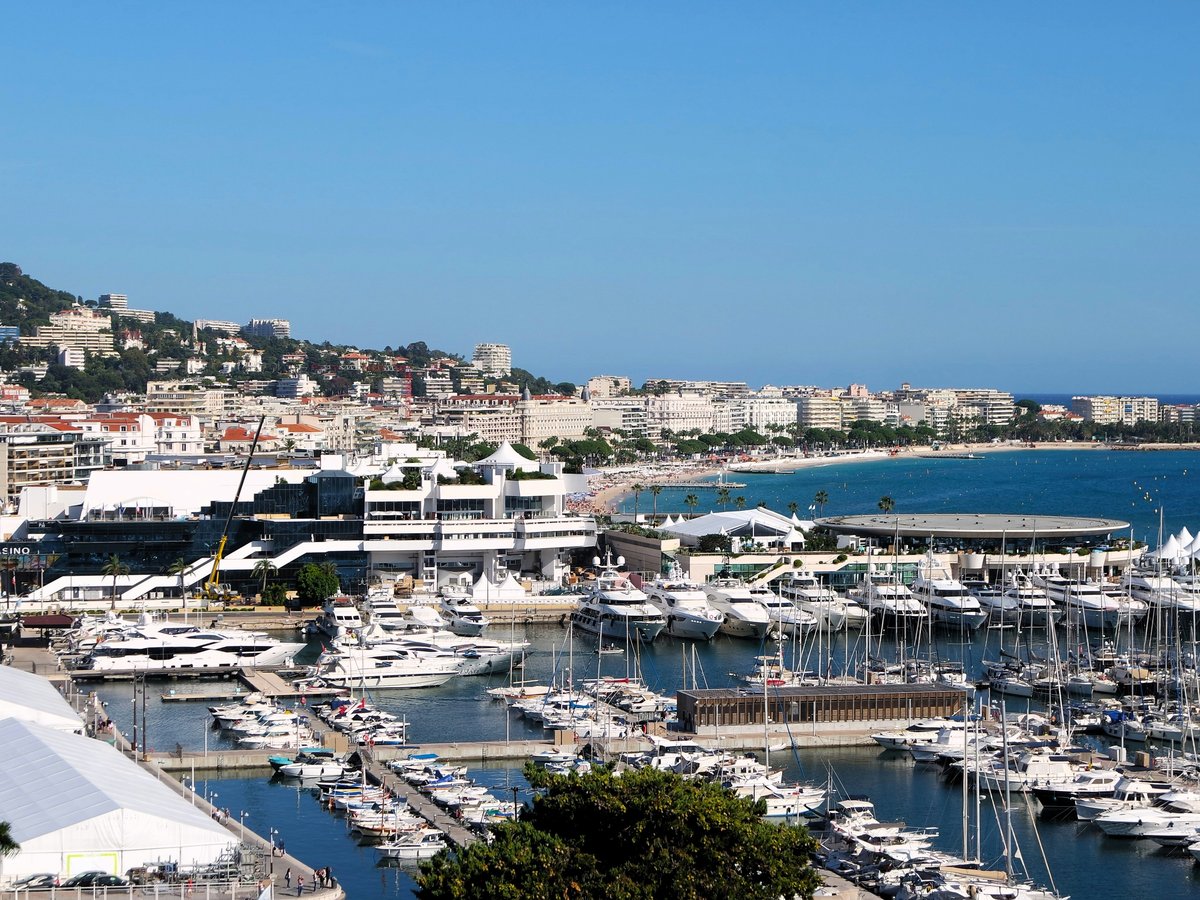
Stay in Cannes in July
59 hotels in the Trip.com pool for Cannes, from US$57 a night.
Opens Trip.com on Fri 2 Jul to Sun 4 Jul 2027; change the dates there.
July in Cannes means heat, crowds, and the Mediterranean at its warmest. Daytime temperatures sit around 30°C (86°F), and the city fills with French and Italian vacationers who claim every patch of sand along La Croisette by 10 a.m. Hotel rates reach their annual peak, restaurant terraces in Le Suquet spill onto cobblestone sidewalks, and the Festival d'Art Pyrotechnique lights up the Baie de Cannes with competitive fireworks on select evenings. Rain is nearly nonexistent, with roughly 10mm falling across the entire month.
That said, there's a reason people pay the premium. The sea temperature climbs to about 23-24°C (73-75°F), warm enough for long afternoon swims without any cold-water shock. Bastille Day on July 14 brings one of the Côte d'Azur's better fireworks shows, launched from barges anchored off the Palais des Festivals. Evenings cool to a comfortable 22°C (71°F), and you can eat outdoors past 10 p.m. without needing a layer. The light lingers until nearly 9:30 p.m., which tends to make every terrasse feel like it's been purpose-built for lingering over a glass of Côtes de Provence rosé.
If you prefer Cannes with breathing room, with tables at Marché Forville you don't have to elbow for, with Plage du Midi beaches where your towel isn't touching a stranger's, late May or September might suit you better. July is confident in what it is, and it charges accordingly. Expect to spend significantly more on a hotel room than you would in April or October. The trade-off is 14 hours of sunlight and water you can stay in for an hour without shivering. Cannes recorded roughly 330 hours of sunshine in July over the past 5 years.
Why visit in July
- Nearly zero rainfall at 10mm for the month, making outdoor plans extremely reliable compared to October's 123mm or March's 101mm
- Sea temperature reaches 23-24°C (73-75°F), the warmest of the year and comfortable for extended swimming off La Croisette and the Îles de Lérins
- The Festival d'Art Pyrotechnique runs several nights through the month, with international fireworks teams competing over the Baie de Cannes. Free to watch from the beaches
- Bastille Day on July 14 brings fireworks, open-air dances (bals des pompiers), and a festive atmosphere across the entire Côte d'Azur
- Provençal summer produce peaks in July. Courgette flowers, Cavaillon melons, white peaches, and figs appear at Marché Forville at their seasonal best
Worth knowing
- Hotel rates are well above the annual average, often the highest of any month. Beachfront properties can double compared to spring or autumn pricing
- La Croisette and the public beaches fill by mid-morning. The private beach clubs (plages concédées) charge a daily premium for a sunbed, and even those fill on weekends
- Parking in central Cannes becomes a genuine problem. The Parking Forville and Parking Laubeuf garages often fill before noon on weekends
- Temperatures occasionally spike above 35°C (95°F) during Côte d'Azur heat waves, which have grown more frequent since 2019. Air conditioning is still not standard in older buildings and budget accommodations
Best for
Think twice if
July is the driest and one of the two hottest months in Cannes. The average high sits at 30.1°C (86°F) and the average low at 21.7°C (71°F). Rainfall drops to roughly 10mm for the entire month, spread across about 3 days. That's a dramatic contrast with October's 123mm or January's 88mm. Humidity averages 62%, which is noticeable but lower than tropical destinations. The Mediterranean keeps air moving along the coast, and the occasional mistral-adjacent breeze sweeps through from the west. Mornings tend to start warm, around 24-25°C by 9 a.m., and the peak heat arrives between 1 and 4 p.m. Evenings cool gradually, settling around 22-23°C by 10 p.m. UV index runs high, typically 8-9, so sunburn happens fast without protection.
Seasonal caution
- Heat waves have become more frequent along the Côte d'Azur. In July 2023, temperatures in the Alpes-Maritimes exceeded 37°C (99°F) for several consecutive days. Stay hydrated and avoid prolonged exposure between 1 and 4 p.m. during heat alerts
- Forest fire risk in the Massif de l'Esterel (directly west of Cannes) rises sharply in July. Hiking trails in the Esterel may close during red-alert days. Check the Préfecture des Alpes-Maritimes alerts before planning any inland hikes
- UV index regularly reaches 8-9 in July. Sunburn can develop in under 20 minutes of unprotected midday exposure, especially on the water or at the beach where reflection intensifies the effect
Year-round climate
Averages from the last 5 years.
| Month | Avg high (°C) | Avg low (°C) | Rainfall (mm) |
|---|---|---|---|
| Jan | 13 | 6 | 88 |
| Feb | 14 | 7 | 71 |
| Mar | 16 | 8 | 101 |
| Apr | 18 | 10 | 75 |
| May | 22 | 14 | 58 |
| Jun | 27 | 19 | 52 |
| Jul | 30 | 22 | 10 |
| Aug | 31 | 22 | 32 |
| Sep | 26 | 18 | 62 |
| Oct | 22 | 15 | 123 |
| Nov | 17 | 9 | 81 |
| Dec | 14 | 7 | 78 |
Holidays and festivals in July
Public holidays
- Bastille Day(Fête nationale)14 July 2027
Headline events
Festival d'Art Pyrotechnique de Cannes
Several dates in July and August, typically 3-4 shows in July alone
International fireworks competition held over the Baie de Cannes since 1967. Pyrotechnic teams from countries like Japan, Italy, and China each get a night to stage a 25-minute show choreographed to music, launched from barges in the bay. Tens of thousands watch from the beaches and La Croisette. The shows typically start around 10 p.m. and are free to view from any public beach or the Croisette promenade.
Best things to do in July
Watch the Festival d'Art Pyrotechnique from Plage du Midi
entertainmentThe western public beach offers an unobstructed view of the fireworks barges in the Baie de Cannes without the dense crowds on La Croisette. Locals spread blankets on the sand by 8 p.m. and wait for the 10 p.m. launch. The 25-minute shows are choreographed to music broadcast on a local FM frequency, so bring a portable radio or earbuds connected to your phone.
The competition runs from July through August, with 3-4 shows scheduled in July aloneBooking tipNo booking needed. Arrive by 8:30 p.m. to secure a good spot on the sand
Day trip to Île Sainte-Marguerite
natureThe larger of the two Lérins Islands sits 15 minutes by ferry from Cannes' Vieux Port. The island's Aleppo pine forest stays noticeably cooler than the mainland, and the rocky coves on the southern shore offer clear water for snorkeling. The Fort Royal, where the Man in the Iron Mask was held from 1687 to 1698, houses a small maritime museum. Eucalyptus and pine scent the walking trails that loop the island's 3.25km length.
July's calm seas and warm water temperature of 23-24°C make the snorkeling and swimming off the island's south shore comfortable for long stretchesBooking tipFerries depart every 30 minutes in July from the Quai Laubeuf. The first morning boat tends to be the least crowded
Swim at Plage de la Bocca
beachThis public beach west of central Cannes stretches for over 1km and draws fewer tourists than La Croisette's beaches. The sand is coarser, the water drops off more gradually, and the crowd skews local. Families with children tend to cluster near the eastern end closest to the restaurants. The water in July typically sits around 23°C, warm enough that you walk in without bracing yourself.
Sea temperatures reach their annual peak in July and August, and the near-zero rainfall means you can count on beach days almost every day of the monthEvening stroll and dinner in Le Suquet
food and cultureCannes' old quarter climbs the hill above the Vieux Port, with narrow stone streets, 17th-century facades, and terraced restaurants that look out over the bay. The Église Notre-Dame d'Espérance at the summit dates to the 16th century. On July evenings, the cobblestones still hold the day's heat underfoot, the air smells of grilled fish and olive oil from the restaurants, and the light over the Esterel mountains to the west turns pink around 9 p.m.
July's long daylight, with sunset near 9:15 p.m., means you can dine outdoors with a view of the bay in natural light past 9 p.m.Morning market at Marché Forville
foodCannes' covered market operates Tuesday through Sunday, and July mornings bring peak Provençal summer produce. Stallholders sell courgette flowers, Cavaillon melons, white peaches, cherries from the Luberon, lavender honey, and local goat cheeses. The smell of ripe stone fruit and fresh herbs fills the hall. Mind you, getting there before 8 a.m. makes a difference. By 10, the aisles get tight with tourists and the best produce is picked over.
July is the peak month for Provençal stone fruits, melons, and courgette flowers, all of which have a narrow window of peak ripenessHike the Sentier du Littoral toward Pointe de la Croisette
natureThe coastal path runs along the rocky shore east of Palm Beach, past hidden swimming coves and through patches of Mediterranean scrub. The trail is flat to gently undulating, about 3km round trip. The rocks radiate heat by midday, so morning is the window. You'll hear cicadas in the pines, and the water below is clear enough to see the bottom at 4-5 meters depth.
July's calm Mediterranean conditions and warm morning temperatures around 24-25°C make early-morning coastal walks comfortable before the midday heat sets inBastille Day celebrations on July 14
cultural eventThe national holiday fills Cannes with a full day of events. A military parade passes through the city center in the morning, followed by open-air concerts and street entertainment through the afternoon. The evening fireworks launch from barges off the Palais des Festivals, visible from the length of La Croisette. Bals des pompiers, the traditional fire station dances, open the night before on July 13 at the caserne on Avenue de Grasse.
July 14 is France's national holiday, and the Cannes fireworks display over the bay is one of the larger shows on the Côte d'AzurWhat to eat in July
In season: fruit
Cavaillon melon
The Cavaillon melon ripens through July in the Luberon valley, about 180km northwest of Cannes. You'll find them at Marché Forville by the crate, their orange flesh intensely sweet and fragrant. Locals serve them chilled with thin slices of jambon cru. The scent alone, honeyed and slightly musky, tends to fill the entire market hall on warm mornings.
Figs (figues de Solliès)
The early fig harvest from Solliès-Pont, about 90km east of Cannes in the Var, starts arriving at markets in late July. Solliès produces roughly 75% of France's commercial figs. The violette de Solliès variety has dark purple skin and deep red flesh with a jammy sweetness. They bruise within hours of picking, so the ones at Forville are typically from that morning's delivery.
On menus now
Fleurs de courgette farcies
Stuffed courgette flowers, filled with fresh ricotta or brousse cheese and lightly fried. July is peak flowering season for courgettes in Provence, and Marché Forville vendors sell the blossoms by the bunch each morning. The texture is delicate, almost papery, with a faint sweetness from the flower itself. Most bistros in Le Suquet put them on as a starter through the summer months.
Tarte tropézienne
A brioche cake split and filled with a pastry cream and whipped cream mixture, created in Saint-Tropez in the 1950s for the cast filming And God Created Woman. The original recipe by Alexandre Micka is still closely guarded. Bakeries in Cannes stock their own versions through the summer tourist season, and the brioche dough is best eaten the day it's baked, still slightly warm.
What to drink
Rosé de Provence
Côtes de Provence rosé accounts for roughly 40% of all French rosé production, and July is when consumption peaks along the coast. The pale, salmon-colored wines from appellations like Bandol and Côtes de Provence tend toward dry with notes of stone fruit and citrus. You'll find carafes on every terrasse from Le Suquet to La Bocca.
Regular events in July
Bastille Day (Fête Nationale)Free
National holiday on July 14 with a military parade, concerts, and evening fireworks over the Baie de Cannes. The bals des pompiers at the fire station on Avenue de Grasse begin the night of July 13.
July 13-14Les Plages Électroniques
Electronic music festival held on the beach near the Palais des Festivals. International and French DJs perform on stages set up directly on the sand, with the Mediterranean as the backdrop. The festival has run since 2006 and typically draws tens of thousands over its run.
Mid-JulyMarché nocturne de La BoccaFree
Evening market in the La Bocca neighborhood with local artisan goods, Provençal food stalls, and live music. The stalls set up along the main avenue and the market runs into the late evening, cooler than daytime shopping.
Select evenings in JulyBest places this July
Île Sainte-Marguerite
islandThe larger Lérins Island, 15 minutes by ferry from the Vieux Port. Fort Royal held the Man in the Iron Mask from 1687 to 1698. Pine-shaded walking trails circle the island's 3.25km length, and the southern coves have clear, calm water for swimming in July.
Le Suquet
historic quarterCannes' original hilltop quarter above the Vieux Port. Narrow stone lanes, the 16th-century Église Notre-Dame d'Espérance, and the Musée de la Castre in the medieval tower at the summit. The terraced restaurants along Rue Saint-Antoine look out over the bay toward the Esterel.
Le SuquetMarché Forville
marketCovered market operating Tuesday through Sunday, 2 blocks inland from the Vieux Port. Peak Provençal produce in July. The Monday flea market (brocante) replaces the food stalls with antiques and secondhand finds.
CentrePlage du Midi
beachPublic beach west of the Palais des Festivals, stretching toward La Bocca. Less crowded than La Croisette's beaches, with a promenade popular for evening walks. Good vantage point for the Festival d'Art Pyrotechnique shows.
MidiPointe de la Croisette
natureThe eastern tip of the Croisette peninsula, past the luxury hotels. A rocky shoreline with a coastal path and views toward the Lérins Islands. The water is clearer here than along the main Croisette beaches, and the swimming is off rocks rather than sand.
La CroisetteMassif de l'Esterel
natureVolcanic red porphyry mountains beginning about 10km west of Cannes. The Corniche d'Or road hugs the coast with dramatic views. Worth noting, July brings elevated fire risk, so check trail closures with the Préfecture des Alpes-Maritimes before heading out.
Musée de la Castre
museumSmall museum housed in the medieval watchtower and chapel at the summit of Le Suquet. Collections of Mediterranean antiquities and ethnographic objects from Oceania and the Himalayas. The tower's panoramic view over the bay, the Croisette, and the Esterel is the real draw.
Le Suquet
Your packing checklist
Tick items off as you pack. Your progress saves in this browser.
All packed — have a great trip.
Insider tips
The Festival d'Art Pyrotechnique soundtrack is broadcast on a local FM frequency during each show. Bring a small radio or tune in on your phone with earbuds to hear the music the fireworks are choreographed to. Without it, you're watching in silence.
Marché Forville's Monday brocante (flea market) replaces the usual food stalls with antiques, vintage kitchenware, and secondhand books. It draws a different crowd entirely, mostly locals hunting for specific finds rather than tourists browsing produce.
The first ferry to Île Sainte-Marguerite in the morning is the one to catch. By midday the island's swimming coves on the south shore fill up, and the pine-shaded trails feel noticeably more crowded. The return ferries run late enough that you can stay for a full afternoon.
For the July 14 fireworks, the eastern stretch of La Croisette near the Pointe offers a less dense viewing position than the area directly in front of the Palais des Festivals, where the crowd packs tightest.
La Bocca's restaurants serve essentially the same Provençal cuisine as Le Suquet and La Croisette at noticeably lower prices. It's a 15-minute bus ride or a 25-minute walk along the Plage du Midi promenade.
Avoid these mistakes
- Arriving at La Croisette's public beaches after 10 a.m. and expecting to find space. The sand fills early in July. Plage du Midi or Plage de la Bocca have more room later in the morning.
- Planning a hike in the Massif de l'Esterel without checking fire risk alerts. Trails close during red-alert days, which happen multiple times in a typical July. The Préfecture des Alpes-Maritimes posts daily risk levels.
- Skipping sunscreen or underestimating the UV. The index sits at 8-9 through July, and water reflection off the Mediterranean intensifies exposure. Sunburn develops in under 20 minutes at midday without protection.
- Driving into central Cannes on a weekend morning expecting to park easily. The Parking Forville and Parking Laubeuf garages fill before noon. The train from Nice runs every 20-30 minutes along the coast and drops you at Gare de Cannes, a 10-minute walk from La Croisette.
- Booking accommodation last-minute. July is peak season, and the best-value options go early. Booking 6-8 weeks ahead gives you meaningfully better choices, particularly in Le Cannet and La Bocca where rates run lower than the Croisette corridor.
Practical tips for July
July in Cannes is manageable with a bit of planning. Book accommodation well in advance, as July fills faster than any other month and last-minute options tend to be either fully booked or priced at a steep premium. For getting around, the Palm Bus network covers Cannes and surrounding towns, and the train along the coast between Nice and Cannes runs frequently, which saves the headache of parking. Beach days are best started early, before 10 a.m. on the public beaches, though the Plage du Midi and La Bocca stretches stay less dense than La Croisette through the morning. Stay hydrated. The heat between 1 and 4 p.m. is real, and ducking into an air-conditioned shop or the Musée de la Castre in Le Suquet is a reasonable strategy for the hottest hours. Most restaurants along the Croisette and in Le Suquet don't require reservations for lunch, but dinner bookings on Friday and Saturday nights are worth making a day or two ahead. The Gare de Cannes connects to Nice in about 35 minutes, making day trips along the coast straightforward without a car.
FAQ
Is July a good time to visit Cannes, or is it too crowded?
July is the busiest month, but the trade-off is warm sea water around 23-24°C, near-zero rainfall, and 14 hours of daylight. If you're comfortable with peak-season crowds on La Croisette, the weather and swimming conditions are likely the best you'll find all year. For a quieter version of similar weather, late June or early September might be worth considering.
How warm is the sea in Cannes in July?
The Mediterranean off Cannes typically reaches 23-24°C (73-75°F) in July, which is the warmest it gets all year. That's comfortable for swimming for an hour or more without getting cold. By comparison, the water in May still sits around 17-18°C, which most people find bracing.
What should I wear in Cannes in July?
Light, breathable fabrics like cotton and linen work best in the 30°C daytime heat. Cannes tends to be slightly more dressed-up than other coastal towns on the Côte d'Azur, so packing a few evening pieces that work at a waterfront restaurant is worthwhile. Sandals for the beach, closed-toe shoes for Le Suquet's cobblestones.
Are there free things to do in Cannes in July?
The Festival d'Art Pyrotechnique fireworks shows are free to watch from any public beach or the Croisette promenade, with 3-4 shows in July. Bastille Day celebrations on July 14 include free concerts and fireworks. The public beaches at Plage du Midi and Plage de la Bocca cost nothing, and walking the Sentier du Littoral coastal path is free. Marché Forville is free to browse, though you'll likely end up buying melons.
Is it worth visiting the Îles de Lérins in July?
Île Sainte-Marguerite is a 15-minute ferry ride from the Vieux Port and noticeably cooler than the mainland thanks to its pine forest. The southern coves offer clear water for snorkeling, and the Fort Royal where the Man in the Iron Mask was imprisoned is worth an hour. Take the first morning ferry to beat the midday crowds.
Does it rain in Cannes in July?
Almost never. July averages about 10mm of rainfall for the entire month, spread across roughly 3 days. For comparison, October averages 123mm and January 88mm. You can plan outdoor activities with high confidence that rain won't interfere. The occasional summer thunderstorm might pass through quickly, but sustained rain in July is rare on the Côte d'Azur.
Things to Do in Cannes in July
 Free cancellation
 Yacht Me Up All Inclusive Private Cruise Cannes Lérins Sailing
Day trip: 4 hours, free cancellation.
via Viator Free cancellation
 Cruise / Navigation / Sunset in the Lerins Islands
Day trip: 3.5 hours, free cancellation.
via Viator Free cancellation
 Eze and Monaco Private Half-Day Tour
Day trip: 5 hours, free cancellation.
via Viator Free cancellation
 Monaco and Eze Small Group Day Trip from Cannes
Day trip: 10 hours, free cancellation.
via Viator Free cancellation
 Taste Cannes – A Full French Riviera Food Tour by Do Eat Better
Day trip: 3.5 hours, free cancellation.
via Viator Free cancellation
 The best French Riviera Full-Day from Cannes Small-Group Shore Excursion
Day trip: 9 hours, free cancellation.
via ViatorFind a flight to Cannes
Live fares to Cannes appear here once cookies are accepted.
Last verified by automated review (v1.7.2) on . What is automated review?