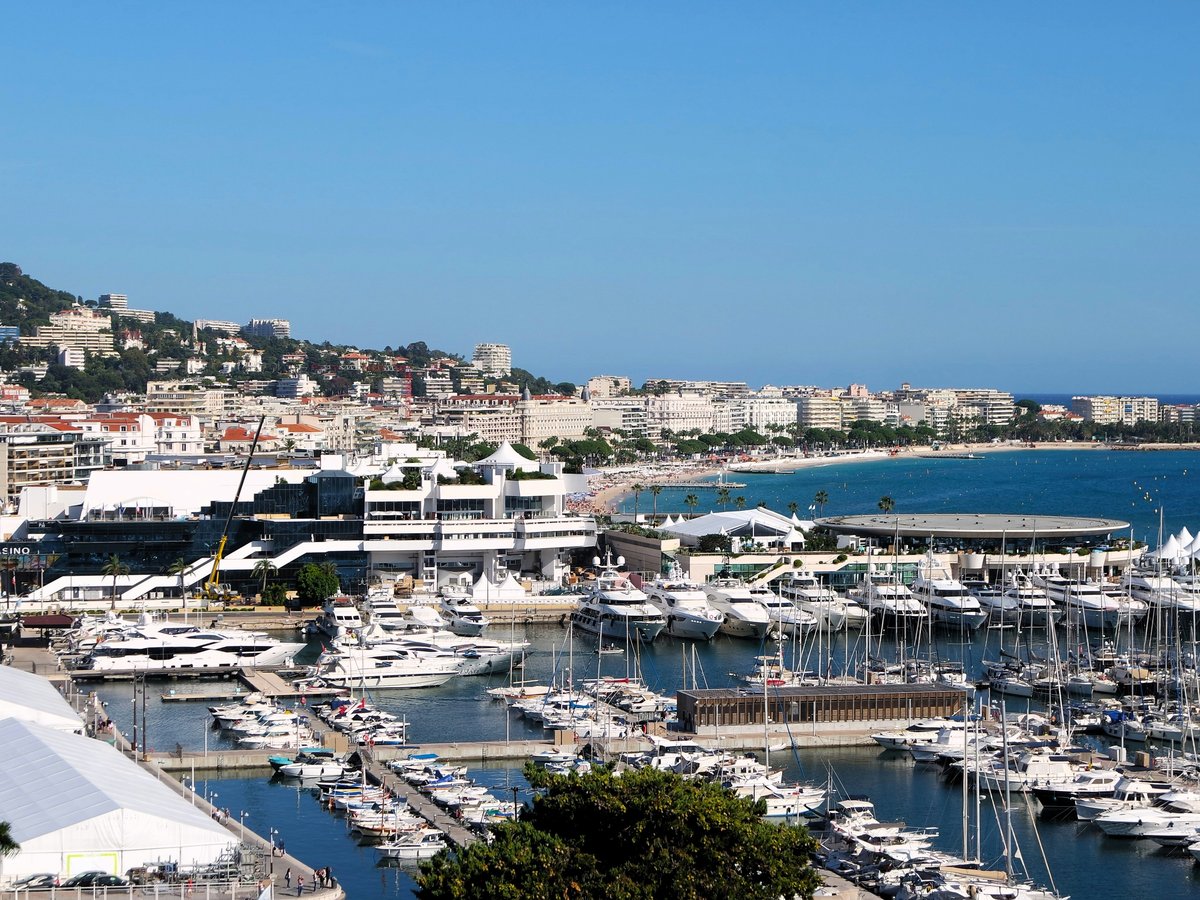
Cannes tends to project an image of red carpets and superyachts moored along the Quai Saint-Pierre. The private beaches on La Croisette still charge 30€ or more for a sunbed, so that reputation is fair enough. But the city's geography does most of the heavy lifting for visitors who arrive with empty pockets. The 2-kilometer Boulevard de la Croisette runs along a public coastline, not a gated one. Le Suquet, the medieval quarter above the harbor, costs nothing to climb. The Parc de la Croix des Gardes covers roughly 70 hectares of wild hillside with views from the Estérel massif to the Îles de Lérins. You might spend a full week in Cannes without paying admission anywhere, because the city's defining features, its waterfront, its light, its hilltop churches, belong to the public. Mind you, you'll still want 1.50€ for an espresso on Rue Meynadier.
Free attractions
-
Le Suquet
The old quarter of Cannes sits on a steep hill above the Vieux Port. Stone stairways wind past shuttered houses that date to the 11th and 12th centuries. At the summit, the square around the Église Notre-Dame d'Espérance opens onto a panorama of the bay, the Îles de Lérins, and the Estérel mountains to the west. The climb takes about 10 minutes from Rue Saint-Antoine. On clear mornings, the light off the water below has a quality you'll notice before you can name it.
Le SuquetHistoric quarter and viewpoint -
Église Notre-Dame d'Espérance
This church was built between 1521 and 1648 in a late-Gothic Provençal style. It sits at the top of Le Suquet, and entry is free. The interior runs several degrees cooler than the streets outside, and the 16th-century stonework has a roughness that feels honest compared to the polished boulevards below. The square outside, Place de la Castre, doubles as a concert venue during summer festivals.
Le SuquetChurch -
Boulevard de la Croisette
The 2-kilometer promenade follows the curve of the Baie de Cannes from the Palais des Festivals to the Pointe Croisette. Pine trees line the inland side. The sea side alternates between private beach concessions and public stretches where you can drop a towel for free. The walk is best before 9 a.m. in summer, when the pavement is still cool and the only company is joggers and dog walkers.
La CroisettePromenade -
Allées de la Liberté
A tree-lined public square between the Vieux Port and Rue Félix Faure. Locals gather here for pétanque most afternoons. The clack of steel balls on gravel carries across the benches. A flower market fills the square on most mornings, Tuesday through Sunday. The shaded allées face the port, so you get mast-and-hull views without the marina price tag.
Centre-villePublic square and garden -
Parc de la Croix des Gardes
Cannes' largest green space covers about 70 hectares of hilly terrain west of the city center. The trails pass through Mediterranean scrubland thick with wild rosemary and cistus. At the 164-meter summit, a cross and an orientation table mark a viewpoint that takes in the bay, the Estérel's red porphyry cliffs, and on very clear days, the southern Alps. The park is still relatively quiet compared to the waterfront, even in July and August.
La Croix des GardesPark and nature reserve -
Parc de la Villa Rothschild
A landscaped public park of about 1.5 hectares around the 19th-century Villa Rothschild, which currently houses the Médiathèque de Noailles. The gardens include palm trees, magnolias, and a rose garden that peaks in May and June. The park sits on Avenue Jean de Noailles, about a 10-minute walk north of the train station. It feels worlds away from the Croisette crowds.
NoaillesPark and garden -
Musée de la Castre
This museum occupies the medieval castle at the top of Le Suquet. Its collections span Mediterranean antiquities, pre-Columbian art, and ethnographic objects from Oceania and the Himalayas. Regular admission is currently 6€, but entry is free on the first Sunday of each month. The 11th-century Tour du Suquet, a square watchtower attached to the museum, offers the highest viewpoint in central Cannes. Worth timing a visit for that first Sunday if your budget is tight.
Le SuquetMuseum (free first Sunday of the month) -
Musée de la Mer, Île Sainte-Marguerite
This museum sits inside the Fort Royal on Île Sainte-Marguerite. It covers the island's history from Roman maritime trade through the legend of the Man in the Iron Mask, who was held here from 1687 to 1698. Admission is normally around 6€ but free on the first Sunday of each month. The Trans Côte d'Azur ferry from Cannes currently runs about 15€ return, so the museum visit itself might be free but getting there is not.
Île Sainte-MargueriteMuseum (free first Sunday of the month) -
Vieux Port de Cannes
The old harbor below Le Suquet is lined with fishing boats on the western quay and pleasure craft on the eastern side. You can walk the full perimeter in about 20 minutes. The morning catch still comes in around 7 a.m. at the Quai Saint-Pierre, and the smell of salt and diesel sits in the air. The port is also where ferries depart for the Îles de Lérins.
Le Suquet / Centre-villeHarbor and waterfront
Free activities
-
Marché Forville
The covered market on Rue du Marché Forville opens Tuesday through Sunday. The ground-floor stalls sell Provençal produce, olives, goat cheese, flowers, and socca, the chickpea-flour flatbread that comes hot off a copper pan and costs around 3€ a portion if you decide to break the zero-budget rule. Monday is brocante day, when the food stalls give way to antiques and secondhand dealers. The market's low concrete vaults trap a mix of lavender, ripe melon, and fresh bread that makes the walk worthwhile from any part of town.
Le Suquet / Centre-villeMarket -
La Croisette to Pointe Croisette walk
This 2.5-kilometer route begins at the Palais des Festivals and follows the full length of Boulevard de la Croisette east to the Pointe Croisette headland. Past the Hôtel Martinez and the private beaches, the path reaches a quieter stretch where rocky shore replaces sand. The Pointe itself has flat rocks that face south toward Île Sainte-Marguerite, good for sitting and watching the ferry traffic. Allow about 40 minutes one way at a slow pace.
La CroisetteWalking route -
Rue Meynadier stroll
The main pedestrian shopping street of old Cannes runs about 400 meters from Rue Félix Faure to the Marché Forville. It is narrower and less polished than the Croisette, with bakeries, cheese shops, and clothing stores that still serve a local clientele. The buildings are 4 to 5 stories of stuccoed Provençal architecture with wooden shutters in faded blues and greens. The street gets morning shade on its southern side, which matters in August.
Centre-villeWalking route -
Public beaches along the Croisette and west of town
Between the private beach concessions on La Croisette, several public stretches marked by blue "plage publique" signs offer free access to the sand and sea. The Plage du Midi, west of the Palais des Festivals, runs for about 1 kilometer and tends to be less crowded than the Croisette-side beaches. The Plage de la Bocca further west draws families and has a wider stretch of sand. Lifeguards are on duty at the main public beaches from June through September. No towel rental, no entry fee. Arrive before 10 a.m. in summer for a decent spot.
La Croisette / La BoccaBeach -
Sentier du littoral coastal path
A segment of the Côte d'Azur coastal trail passes through Cannes east of the Pointe Croisette, connecting toward Golfe-Juan and the quieter neighborhoods beyond. The path follows the rocky shore past small coves and pine-shaded stretches. The rocks are warm underfoot by mid-morning in summer, and the water below is clear enough to see the sandy bottom at 3 to 4 meters depth. Allow about 90 minutes for the full section.
Pointe Croisette / East CannesWalking route -
Île Sainte-Marguerite forest trails
The island's interior is covered by a eucalyptus and pine forest crisscrossed by marked trails. A full loop of the island takes about 2 hours on foot. The southern shore has small rocky beaches with water that stays calm in most conditions. The forest smells of pine resin and sea salt in equal measure. The trails themselves are free, though the return ferry from Cannes currently runs about 15€ with Trans Côte d'Azur.
Île Sainte-MargueriteNature walk
Free events
-
Cinéma de la Plage
Nightly during Festival de Cannes, typically mid-to-late MayDuring the Festival de Cannes in May, free open-air film screenings take place on the Plage Macé, next to the Palais des Festivals. The program typically includes classic films and recent restorations projected on a large screen with the Mediterranean as a backdrop. Screenings begin after sunset, around 9:30 p.m. Seating is first-come, first-served on beach chairs provided by the festival. No ticket or accreditation needed. The sound of waves underneath the soundtrack is something you only get at this particular screening.
Plage Macé, next to the Palais des Festivals -
Festival d'Art Pyrotechnique
Several nights in July and AugustA fireworks competition held over several nights in July and August, with participating teams from different countries each year. The displays launch from the Baie de Cannes and are free to watch from any public beach or the Croisette promenade. Each show lasts about 25 minutes and is synchronized to music broadcast on a local radio frequency. The Plage du Midi tends to offer wide, unobstructed sightlines. Crowds gather from about 9 p.m., with the fireworks starting around 10 p.m.
Baie de Cannes, viewed from public beaches and La Croisette -
Fête de la Musique
June 21, annuallyFrance's national music day on June 21 fills Cannes with free performances across the city. Stages appear on the Allées de la Liberté, along Rue Meynadier, in Le Suquet, and at the Vieux Port. Genres range from jazz and classical to Provençal folk and electronic sets. The event runs from late afternoon until past midnight. The summer solstice timing means daylight lasts until nearly 9:30 p.m. along the coast.
Multiple locations across Cannes -
Marché Forville brocante
Every MondayEvery Monday, the usual food stalls at Marché Forville are replaced by antique and secondhand dealers. You'll find Provençal ceramics, vintage postcards, old marine hardware, and furniture. Entry is free, and haggling is expected. The mix of objects changes weekly, so regulars tend to stop by most Mondays. The market opens around 8 a.m. and winds down by early afternoon.
Marché Forville, Rue du Marché Forville -
Journées Européennes du Patrimoine
Third weekend of September, annuallyOn the third weekend of September each year, buildings normally closed or ticketed open their doors for free across France. In Cannes, this has historically included the Hôtel de Ville, backstage areas of the Palais des Festivals, and some private villas on the Californie hill. The Musée de la Castre and Musée de la Mer are also free on this weekend. The specific program varies by year. The city typically publishes details a few weeks in advance.
Various locations across Cannes
The best free beaches in Cannes, mapped out
Cannes has roughly 7 kilometers of coastline, and the split between private and public sand can confuse first-time visitors. The private beach concessions, where a sunbed might run 25€ to 50€ per day, occupy much of the Croisette's waterfront. Between them sit public sections marked by blue signs reading "plage publique." You can lay down a towel and swim for nothing. Plage du Midi stretches about 1 kilometer west of the Palais des Festivals. The sand is slightly coarser than the Croisette side, and the beach faces south rather than southeast, so it catches afternoon sun until later. Plage de la Bocca continues further west toward Mandelieu-la-Napoule and draws a more local crowd. The water temperature along Cannes sits around 20°C in June, reaching 24°C to 26°C by late July. Lifeguard stations operate from June to September. No reservations, no fees.
Walking Le Suquet, the part of Cannes that existed before the Croisette
The medieval quarter of Le Suquet predates Cannes' resort identity by about 800 years. The neighborhood clings to a rocky hill above the Vieux Port, and its narrow streets still follow paths laid out when the town was a fishing settlement under monastic control from the Îles de Lérins. Rue Saint-Antoine is the oldest commercial street in Cannes. It begins near the Vieux Port. The gradient steepens as you pass through Place du Suquet, where small restaurants set tables on the cobblestones. Turn left at Rue du Mont Chevalier and follow the stone steps upward. The stairways are uneven and worn smooth in places. You'll pass houses with terracotta roofs thick with moss and window boxes trailing bougainvillea in deep magentas and purples. At the top, the 11th-century Tour du Suquet and the Église Notre-Dame d'Espérance share a square with stone benches and a low wall overlooking the bay. The viewpoint takes in the full sweep of La Croisette, the Îles de Lérins, and on clear days, the snow-dusted peaks behind Nice about 30 kilometers to the east. The climb takes roughly 10 to 15 minutes. The descent by a different route via Rue Perrissol drops you near the Marché Forville.
Where free ends and fees begin
A few spots in Cannes that might seem free charge admission, so it is worth knowing before you plan around them. The Musée de la Castre and Musée de la Mer, both municipal, charge standard admission of around 6€ each, though both still offer free entry on the first Sunday of each month. The Centre d'Art La Malmaison on La Croisette hosts temporary art exhibitions that typically run between 4€ and 7€ per show. If your visit happens to fall on a first Sunday, you'll pick up the two museums at no cost, which is a meaningful saving. The Journées du Patrimoine weekend in September is another window when ticketed sites open for free.
FAQ
Are Cannes' beaches really free to use?
Yes, though with a caveat. Much of the Croisette's beachfront is divided into private concessions that charge for sunbeds and parasols, with rates from about 25€ to 50€ per day. Between these concessions, public beaches are free. The Plage du Midi west of the Palais des Festivals and the Plage de la Bocca further west are the largest free stretches. You can swim, sunbathe, and use the public showers at no cost.
Which museums in Cannes offer free entry days?
The Musée de la Castre in Le Suquet and the Musée de la Mer on Île Sainte-Marguerite are both currently free on the first Sunday of each month. The Musée de la Castre holds Mediterranean antiquities and ethnographic collections. The Musée de la Mer covers the island's history and the story of the Man in the Iron Mask. Outside those first Sundays, expect to pay around 6€ each. The annual Journées du Patrimoine weekend in September also opens both museums for free, along with other normally ticketed sites.
Can you visit Île Sainte-Marguerite for free?
The island itself has free trails and beaches once you arrive. The Fort Royal exterior and forest paths cost nothing to walk. The catch is the ferry. Trans Côte d'Azur currently charges about 15€ return for the 15-minute crossing from the Vieux Port. If you time your visit for the first Sunday of the month, the Musée de la Mer inside the fort is free, which saves you the 6€ admission on top of the ferry cost.
Is there anything free to do during the Cannes Film Festival?
The Cinéma de la Plage screenings on Plage Macé are free and open to the public every evening during the festival, typically in mid-to-late May. No accreditation or ticket needed. Films start after sunset around 9:30 p.m., and beach chairs are first-come, first-served. Beyond the screenings, the atmosphere around the Palais des Festivals and La Croisette is worth experiencing on its own. You will likely see film crews, promotional events, and the general buzz of the festival on the boulevard.
What is the best free viewpoint in Cannes?
The top of Le Suquet, at the square outside the Église Notre-Dame d'Espérance, offers the most complete panorama of the city. You can see La Croisette, the Vieux Port, the Îles de Lérins, and the Estérel massif from there. For a wider and more elevated view, the summit of the Parc de la Croix des Gardes at 164 meters gives a fuller perspective that includes the hills behind Cannes and the Cap d'Antibes to the east. Both are free and accessible year-round.
How much of Cannes can you realistically see without spending anything?
Quite a lot, to be honest. The Croisette promenade, Le Suquet, Marché Forville for browsing, the Vieux Port, the Allées de la Liberté, both major parks, and the public beaches are all free. You could fill 3 to 4 full days with walking routes, beach time, and park visits without paying admission anywhere. The main costs you cannot avoid are the ferry to Île Sainte-Marguerite at about 15€ return, museum admission outside first Sundays at around 6€ each, and food.
Last verified by automated review (v1.7.2) on . What is automated review?