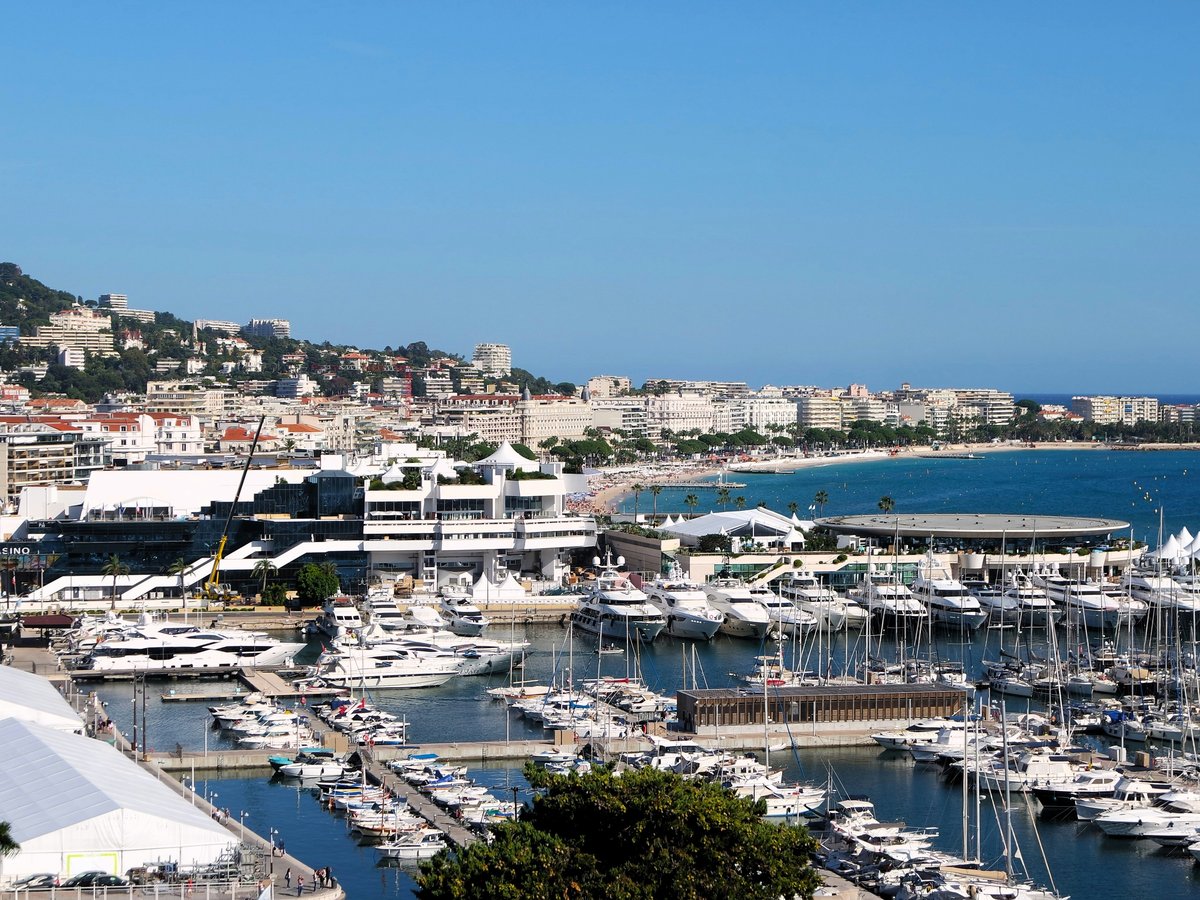
Cannes sits on a narrow shelf between the Massif de l'Esterel and the Mediterranean, and that geography shapes everything. The red porphyry hills start less than 10 kilometers west of the city center, dropping straight into deep blue water. To the south, the Îles de Lérins float about 15 minutes offshore by boat. The city itself climbs from the Croisette seafront up through Le Suquet and the Croix des Gardes hill, which tops out around 164 meters. Most visitors associate Cannes with the film festival and the promenade, but the outdoor side of the place tends to catch people off guard. You'll find 300-odd days of sunshine a year, trail networks that connect directly to the GR51 long-distance path, and water warm enough for comfortable swimming from June through October. The mistral wind can rip through in winter and spring, dropping temperatures fast. That said, even January sees mild enough conditions for hill walking. The Esterel, in particular, is the draw. Those red rock formations against the blue sea look almost unreal on a clear morning, and the trail system there has been walked since Roman times.
Outdoor activities
-
Road Cycling the Corniche de l'Esterel
The D559 coastal road between Cannes and Saint-Raphaël runs about 30 kilometers along the base of the Esterel massif. The road hugs the coast with short, punchy climbs between calanques. Traffic can be heavy in July and August, but early mornings, say before 8 a.m., are still manageable. You'll pass through Théoule-sur-Mer, Miramar, and Agay. The road surface is generally good, though some sections near the Pointe de l'Observatoire have rough patches. Local clubs from Cannes ride this route year-round.
- Difficulty
- Moderate. Cumulative elevation around 400-500 meters depending on detours.
- Duration
- 2-3 hours round trip at a touring pace
- Best season
- March through June and September through November. Summer mornings work but the heat after 10 a.m. is real.
-
Trail Running in the Croix des Gardes
The Parc Naturel Départemental de la Croix des Gardes covers about 80 hectares right inside city limits, and the trail network there is surprisingly rugged for an urban park. Dirt singletrack winds through Aleppo pine forest with some rocky sections near the summit. The 164-meter high point gives you a full panorama over the bay, the Lérins islands, and the Esterel ridge. Locals run here before work. The trails dry fast after rain, though the red clay sections can be slippery when wet.
- Difficulty
- Easy to moderate. Short but with some uneven rocky ground.
- Duration
- 30-60 minutes for a loop
- Best season
- Year-round. Summer afternoons get hot on the exposed sections.
-
Rock Climbing in the Esterel
The red porphyry of the Esterel offers multi-pitch and sport climbing routes, concentrated around the Pic du Cap Roux area and the Calanque du Petit Caneiret. The rock is volcanic, rough-textured, and generally solid, though some routes have loose sections that need care. Routes range from 4a to 7c on the French scale. The setting is distinctive. Red rock, blue sea below, maquis scrub in every crack. Climbers typically park at the Col de l'Évêque or the Maison Forestière du Gratadis and walk in. A local guide service operates out of Mandelieu-la-Napoule.
- Difficulty
- Varies. Beginner-friendly bolted routes exist alongside serious multi-pitch lines.
- Duration
- Half day to full day
- Best season
- October through May. Summer south-facing walls reach uncomfortable temperatures by mid-morning.
-
Mountain Biking on the Esterel Trails
The Esterel forest has a network of DFCI fire roads and singletrack that mountain bikers share with hikers. The terrain is technical in places, with loose red gravel, exposed roots, and some steep descents toward the coast. The main access points from the Cannes side are near Théoule-sur-Mer and the Col du Tanneron road. Mind you, the fire roads are wide and mellow, but the singletrack spurs demand real bike handling. Bring your own bike or rent from shops along the Rue d'Antibes.
- Difficulty
- Moderate to difficult depending on the trail chosen
- Duration
- 2-4 hours
- Best season
- September through June. Trails can be dusty and loose in high summer.
-
Paragliding over the Baie de Cannes
Tandem paragliding flights launch from sites above Gourdon and in the hills behind Grasse, roughly 30 to 40 minutes by car from Cannes. The flight path often drifts south toward the coast, giving you a long look at the bay, Cap d'Antibes, and the Lérins islands from maybe 1,200 meters up. Conditions tend to be best when a light onshore thermal builds in late morning. Several operators run tandem flights for first-timers, typically costing between 90 and 150 euros as of 2024.
- Difficulty
- None required for tandem. The operator handles the flying.
- Duration
- 15-25 minutes airborne, plus transport and briefing
- Best season
- April through October, when thermal conditions are most consistent
Day hikes
-
Pic du Cap Roux from the Col du Saint-Pilon
This is likely the best half-day hike accessible from Cannes. The trailhead at the Maison Forestière du Gratadis sits about 25 minutes by car west along the N98 and then inland. The path climbs through dense maquis and cork oak before breaking out onto exposed red porphyry ridges. The summit of Cap Roux reaches 452 meters and the views drop straight to the sea. On a clear day you can see the Îles de Lérins, the Baie de Cannes, and the Maures range beyond Saint-Raphaël. The descent retraces your steps or loops via the Sainte-Baume grotto. The trail is well-marked with yellow blazes but rocky underfoot.
- Difficulty
- Moderate. About 350 meters of elevation gain with some scrambling near the top.
- Duration
- 3-4 hours round trip
- Best season
- October through May. Summer heat on the exposed ridgeline is serious.
-
Tour of Île Sainte-Marguerite
A 15-minute ferry from Cannes old port drops you on the larger of the Lérins islands. A trail loops the island's perimeter, roughly 6 kilometers, through Aleppo pine and eucalyptus forest, past the Fort Royal where the Man in the Iron Mask was held, and along rocky shoreline with small swimming coves. The terrain is flat to gently rolling. The interior trails are shaded and smell strongly of pine resin on warm days. The south shore has a few sandy patches where you can swim after the walk. Ferries run frequently from April through October, less often in winter.
- Difficulty
- Easy. Flat terrain, well-maintained paths. Suitable for families.
- Duration
- 2-3 hours for the full loop, plus ferry time
- Best season
- April through October for the best ferry schedule and swimming. Spring wildflowers peak in April.
-
Sentier du Littoral from La Croisette to Mouré Rouge
The coastal path starts at the eastern tip of the Croisette (Pointe Croisette) and follows the rocky shoreline south toward the Pointe de la Galère. It's a low-level walk along wave-cut rock platforms, with sections of paved path, rough stone steps, and some spots where you're picking across slippery boulders at water level. The Mediterranean is right there, close enough to feel spray on windy days. The path passes several small coves, some of them swimmable in calm conditions. Worth noting, storm damage closes sections occasionally, so check locally before setting out.
- Difficulty
- Easy to moderate. Short but uneven footing in places.
- Duration
- 1.5-2 hours one way
- Best season
- Year-round, though winter storms can close sections. Spring and autumn have the best light.
-
Mont Vinaigre via the Esterel Forest Road
Mont Vinaigre at 618 meters is the highest point in the Massif de l'Esterel. The standard approach follows the forest road from the Maison Forestière de l'Esterel on the N7, about 35 minutes west of Cannes. The route climbs steadily through cork oak and pine, with the red rock increasingly exposed as you gain altitude. A telecommunications tower marks the summit, which is a bit anticlimactic, but the 360-degree views are wide open. You can see the Alps on clear winter mornings. The return is the same route unless you arrange transport to another trailhead.
- Difficulty
- Moderate to difficult. Around 450 meters of elevation gain, mostly on forestry track but steep in the final section.
- Duration
- 4-5 hours round trip
- Best season
- October through April. Snow is rare but possible in January. Summer fire-risk closures are common.
-
Île Saint-Honorat Circuit
The smaller Lérins island, Saint-Honorat, is home to the Abbaye de Lérins, where Cistercian monks still produce wine and liqueur. A path circles the 1.5-kilometer-long island, passing fortified medieval towers, vineyards, and lavender plantings. The atmosphere here is notably quieter than Sainte-Marguerite. The monks ask visitors to respect the silence in certain zones. The south side of the island has flat rock shelves where you can sit with your feet in the water. Ferries depart from the old port, separate from the Sainte-Marguerite service.
- Difficulty
- Easy. Completely flat, under 4 kilometers total.
- Duration
- 1-1.5 hours walking, plus time at the abbey and ferry transit
- Best season
- April through October. The abbey shop sells the monks' Lérins wines, and the vineyard is most photogenic in autumn.
Water activities
-
Sea Kayaking to the Îles de Lérins
Paddling from the Cannes coastline to Île Sainte-Marguerite covers about 1.5 kilometers of open water. Several rental outfits near the Vieux Port and along the Boulevard du Midi offer sit-on-top kayaks by the hour or half-day. The crossing is short but exposed. If the wind picks up from the east, the return paddle can be slow work. Once at the island, you can explore the rocky coves along the south shore and find clear water over sand and Posidonia seagrass. Mornings tend to be calmer. To be fair, by early afternoon in summer the boat traffic between the mainland and the islands gets busy.
- Difficulty
- Easy to moderate. Open-water crossing requires basic paddling fitness.
- Duration
- Half day including island exploration
- Best season
- May through October. July and August have the warmest water but the most boat traffic.
-
Swimming at Plage du Midi
The public beaches west of the Vieux Port, along the Boulevard du Midi Jean Hibert, are wider and less crowded than the Croisette side. Plage du Midi is sandy, gently shelving, and free. The water is typically swimmable from mid-May through late October, reaching around 23-25 degrees Celsius in August. Lifeguard stations operate in summer. The beach faces south-southwest, so you get sun well into the evening. The smell of sunscreen and salt mixes with whatever the shoreline restaurants are grilling.
- Difficulty
- None. Sandy entry, gentle slope.
- Duration
- As long as you like
- Best season
- June through September for warm water. May and October are possible but the water has dropped to 17-19 degrees.
-
Stand-Up Paddleboarding along the Croisette
SUP rental stations appear along the Croisette beaches from April onward. The bay between the Palais des Festivals and the Pointe Croisette is relatively sheltered, making it a forgiving spot for first-timers. Early mornings before the jet skis and tenders start up are best. The water is clear enough in places to see the bottom at 3-4 meters. You can paddle east toward the rocky headland of the Pointe Croisette, where the water deepens and small fish gather around the submerged rocks.
- Difficulty
- Easy. Sheltered bay conditions most mornings.
- Duration
- 1-2 hours
- Best season
- May through October. Mornings are calmest.
-
Freshwater Swimming and Kayaking at Lac de Saint-Cassien
This reservoir sits about 25 kilometers northwest of Cannes, near the village of Tanneron. It covers around 430 hectares and the water is warm by midsummer, typically 22-26 degrees. Several beaches along the north shore allow swimming, and kayak or pedal-boat rental operates from the eastern end near the dam. The setting feels completely different from the coast. Forested hills surround the lake, and the water is a dark green. Birdwatchers come for the herons and cormorants on the western marshes. You'll want a car to get there, as public transport options are limited.
- Difficulty
- Easy. Calm freshwater with gentle shoreline access.
- Duration
- Half day to full day
- Best season
- June through September. The lake is quieter in early June before school holidays.
-
Sailing from the Vieux Port
Cannes has a long sailing tradition, and the Vieux Port is home to several yacht clubs and charter operations. Day-charter catamarans and monohulls are available for experienced sailors, and skippered half-day sails toward the Lérins or along the Esterel coast are common for visitors. The prevailing summer wind is a light southeasterly that builds through the afternoon. Winter brings the mistral, which funnels down the Rhône valley and can reach 60-70 km/h locally. Races run out of the Yacht Club de Cannes through much of the year, and the Régates Royales in late September draw classic wooden yachts from across the Mediterranean.
- Difficulty
- Varies. Skippered trips require no experience. Bareboat charters need proof of competence.
- Duration
- Half day to full day
- Best season
- May through October for recreational sailing. September and October have the most consistent afternoon thermal breezes.
Parks & gardens
-
Parc Naturel Départemental de la Croix des Gardes
FreeThis is the largest green space inside Cannes, 80 hectares of Aleppo pine, maquis shrubland, and Mediterranean wildflowers spread over a low hill west of the center. The park was protected from development in the 1990s after local campaigns. The trails are unpaved and feel more like countryside than city park. In February and March, the mimosa blooms turn whole slopes yellow, and the smell of it carries on the wind. Stone ruins dot the upper sections. The summit viewpoint looks out over the Croisette, the old port, and across to the islands.
Highlights: Mimosa blooms in late winter, summit panorama over the bay, remnants of 19th-century estate walls, native orchid species in spring
-
Parc de la Vallombrosa
FreeA quieter green space near the Cannes-la-Bocca end of town, Vallombrosa feels residential and unhurried. Old Mediterranean pines provide deep shade even in August. The park sits on the grounds of what was once a private estate, and some of the exotic plantings, palm varieties and mature cedars, date from that era. It draws a local crowd. Families, dog walkers, people reading on benches under the canopy.
Highlights: Mature cedar and palm specimens, shaded walking paths, relative quiet even in peak tourist season
-
Les Jardins de la Croisette
FreeThe formal gardens lining the Boulevard de la Croisette run for about 2 kilometers between the Palais des Festivals and the Pointe Croisette. They're narrow but well maintained, with seasonal flower plantings, sculpture installations, and mature umbrella pines. The salt air and the sound of waves are constant. Worth noting, these gardens look different in every season. Summer has the crowds and the yachts as backdrop. Winter mornings are nearly empty, with low light making the water a deep grey-green.
Highlights: Seasonal floral displays, public sculpture, uninterrupted views of the Lérins Islands and the Esterel headlands
-
Jardin du Suquet
FreeNot a formal garden but a series of small terraced green spaces climbing through the old town around the Musée de la Castre and the Tour du Suquet. Olive trees, bougainvillea, and fig trees grow in tight spots between medieval stone walls. The top terrace, next to the church of Notre-Dame-d'Espérance, sits about 60 meters above the port. You'll hear the bell tower chime the hour. The old fishermen's quarter below still has its narrow lanes and pastel facades.
Highlights: Panoramic old-port views from the Tour du Suquet terrace, 11th-century chapel walls, mature olive trees in the churchyard
-
Parc de la Roseraie
FreeA compact rose garden near the eastern end of the Croisette, tucked behind the beachfront hotels. It holds several hundred rose varieties on about 1 hectare. Peak bloom is May into early June, when the scent is thick enough to notice from the path. The layout is classic French formal, with gravel paths and low box hedging. It's a calm spot when the Croisette itself feels hectic.
Highlights: Peak rose bloom in May, labeled variety beds, quiet benches away from the seafront crowds
Practical tips
- Sun Protection
- The Côte d'Azur UV index regularly reaches 8-9 in summer, and reflected light off the water and the pale Esterel rock adds to the exposure. SPF 50 is not overkill. A brimmed hat and sunglasses with UV400 rating are standard for any hike from April through October. The coastal paths and Esterel ridges have almost no shade on exposed sections. Reapply sunscreen every 90 minutes if you're sweating.
- Water and Hydration
- Carry at least 1.5 liters per person for any Esterel hike, and 2 liters or more if temperatures are above 25 degrees. There are no reliable water sources on the Esterel trails. The islands have limited facilities, with a small shop on Sainte-Marguerite near the fort and the abbey shop on Saint-Honorat, but don't count on them outside peak season. Tap water in Cannes is drinkable and public fountains exist near the Vieux Port and along the Croisette.
- Trail Conditions and Fire Risk
- The Esterel massif closes to public access on days when fire risk reaches the highest level, usually several weeks between mid-June and mid-September. The prefecture posts daily fire-risk maps at massif-esterel.com and at trailhead signboards. Check before driving out. Even when trails are open, the rocky red terrain is loose underfoot in dry conditions. Ankle-supporting hiking shoes are a genuine advantage over trainers on the Esterel paths. After heavy rain, the clay sections become slick.
- Getting to Trailheads
- A car is the practical option for Esterel trailheads and Lac de Saint-Cassien. The Maison Forestière du Gratadis and the Col de l'Évêque have small parking areas that fill by 9 a.m. on weekends in spring and autumn. For the islands, ferries run from the Vieux Port. Trans Côte d'Azur and Planaria both operate the Sainte-Marguerite route, roughly 15 euros return as of 2024. The Croix des Gardes park is walkable from the city center in about 20 minutes.
- Gear Essentials
- For Esterel hikes, bring proper shoes with grip, a wind layer even in warm months because ridgeline wind can be cold, and a basic first aid kit. The porphyry rock is abrasive if you slip. For water activities, a rash guard is useful against both sun and jellyfish, which appear in the bay sporadically from July onward. Rental kayaks and SUP boards rarely include dry bags, so bring a waterproof phone pouch if you have one.
- Seasonal Timing
- The sweet spot for outdoor Cannes is April through mid-June and September through November. Temperatures sit between 15 and 25 degrees, trails are open, the water is warming or still warm, and the summer crowds have not yet arrived or have left. July and August bring 30-plus degree heat, heavy beach traffic, and fire closures in the Esterel. Winter is mild, rarely below 5 degrees at sea level, and fine for hill walking, though short days limit how far you can go.
FAQ
Are the Esterel hiking trails open year-round?
Not always. The massif is subject to fire-risk closures, typically between mid-June and mid-September. The prefecture publishes daily access decisions. In winter and spring the trails are almost always open, though heavy rain can make some sections impassable for a day or two. Always check the daily fire-risk map before heading out.
How do I get to the Lérins Islands from Cannes?
Ferries to Île Sainte-Marguerite depart from the Vieux Port (Quai Laubeuf) roughly every 30 minutes in summer, less often in winter. The crossing takes about 15 minutes. Saint-Honorat has a separate ferry service. Return tickets cost around 15 euros for adults as of 2024. No car ferry exists, and you don't need one, since both islands are small enough to walk.
Is it safe to swim in the sea at Cannes in October?
The water temperature in October typically sits around 19-21 degrees Celsius, which is cooler than summer but swimmable for most people. Lifeguard coverage ends in mid-September at most beaches. Currents are generally mild in the bay, though easterly winds can create choppy conditions. Many locals swim through October and even into November.
Do I need hiking boots for the Esterel trails?
Proper hiking shoes with ankle support and good grip are strongly recommended. The red porphyry rock is loose in places, and the trail surfaces alternate between compacted earth, exposed root, and broken stone. Trail runners with aggressive tread work on the easier routes, but the summit approaches to Cap Roux and Mont Vinaigre are rocky enough that boots earn their weight.
Can I rent kayaks or paddleboards directly on the beach in Cannes?
Yes. Several beach concessions along the Croisette and near the Vieux Port rent sit-on-top kayaks and SUP boards by the hour from roughly April through October. Expect to pay 15-25 euros per hour for a paddleboard and 20-35 euros for a kayak. Availability depends on weather and sea conditions, and some operators close on windy days.
What is the best month to visit Cannes for outdoor activities?
September and early October tend to be the best overall window. The sea is still warm from summer, around 22-24 degrees. Air temperatures hover near 22-26 degrees. The Esterel fire closures have typically ended. Tourist numbers drop after mid-September, meaning less crowded trails and beaches. May is a close second, with wildflowers in the Esterel and pleasant hiking temperatures, though the sea is still cool at around 17-18 degrees.
Last verified by automated review (v1.7.2) on . What is automated review?