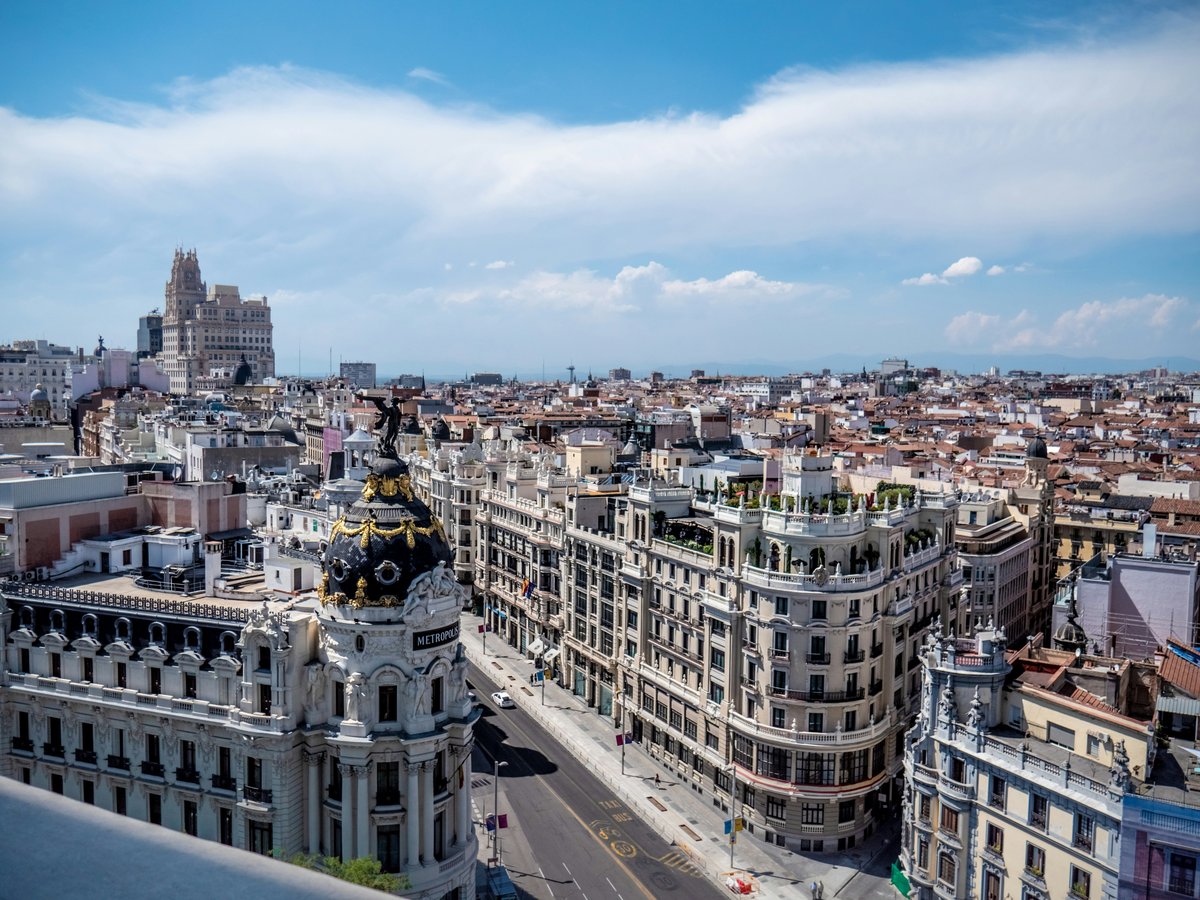
Best Time to Visit Madrid, by Season
Madrid's average high swings from January's 10.5°C to July's 34.7°C, a 24.2°C range that makes timing everything. Here is the single best window for every kind of traveller, projected from 5 years of daily weather observations.
Published · Updated
1 July's 34.7°C Highs and August's 34.6°C Make Madrid's Summer a Furnace Worth Respecting
The heat hits your face like an open oven the moment you step out of Atocha station in July. Madrid sits on a high plateau, exposed and treeless across long stretches, and when the average high reaches 34.7°C in July, that number tells only part of the story. Madrid's sidewalks radiate stored warmth well past sundown. The average low in July still sits at 20.2°C, which means nights offer limited relief.
August is nearly identical. The average high drops by a fraction to 34.6°C, and the average low rises to 20.7°C. That 0.5°C increase matters at 3 AM when your hotel room faces south and the air conditioning struggles. Madrid's summer heat is dry rather than humid, which some travellers prefer, but it constrains your day. Between noon and 5 PM, the Prado and Reina Sofía become refuges of necessity, not choice.
To be fair, Madrid's summer has compensations. June eases you in with an average high of 30.2°C and a more tolerable low of 17.2°C. The first two weeks of June often feel like late spring, and hotel rates haven't yet reached their July peak. If you must visit in summer, early June is the window. By late June the trajectory toward July's 34.7°C ceiling is unmistakable.
The real question is who summer Madrid suits. Budget travellers will find no bargains in July or August. Families with small children will struggle with the midday heat that keeps Retiro Park empty from 1 to 4 PM. Madrileños themselves leave in August, heading to the coast, which strips the neighbourhoods of the foot traffic and open-terrace energy that defines them in cooler months. September's average high falls to 26.5°C, a drop of more than 8°C from July's 34.7°C, and the city wakes back up almost overnight.
If you handle heat well and want the longest daylight hours, late June at 30.2°C still works. July at 34.7°C and August at 34.6°C are Madrid's most punishing months, and the average lows of 20.2°C and 20.7°C mean no thermal reset at night. The terrace you imagined lingers in the shade until 9 PM.
September's average high falls to 26.5°C, a drop of more than 8°C from July's 34.7°C, and the city wakes back up almost overnight.
2 May's 24.5°C Highs and 11.7°C Lows Hit the Sweet Spot for a First Visit
The light in Madrid turns golden around 8 PM in May as the sun drops toward the Sierra de Guadarrama. The average high reaches 24.5°C. Perfect terrace weather. The average low of 11.7°C means evenings carry a pleasant coolness without needing more than a light layer.
Compare that range to the months on either side. April's average high of 19.8°C is comfortable enough during the day, but April's low of 7.8°C can feel genuinely cold after sunset, nearly 4°C colder than May's 11.7°C evening reading. June's average high of 30.2°C is already a different animal, almost 6°C warmer than May's 24.5°C and firmly in the territory where midday shade-seeking becomes mandatory.
May's position on the calendar is what makes it work for Madrid. You get warm-enough days for outdoor dining in the Plaza de Santa Ana. You get cool-enough nights for comfortable sleep. The 24.5°C daytime reading sits in the narrow band where Madrid's terraza life, the open-air culture on every plaza and sidewalk, operates at its best. Warm enough to sit outside at 10 PM on Calle de Ponzano. Not so warm that the chairs feel like they've been baking in a kiln.
Worth noting, though. May is not a secret. Every booking platform knows the data. Flight prices and hotel rates tend to reflect that 24.5°C sweet spot. If you have flexibility, early May tends to sit closer to April's cooler 19.8°C pattern. Late May drifts toward June's 30.2°C. The first half of the month likely gives you the best weather-to-crowd ratio.
For first-time visitors who want to see the Prado, walk Retiro Park, and eat outdoors without heat or cold dictating the schedule, May's range of 24.5°C to 11.7°C is the answer. October's 22.3°C high comes close, 2.2°C lower, with a low of 11.9°C that nearly matches May's 11.7°C. May wins on daylight hours and energy. October wins on thinner crowds.
May's 24.5°C daytime reading sits in the narrow band where Madrid's terraza life operates at its best.
3 October's 22.3°C Average High Makes It Madrid's Best-Kept Shoulder Month
Step out onto Gran Vía on an October morning and the air has a crispness that summer burned away months ago. The average high sits at 22.3°C, warm enough for shirtsleeves at lunch but no longer the relentless heat of a city that hit 34.7°C in July. The average low of 11.9°C means you'll want a jacket by dinner, but the cool is welcome after six months of warmth.
October in Madrid occupies a peculiar position. The summer tourists have gone home. The Christmas-market visitors haven't arrived yet. Hotel rates typically drop from their June-through-September levels, and the major museums see noticeably shorter queues. The Prado on an October Tuesday morning feels like a different institution than the Prado on an August Saturday.
The numbers confirm the instinct. September's average high of 26.5°C still carries real warmth, 4.2°C higher than October's 22.3°C. November's average high of 14.6°C drops sharply, nearly 8°C below October. That makes October the last month where outdoor terrace culture in Madrid remains comfortable in a T-shirt during the day. The window is specific.
Mind you, October is not May. May's average high of 24.5°C sits 2.2°C warmer, and May's evenings at 11.7°C are almost identical to October's 11.9°C. The difference is the trajectory. In May, every week gets warmer, pushing toward June's 30.2°C. In October, every week gets cooler, falling toward November's 14.6°C. The first two weeks of October tend to feel closer to September's pleasant 26.5°C, while the last week edges toward the November chill.
For the traveller who has visited Madrid before and wants to see it without the crowds, or for anyone who prefers sweater weather to sunburn, October's 22.3°C to 11.9°C range is the recommendation. Pack a light jacket for evenings. The 22.3°C daytime highs deliver Madrid's terrace experience without July's 34.7°C penalty.
October is the last month where Madrid's outdoor terrace culture remains comfortable in a T-shirt during the day.
4 September's 26.5°C Highs Belong to the Locals, and You Should Join Them
The sound of Madrid waking back up in September is unmistakable. Shutters creak open on restaurants that closed for the August exodus. The terraces along Calle de Ponzano fill again, and the conversations are in rapid-fire Castilian, not guidebook English. The average high of 26.5°C is warm enough for late dinners outside but a full 8.1°C cooler than August's 34.6°C. The city feels like it belongs to itself again.
September sits at the hinge between Madrid's brutal summer and its gentle autumn. The average low of 14.9°C drops noticeably from August's 20.7°C, a nearly 6°C shift that transforms the nights. You can sleep with the window open. The air moves. That 14.9°C low carries the first signal of the shoulder season, while the 26.5°C high still holds enough warmth for outdoor plans without reservation.
That said, September in Madrid is not a hidden gem in the way October is. The city's re-entry from summer holiday brings locals back in force, and the cultural calendar restarts. Galleries along Calle del Doctor Fourquet open new exhibitions. Theatres launch their autumn seasons. The trade-off is that September's warmth still overlaps with the tail end of summer tourism. You won't have the Reina Sofía to yourself the way you might in November, when the average high falls to 14.6°C and visitor numbers thin considerably.
For whom does September work best? Travellers who want warm weather without the extremes. October's 22.3°C high is more comfortable for long walking days, but September's 26.5°C lets you linger outdoors past 10 PM without reaching for a jacket, something the October low of 11.9°C won't allow. September's 14.9°C overnight compares favourably to July's 20.2°C and August's 20.7°C.
If warm evenings and local energy are the priority, September at 26.5°C is the pick. If cooler days and thinner crowds matter more, October at 22.3°C wins. Both outperform July's 34.7°C and August's 34.6°C by every measure that matters for walking, eating, and sleeping.
September's 26.5°C average is warm enough for late dinners outside but a full 8.1°C cooler than August's 34.6°C.
5 April's 19.8°C Afternoons and 7.8°C Evenings Divide Opinion on Spring in Madrid
April in Madrid smells like orange blossom in the Barrio de las Letras and wet stone after a sudden shower. The month sits in an awkward zone. The average high of 19.8°C feels lovely at 2 PM in the sun. The average low of 7.8°C feels genuinely cold at 11 PM on a rooftop bar. That 12°C daily swing is the widest in Madrid's spring months, and it makes packing difficult.
March, for comparison, averages a high of 15.6°C and a low of 5.3°C. That's proper coat weather, and nobody argues about it. May's high of 24.5°C and low of 11.7°C sit comfortably in warm-season territory. April lands between these two at 19.8°C and 7.8°C, and the indeterminacy is the point. Some April days in Madrid feel like May. Others feel like March. The month cannot make up its mind.
The practical question is whether April's 19.8°C daytime high is warm enough for the outdoor Madrid experience. The answer depends on the hour. Lunch on a south-facing terrace in the Plaza de Santa Ana works fine at 19.8°C. Dinner outside at 9 PM, when the temperature has been falling toward that 7.8°C low for hours, requires a proper jacket and some resolve. May's 11.7°C low would make the same dinner at the same table 3.9°C warmer.
Mind you, April has advantages the thermometer alone doesn't capture. Hotel rates in April tend to sit below the May-through-June peak, and the tourist density in Madrid is noticeably lighter. Semana Santa, which sometimes falls in April, brings processions and crowds to the centre but also a cultural atmosphere that no other month provides. If your trip coincides with Semana Santa in Madrid, book early.
For budget-conscious travellers who own a good jacket and don't mind variability, April at 19.8°C and 7.8°C works. For anyone who plans to eat dinner outdoors more than twice, May's 24.5°C and 11.7°C is worth the premium. The 3.9°C gap in evening lows between April and May is the difference between enjoying a Madrid terrace and enduring one.
The 3.9°C gap in evening lows between April and May is the difference between enjoying a Madrid terrace and enduring one.
6 December Through February Stays Below 15°C, but Empty Museums and Low Fares Change the Equation
The cold in Madrid is different from London or Paris. It's dry, sharp, and still. Walk down Paseo del Prado on a January morning and the air bites your face, but the sky is often a hard, brilliant blue. January's average high of 10.5°C and average low of 1.5°C make it Madrid's coldest month. Those 1.5°C nights can feel like they belong to a different city entirely.
December is marginally warmer, with an average high of 11.3°C and a low of 3.6°C. February starts the slow climb back, reaching 14.2°C for its average high with lows of 3.2°C. The three-month winter window of 10.5°C to 14.2°C highs means outdoor dining in Madrid is off the table, full stop. This is indoor Madrid.
That's not the penalty it sounds like. Madrid has one of Europe's strongest museum concentrations within walking distance of a single boulevard. The Prado, the Reina Sofía, and the Thyssen-Bornemisza line up along the same axis, and in winter the queues shrink to fractions of their summer length. The Prado on a December Tuesday bears no resemblance to the Prado on an August Saturday.
Flight prices to Madrid in January and February tend to sit at their annual low across most European departure cities. Hotel rates follow a similar pattern. The savings can be substantial enough to fund extra nights or a day trip to Toledo or Segovia, both under 90 minutes from Atocha by rail.
To be fair, winter Madrid has limits. January's 1.5°C low and February's 3.2°C low make evening walks uncomfortable without serious layers. Daylight is short. The famous rooftop bar scene along Gran Vía operates only in enclosed, heated spaces, which strips away the open-air atmosphere.
For museum-first travellers, architecture enthusiasts, or anyone chasing value, the December-through-February window of 10.5°C to 14.2°C highs is the pick. You lose the terraces. You gain Madrid at its quietest and most affordable. February at 14.2°C edges out January's 10.5°C as the milder winter option.
Madrid's cold is different from London or Paris. It's dry, sharp, and still, and the sky is often a hard, brilliant blue.
7 March at 15.6°C and November at 14.6°C Are the Transition Months Nobody Discusses
March and November in Madrid share an almost identical average high, 15.6°C and 14.6°C respectively, separated by a single degree. They sit on opposite sides of the calendar but occupy the same thermal band. They also share the same reputation among travel planners, which is to say, none at all.
March in Madrid feels like a city shaking off winter. The average high of 15.6°C and low of 5.3°C are still chilly, especially in the shade along the narrow streets of La Latina. But the daylight is lengthening and the terraces along Malasaña start testing their outdoor setups even when the thermometer hasn't cooperated. March is a forward-looking month. February's average high of 14.2°C sits only 1.4°C behind, but the psychological shift feels larger than the mercury suggests. You sense spring approaching in Madrid in March. In February, you sense winter persisting.
November reverses the arc. October's generous 22.3°C average high drops to 14.6°C in November, a fall of 7.7°C in a single month. That is the steepest month-over-month decline in Madrid's entire calendar year. The average low of 6.2°C makes November evenings cold enough that terrace dining requires heated lamps, and most restaurants pull their outdoor furniture by mid-month. December's 11.3°C high and 3.6°C low lurk right ahead.
The case for March over November comes down to trajectory. March is warming toward April's 19.8°C, a gain of 4.2°C in the next month. November is cooling toward December's 11.3°C, a drop of 3.3°C. If you're flexible and choosing between the two, March gives you the possibility of an unexpectedly warm afternoon in Retiro Park. November gives you the near-certainty of a cooling one.
Both months suit a specific Madrid traveller. They're too cool for outdoor culture at 15.6°C and 14.6°C respectively, but they're warmer than the deep winter months when January's low hits 1.5°C. March at 15.6°C and 5.3°C edges November at 14.6°C and 6.2°C on trajectory, daylight hours, and the first terrace openings of the season.
October's 22.3°C average high drops to 14.6°C in November, a fall of 7.7°C. That is the steepest month-over-month decline in Madrid's entire year.
8 The Single Best Window for Each Kind of Madrid Traveller, Named and Defended
Madrid's 12-month average high spans from January's 10.5°C to July's 34.7°C, a range of 24.2°C. The sweet spot sits between April's 19.8°C and October's 22.3°C, with May at 24.5°C at the peak of the comfortable band. The recommendations resolve clearly when matched to what each traveller wants.
The first-time visitor who wants everything. May. The 24.5°C average high and 11.7°C low give you the widest range of comfortable activities in Madrid, from noon terraces in the Plaza Mayor to late-evening walks through Malasaña without a jacket. May is also the last month before June's 30.2°C tips the balance toward heat management.
The repeat visitor chasing atmosphere. Late September into early October. September's 26.5°C high carries summer's warmth while October's 22.3°C offers cooler walking days. The transition around the first of October tends to split the difference. Madrileños are back from the August coastal exodus and the cultural calendar along Calle del Doctor Fourquet is in full swing.
The budget traveller. Late January through mid-February. January's average high of 10.5°C and low of 1.5°C are cold, no question. February warms to 14.2°C highs and 3.2°C lows. But flight and hotel rates from most European cities sit at their annual floor. The Prado and Thyssen-Bornemisza are uncrowded. The restaurants are unhurried.
The heat-lover. First two weeks of June. The average high of 30.2°C and low of 17.2°C are warm enough to satisfy but haven't yet reached July's oppressive 34.7°C ceiling or the 20.2°C overnight lows that prevent thermal recovery.
The family with young children. The second and third weeks of October. At 22.3°C highs and 11.9°C lows, Retiro Park and Casa de Campo are comfortable for afternoon outings. Museum crowds in Madrid are thinner than in May. The temperature doesn't force the midday retreat that July's 34.7°C demands.
The outdoor enthusiast. April. The 19.8°C highs make it ideal for day hikes in the Sierra de Guadarrama, while the 7.8°C lows keep the trails cool. May at 24.5°C works for early starts. Madrid's summer months above 30°C are poor hiking weather at this latitude and altitude. May at 24.5°C is the single best all-round window. October at 22.3°C is the best-value alternative.
May at 24.5°C is the single best all-round window. October at 22.3°C is the best-value alternative.
Last verified by automated review (v1.7.0_onboard-madrid-flagship-2026-06-17) on . What is automated review?