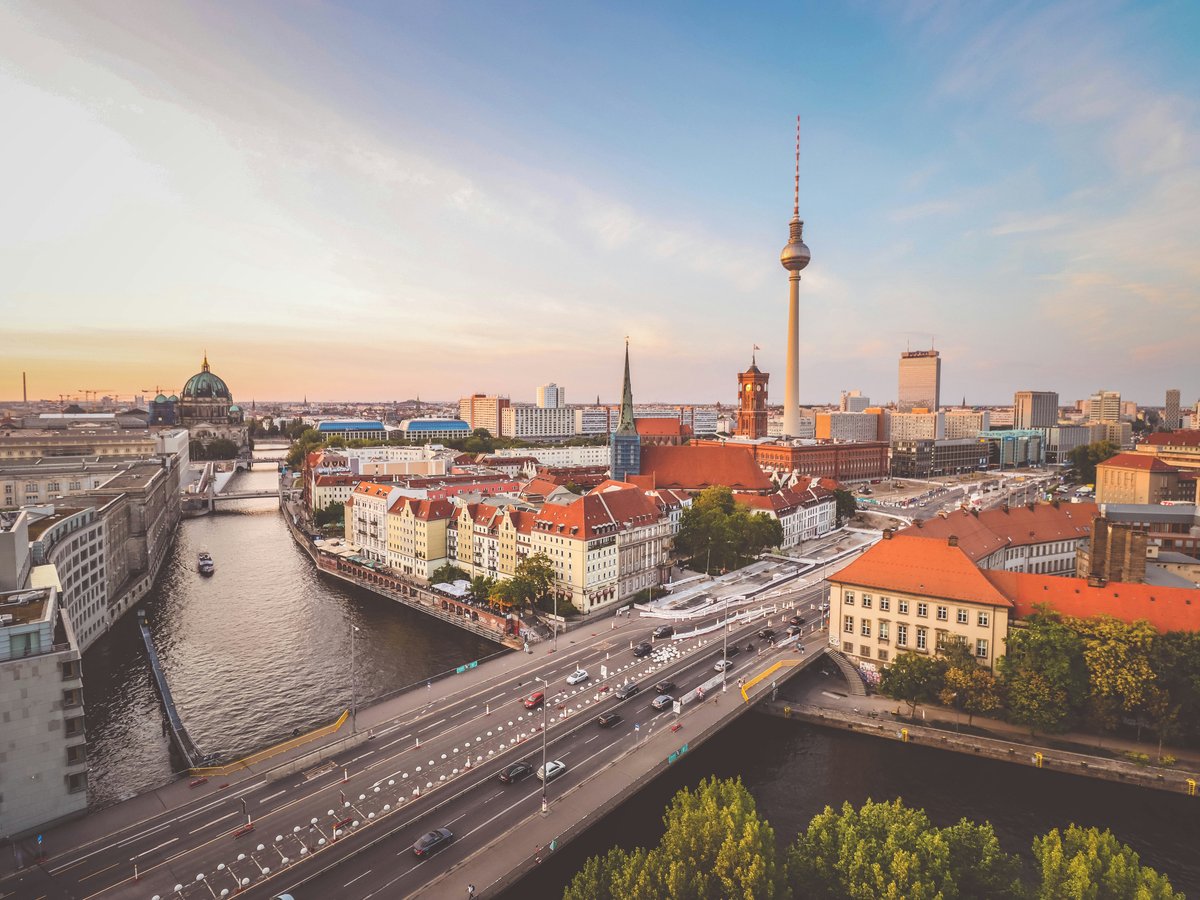
Stay in Berlin in July
137 hotels in the Trip.com pool for Berlin, from US$14 a night.
Opens Trip.com on Fri 2 Jul to Sun 4 Jul 2027; change the dates there.
July in Berlin means 16 hours of daylight and a city that moves almost entirely outdoors. The sun doesn't set until after 9:30 p.m., and along the Landwehrkanal in Kreuzberg you'll find Berliners grilling, drinking Berliner Weiße, and settling in for evenings that stretch well past midnight. Prater Garten, the city's oldest beer garden on Kastanienallee in Prenzlauer Berg (open since 1837), packs its 600 seats by 6 p.m. on any warm evening. If you're someone who thrives on that kind of communal, open-air energy, July rewards you.
The trade-off is rain. July is Berlin's wettest month, averaging 92mm across roughly 12 rainy days. Afternoon thunderstorms are the typical pattern. They tend to build fast over Tempelhof and Tiergarten, dump heavy rain for 20-30 minutes, then break apart. Temperatures hover around 24.7°C (76°F) during the day and drop to a comfortable 15.4°C (60°F) at night. Humidity sits at about 65%, noticeable but never oppressive. You won't melt. You will get rained on.
The month's defining event is Christopher Street Day, Berlin's Pride parade, which typically lands on the last Saturday of July. CSD draws upwards of 500,000 people along the route from Kurfürstendamm through Tiergarten to Brandenburger Tor. If you're visiting late July, expect packed U-Bahn trains, booked-out hotels in Schöneberg and Mitte, and street closures along the 7-kilometer parade route.
Why visit in July
- Over 16 hours of daylight in early July, with sunset after 9:30 p.m., stretches every day for sightseeing and outdoor dining along the Spree.
- Berlin's park and lake culture peaks this month. Tiergarten, Tempelhof, and dozens of swimmable lakes within the S-Bahn network offer free outdoor activities daily.
- Christopher Street Day in late July is one of Europe's largest Pride celebrations, drawing 500,000+ people to a city-wide street party that runs for several days.
- Seasonal Pfifferlinge (chanterelle mushrooms) appear on restaurant menus across Mitte and Prenzlauer Berg, marking the start of Germany's foraging season.
Worth knowing
- July is Berlin's wettest month at 92mm of rainfall, with afternoon thunderstorms likely on roughly 12 days. Outdoor plans need a rain backup.
- Hotel rates in central neighborhoods like Mitte and Charlottenburg climb 30-40% above annual averages, and availability tightens sharply during CSD weekend.
- Some locally loved restaurants close for Betriebsferien (staff holiday) in the second half of July, particularly smaller owner-operated spots in Neukölln and Kreuzberg.
- Late July coincides with school holidays in several German states, raising crowd levels at popular sites like Museum Island and Brandenburger Tor.
Best for
Think twice if
July is Berlin's warmest month alongside June, but also its wettest. Daytime temperatures typically reach around 24.7°C (76°F), which feels pleasant in shaded beer gardens but warmer along treeless stretches of Friedrichstraße or Alexanderplatz. Nights settle at 15.4°C (60°F), comfortable for sleeping with a window open. The 92mm of rainfall tends to arrive as short, sharp afternoon thunderstorms rather than all-day drizzle. You might get 4-5 consecutive dry days followed by a stretch of daily storms. Humidity hovers around 65%, noticeable when you're walking but not the wall-of-heat feeling you'd get in tropical cities.
Seasonal caution
- Occasional heat waves can push temperatures above 35°C (95°F) for 3-5 consecutive days, as happened in July 2019 when Berlin recorded 38.6°C. Air conditioning is not standard in Berlin. Most apartments, many restaurants, and even some mid-range hotels lack it entirely.
Year-round climate
Averages from the last 5 years.
| Month | Avg high (°C) | Avg low (°C) | Rainfall (mm) |
|---|---|---|---|
| Jan | 5 | 0 | 60 |
| Feb | 6 | 0 | 54 |
| Mar | 11 | 1 | 35 |
| Apr | 14 | 5 | 36 |
| May | 19 | 9 | 52 |
| Jun | 25 | 14 | 57 |
| Jul | 25 | 15 | 92 |
| Aug | 25 | 15 | 60 |
| Sep | 21 | 12 | 37 |
| Oct | 15 | 8 | 54 |
| Nov | 8 | 3 | 55 |
| Dec | 5 | 1 | 57 |
Headline events
Christopher Street Day (CSD Berlin)
Last Saturday of July (parade day), with associated events running the full week prior
Berlin's Pride parade and one of Europe's largest LGBTQ+ celebrations. The parade runs from Kurfürstendamm through Tiergarten to Brandenburger Tor, drawing 500,000+ participants. The surrounding week includes concerts, film screenings, political rallies, and parties across Schöneberg, Kreuzberg, and Mitte. Berlin's CSD has a distinctly political edge compared to many commercial Pride events elsewhere.
Best things to do in July
Swimming at Schlachtensee
outdoorA glacial lake in the Grunewald forest, about 40 minutes by S-Bahn from Friedrichstraße. The 780-meter-long lake has a sandy shoreline along much of its western bank and clear water that typically reaches 20-22°C by mid-July. The S1 line drops you within a 5-minute walk of the north shore.
Water temperatures peak in July, and the 16+ hours of daylight mean you can swim until well past 8 p.m.Booking tipArrive before 11 a.m. on weekends. The north shore fills up fast once temperatures pass 25°C.
Tempelhof open-air evening
outdoorThe former airport's 300-hectare field is Berlin's largest open space. July evenings bring kite-flyers, cyclists on the old runways, and groups grilling on the designated barbecue areas in the southeast corner. The flat, treeless expanse means you can watch the sun drop over the entire western horizon.
Sunset after 9:30 p.m. gives you 3-4 hours of warm evening light on the field after a workday.Cycling the Mauerweg (Berlin Wall Trail)
cyclingThe 160-kilometer trail follows the former path of the Berlin Wall around the entire city. July's long daylight hours make it possible to cover the southern sections between Checkpoint Charlie and the East Side Gallery in a single afternoon, roughly 15 kilometers along the Spree.
The extended daylight window and warm, dry spells between July's storms give you the longest rideable stretches of the year.Booking tipRental bikes are available at most S-Bahn stations through Berlin's bike-share network.
Open-air cinema at Freiluftkino Kreuzberg
cultureOne of Berlin's oldest outdoor cinemas, tucked inside Mariannenplatz in Kreuzberg. The program leans toward independent and arthouse films, with a mix of German and English-language screenings. Seating is on deck chairs under the trees, and screenings start after sunset, typically around 9:45 p.m. in early July.
The outdoor cinema season peaks in July when warm, dry evenings are most frequent and films can start before 10 p.m.Museum Island without the rush
cultureBerlin's UNESCO-listed museum complex on the Spree holds 5 museums including the Pergamonmuseum and the Neues Museum. On weekday mornings in July, the crowds are thinner than you might expect, because many visitors head for the lakes and parks instead.
The outdoor pull of warm July weather tends to thin indoor museum crowds on weekday mornings, giving you quieter galleries.Booking tipBook timed-entry tickets online in advance. The combined day pass covers all 5 museums.
Spree river boat tour
sightseeingPassenger boats run between Friedrichstraße and the Mühlendamm lock through the historic center, passing the Reichstag, Berliner Dom, and Museum Island. The round trip takes about an hour. July's warm evenings make the sunset departures, typically leaving around 8 p.m., the most popular.
July's late sunsets mean you get golden-hour light over the Reichstag dome on the evening departures.Flea market browsing at Mauerpark
shoppingEvery Sunday, the Mauerpark flea market in Prenzlauer Berg draws hundreds of vendors selling vintage clothing, vinyl records, GDR memorabilia, and handmade crafts. The adjacent amphitheater hosts a bearpit karaoke session that draws 2,000+ spectators on warm July Sundays.
July Sundays bring the largest vendor turnout of the year, with the warm weather drawing sellers who skip the colder months entirely.Booking tipShow up by 10 a.m. for the best selection. The market runs until 6 p.m. but the good vintage pieces go early.
What to eat in July
In season: fruit
Kirschen (cherries)
Brandenburg cherries hit peak ripeness in July. Farmers' markets at Winterfeldtplatz in Schöneberg and the Turkish Market on Maybachufer in Kreuzberg sell them by the kilo. Sweet and sour varieties both peak this month, and bakeries put out Kirschkuchen (cherry cake) and Kirschstreusel.
Heidelbeeren (blueberries)
German-grown blueberries start appearing at Berlin farmers' markets in July. Smaller and more intensely flavored than imported varieties, they show up in Pfannkuchen (pancakes), on Quark desserts, and piled into tarts at bakeries across Charlottenburg and Prenzlauer Berg.
On menus now
Matjes (young herring)
Matjes season runs from mid-June into July, and Berlin's Markthalle Neun in Kreuzberg typically carries fresh fillets from the North Sea. Served on a Brötchen with onions and pickled cucumber, it's a northern German summer staple that you'll find at fish counters across the city.
What to drink
Berliner Weiße mit Schuss
Berlin's traditional sour wheat beer, served with a shot (Schuss) of either Waldmeistersirup (woodruff, turns it green) or Himbeersirup (raspberry, turns it red). It's around 3% alcohol, tart and refreshing at about 5°C, and at its best on a July afternoon in a beer garden. Prater Garten and Café am Neuen See in Tiergarten both serve it.
In markets
Pfifferlinge (chanterelle mushrooms)
Chanterelle season starts in July across Brandenburg's forests, and Berlin restaurants respond immediately. You'll find them pan-fried with butter and parsley, folded into Rahmsauce (cream sauce), or served alongside Schnitzel. Restaurants in Prenzlauer Berg and Mitte often run dedicated Pfifferlinge specials through August.
Regular events in July
Classic Open Air at Gendarmenmarkt
Orchestral and opera performances on an open-air stage between the Französischer Dom and Deutscher Dom, one of Berlin's most architecturally striking squares. Runs for several weeks through July.
Throughout JulyBerliner Philharmoniker Waldbühne Concert
The Berlin Philharmonic's annual open-air season finale at the 22,000-seat Waldbühne amphitheater in Westend. The program typically includes crowd-friendly classical works and ends with an encore tradition of torch-lit singalongs.
Late June or early JulyFête de la MusiqueFree
A city-wide free music festival with over 100 stages across all neighborhoods, running from afternoon into the early morning hours. Berlin's version draws from the French original but leans heavily on electronic, world music, and experimental genres.
June 21 (often spills into July programming)Karneval der Kulturen (if June overlap)Free
A four-day multicultural street festival in Kreuzberg with a parade of 4,500 participants, 70+ music and dance groups, and food stalls representing over 80 countries. The main parade route runs along Hermannplatz and Gneisenaustraße.
Pentecost weekend, sometimes falling in late June or early JulyBest places this July
Tiergarten
parkBerlin's 210-hectare central park stretches from Brandenburger Tor to the Zoo. July turns its shaded paths into the city's most comfortable walking routes when temperatures climb above 28°C. Café am Neuen See, on the park's lake, is the spot for a Berliner Weiße on a hot afternoon.
TiergartenEast Side Gallery
landmarkA 1.3-kilometer stretch of the Berlin Wall along Mühlenstraße, covered in over 100 murals painted in 1990. July's long evenings mean soft light on the riverside murals well past 9 p.m., and the Spree promenade beside it fills with locals after work.
FriedrichshainMarkthalle Neun
marketA 19th-century market hall in Kreuzberg that hosts a weekly Street Food Thursday with rotating vendors. The building itself dates to 1891 and the regular weekday market carries regional produce from Brandenburg farms.
KreuzbergTeufelsberg
landmarkA Cold War-era listening station built on an artificial hill of WWII rubble in Grunewald forest. The radar domes and graffiti-covered ruins sit at 120 meters above sea level, the second-highest point in Berlin. July's clear evenings offer views across the entire city.
Charlottenburg-WilmersdorfPfaueninsel (Peacock Island)
natureA UNESCO World Heritage island in the Havel river, reached by a short ferry from Wannsee. The 67-hectare island has free-roaming peacocks, a ruined 18th-century castle, and old-growth oak trees. July is the best month for the ferry crossing and a picnic on the island's lawns.
WannseeBösebrücke at Bornholmer Straße
historicalThe bridge where the Berlin Wall first opened on the night of November 9, 1989. Less visited than Checkpoint Charlie, the memorial plaques and small outdoor exhibition tell the story of the first crossing. A 10-minute walk north from Schönhauser Allee station.
Prenzlauer Berg
Your packing checklist
Tick items off as you pack. Your progress saves in this browser.
All packed — have a great trip.
Insider tips
The U-Bahn and S-Bahn run 24 hours on Friday and Saturday nights in Berlin, which makes late-night returns from Kreuzberg or Friedrichshain far simpler than in most European cities. On weeknights, night buses (Nachtbus) cover the same routes at roughly 30-minute intervals.
Berlin's tap water comes from deep aquifers beneath the city and is perfectly safe to drink. Most locals drink it daily, and restaurants will serve it if you ask for Leitungswasser, though some places still prefer to sell bottled water.
Betriebsferien (staff holidays) shut down many smaller restaurants and cafés in the second half of July. If you have a specific spot in Neukölln or Kreuzberg you want to visit, check their social media before heading over. Larger restaurants in Mitte tend to stay open through the month.
The Ringbahn (S41/S42) is a circular S-Bahn line that loops the inner city in about 60 minutes. Riding the full loop on a warm July evening is a surprisingly good way to see Berlin's neighborhoods from above, since much of the track is elevated. Locals call it the "Ringbahn challenge" when you do it with a beer in hand.
Mauerpark's bearpit karaoke on Sunday afternoons is free to watch and draws a crowd of 2,000+ in July. The amphitheater fills up by 3 p.m., so arrive early or be prepared to stand on the hill above.
Avoid these mistakes
- Assuming every building in Berlin has air conditioning. Most apartments, many restaurants, and even mid-tier hotels rely on open windows and fans. If heat sensitivity is a concern, confirm AC before booking.
- Trying to visit Museum Island on a Saturday afternoon in July. The combination of tourist crowds and locals avoiding the heat outdoors creates the worst queues of the year. Weekday mornings before 11 a.m. are significantly calmer.
- Skipping the lakes for the Freibäder (public pools) without checking hours. Several outdoor pools close early on weekdays or have restricted hours during school holiday periods in July.
- Not carrying cash. Berlin is still more cash-dependent than most Western European capitals. Many smaller Kreuzberg and Neukölln cafés, bars, and market stalls at the Turkish Market on Maybachufer do not accept cards.
- Underestimating distances between neighborhoods. Berlin covers nearly 892 square kilometers, roughly 9 times the area of Paris. A bike or a day transit pass is more practical than walking between Charlottenburg and Friedrichshain.
Practical tips for July
Book CSD weekend accommodation at least 6 weeks in advance if you want to stay inside the Ringbahn loop. The BVG day pass covers all zones of the U-Bahn, S-Bahn, tram, and bus network and is the most practical option for a full day of sightseeing across multiple neighborhoods. Berlin restaurants typically do not expect tips above 10%, and rounding up to the nearest euro is common for smaller bills. Most museums close on Mondays, with the notable exception of the museums on Museum Island, which maintain Tuesday closures instead. Pharmacies (Apotheken) rotate night and weekend shifts. The nearest open pharmacy is listed on the door of any closed one, or you can check the aponet.de website. Sunscreen is worth applying even on overcast July days, since the UV index at this latitude still reaches moderate levels through cloud cover.
FAQ
Is July a good time to visit Berlin?
July is one of Berlin's best months for outdoor activities, with 16+ hours of daylight and average highs of 24.7°C. The trade-off is that it's also the wettest month at 92mm of rain, and hotel rates run 30-40% above the annual average. If you enjoy long evenings, lake swimming, and open-air events like CSD, it's a strong choice. If you need consistent dry weather or budget pricing, May or September might suit you better.
How rainy is Berlin in July?
July averages about 92mm of rainfall spread across 12 days. The pattern tends to be afternoon thunderstorms that build quickly, drop heavy rain for 20-30 minutes, and clear. Full-day washouts are uncommon. A compact rain jacket handles most of it, and mornings are typically dry enough for outdoor plans.
What should I wear in Berlin in July?
Light cotton or linen layers for daytime, a compact rain jacket for afternoon thunderstorms, and a light sweater or hoodie for evenings when temperatures drop to about 15°C. Comfortable walking sandals that can handle a sudden downpour are more practical than white sneakers. Sunscreen is important even on cloudy days, since the UV index reaches 6-7 at Berlin's latitude.
Is Berlin crowded in July?
Yes, particularly in the last week around CSD weekend and during the school holiday period. Museum Island, Brandenburger Tor, and Checkpoint Charlie see their highest visitor numbers. That said, Berlin's size means the crowds tend to concentrate in Mitte while neighborhoods like Wedding, Lichtenberg, and Moabit stay relatively calm.
Can you swim in Berlin's lakes in July?
Berlin and Brandenburg have dozens of swimmable lakes accessible by S-Bahn. Schlachtensee, Wannsee, and Müggelsee are the most popular. Water temperatures typically reach 20-22°C by mid-July. The lakes are free to access, though some designated swimming areas (Strandbäder) charge a small entry fee. Arrive early on hot weekends, as the popular shores fill up quickly.
Things to Do in Berlin in July
 Free cancellation
 Discover Berlin Half-Day Walking Tour
City tour: 3.5 hours, free cancellation.
via Viator Free cancellation
 Berlin: Sachsenhausen Concentration Camp Tour in English
Day trip: 5.5 hours, free cancellation.
via Viator Free cancellation
 Third Reich Berlin: Hitler and WWII Walking Tour
City tour: 3 hours, free cancellation.
via Viator Free cancellation
 Communist East Berlin and Berlin Wall Walking Tour
City tour: 2 hours, free cancellation.
via Viator Free cancellation
 Sachsenhausen Concentration Camp Memorial Tour (Max. 15 Guests)
City tour: 6 hours, free cancellation.
via Viator Free cancellation
 Cold War, Berlin Wall, Spies and the East Side Gallery
City tour: 3 hours, free cancellation.
via ViatorFind a flight to Berlin
Live fares to Berlin appear here once cookies are accepted.
Last verified by automated review (v1.7.2) on . What is automated review?