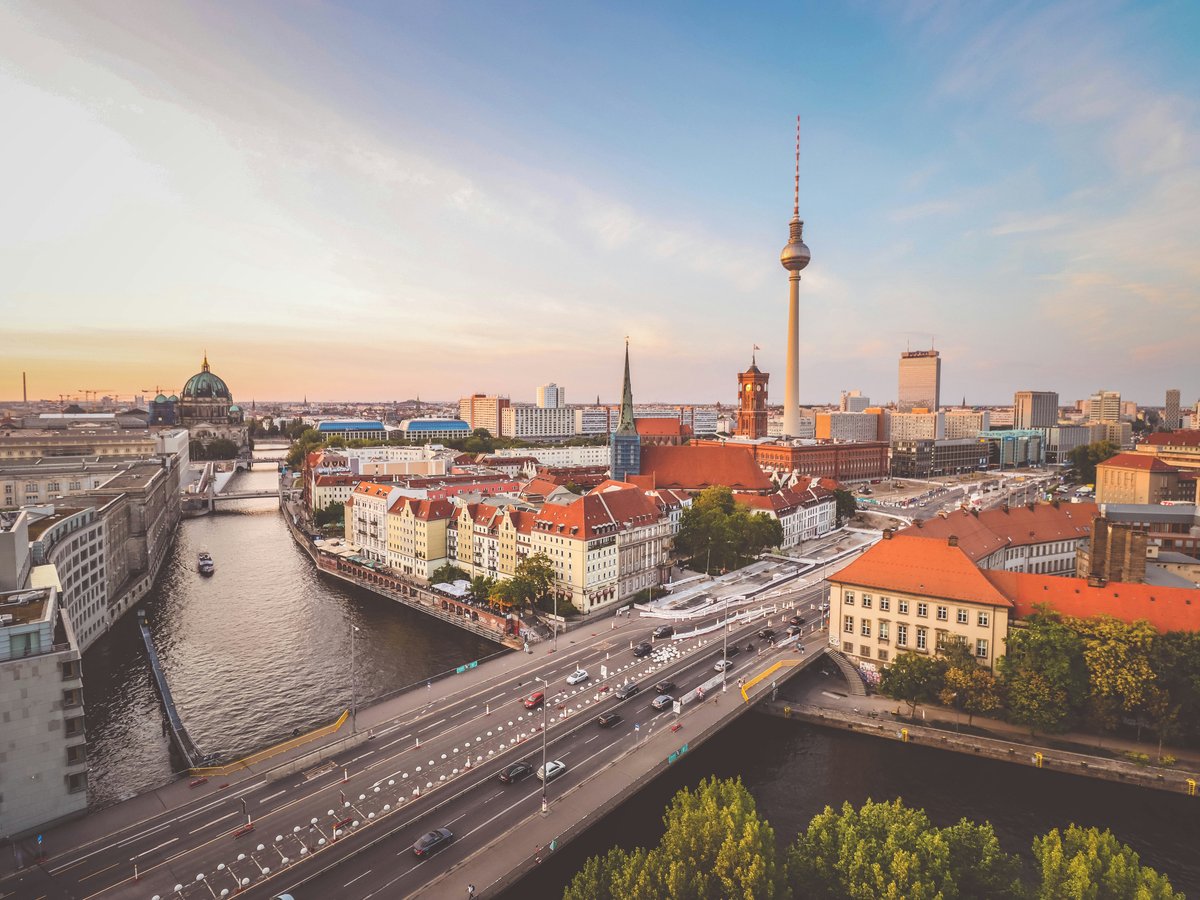
Berlin sits on the North European Plain, flat as a table, threaded by the Spree and Havel rivers and ringed by glacial lakes left behind after the last ice age around 10,000 years ago. About a third of the city is green space or water. That ratio tends to surprise people. The Grunewald forest alone covers roughly 3,000 hectares on the western edge, and the Müggelsee in the east stretches 7.4 square kilometers. You'll find locals swimming in lakes by late May and cross-country skiing through Grunewald in a good January. The terrain is almost entirely flat, with the Teufelsberg at 120 meters being the highest point, and that's an artificial hill built from World War II rubble. So if you want steep elevation, Berlin won't deliver. What it does deliver is water, forest, and an unusual amount of wild urban space for a capital of 3.7 million people. Tempelhof, a former airport, is now a 300-hectare open field where people kiteboard on windy days. The Mauerweg, a 160-kilometer trail tracing the old Berlin Wall, circles the entire city. It's a strange, compelling landscape. Not dramatic, but deeply accessible.
Outdoor activities
-
Cycling the Mauerweg (Berlin Wall Trail)
The Mauerweg follows the former path of the Berlin Wall for roughly 160 kilometers around the city. Most of it is paved or packed gravel, passing through Potsdamer Platz, along the East Side Gallery, through suburban Staaken, and into the forests near Wannsee. You can ride the whole loop in 2 days or pick shorter segments. The southern stretch between Griebnitzsee S-Bahn and Wannsee station runs about 15 kilometers and passes the Glienicker Brücke, the Cold War spy-swap bridge. Flat throughout, so the challenge is distance rather than terrain.
- Difficulty
- Easy to moderate (flat, but long if doing the full loop)
- Duration
- 8-12 hours for the full 160 km loop, or 1-3 hours per segment
- Best season
- April through October
-
Kiteboarding at Tempelhofer Feld
Tempelhof's old runways and wide-open 300-hectare field catch steady wind from the west, and on blustery spring or autumn days you'll see 15 to 20 kiters out on the grass. The surface is tarmac and mowed grass, which is forgiving for beginners learning ground handling. Several Berlin kite schools run intro sessions here between March and November. No water involved, so this is land-kiting with trainer kites and buggies. The park is free to enter, open from sunrise to sunset.
- Difficulty
- Beginner-friendly for land kiting
- Duration
- 2-3 hours per session
- Best season
- March through May and September through November, when winds are strongest
-
Bouldering at Magic Mountain (Der Kegel)
Magic Mountain in Wedding, on Brunnenstrasse, is a 17-meter-tall outdoor climbing wall built from concrete. It's free, unsupervised, and rough on the hands. The holds are mostly carved concrete features and metal grips, and routes range from beginner-friendly slabs to genuinely tricky overhangs on the north face. Bring your own crash pad if you're bouldering the lower sections. For indoor alternatives, the Berta Block gym in Mitte and the BoulderKlub in Friedrichshain both have extensive walls. Magic Mountain tends to get crowded on warm weekends.
- Difficulty
- Beginner to advanced depending on the route
- Duration
- 1-3 hours
- Best season
- April through October for outdoor climbing
-
Running the Havelchaussee
The Havelchaussee is a quiet road through the Grunewald forest along the Havel river, roughly 10 kilometers one-way between Schildhorn and Wannsee. On weekday mornings it's mostly empty. The surface is asphalt with soft forest paths branching off to viewpoints like Schildhorn peninsula. The route is flat with gentle undulations, canopy shade in summer, and Havel views through the birch trees. Many runners do an out-and-back for a 20-kilometer session. S-Bahn Wannsee is a 10-minute walk from the southern end.
- Difficulty
- Easy to moderate
- Duration
- 1-2 hours for a 10-20 km run
- Best season
- Year-round, though summer mornings before 9 AM are ideal
-
Inline Skating on the Kronprinzessinnenweg
This 5-kilometer stretch of smooth asphalt runs dead straight through the Grunewald from the Avus highway bridge down to Wannsee. Cars are banned, so it's popular with skaters, especially on Sunday mornings. The surface is well-maintained and flat. Berlin's inline skating community holds Wednesday evening group skates that typically start near Potsdamer Platz and roll 20 to 30 kilometers through the city, sometimes passing 1,000 participants in summer.
- Difficulty
- Easy (flat, smooth surface)
- Duration
- 30 minutes to 2 hours depending on distance
- Best season
- May through September
-
Cross-Country Skiing in Grunewald
In winters with sufficient snowfall, the trails through Grunewald become usable for cross-country skiing. The flat terrain around Teufelsberg and the Grunewaldsee area offers 5 to 10 kilometer loops. Mind you, Berlin's winters are unpredictable. Some years bring weeks of snow cover, others barely a dusting. January and February are the likeliest months. There's no formal grooming, so you're breaking trail on forest paths. Rental gear is available at Sporthaus Olympia near Kudamm.
- Difficulty
- Easy to moderate (flat but ungroomed)
- Duration
- 1-3 hours
- Best season
- January and February, snow-dependent
Day hikes
-
66-Seen-Wanderweg (66 Lakes Trail), Stages near Potsdam
The 66-Seen-Wanderweg is a 400-kilometer loop trail through Brandenburg, but individual stages work well as day hikes from Berlin. The stage from Potsdam Hauptbahnhof to Marquardt runs about 15 kilometers along the Havel lakes and through the Sanssouci park grounds. The landscape is flat, sandy in places, and wooded. You'll pass Heiliger See and the Neuer Garten before entering forest. The RE1 train from Berlin Hauptbahnhof to Potsdam takes 25 minutes. Trail markers are yellow dots on a white background.
- Difficulty
- Easy (flat terrain, well-marked paths)
- Duration
- 4-5 hours for the Potsdam-Marquardt stage
- Best season
- April through October
-
Naturpark Barnim, Wandlitz Lake Loop
Take the Heidekrautbahn (RB27) from Berlin-Karow north to Wandlitzsee station, about 35 minutes. A 12-kilometer loop circles the Wandlitzsee lake through mixed beech and pine forest. The trail is mostly flat sandy paths with some rooty sections. The lake has a public Strandbad (beach) at Wandlitz town where you can swim after the hike (entry around 5 euros in summer). The forest smells like pine resin on warm days, and you'll likely hear woodpeckers. It's quiet on weekdays.
- Difficulty
- Easy (flat, 12 km, sandy paths)
- Duration
- 3-4 hours including a swim stop
- Best season
- May through September
-
Schorfheide Biosphere Reserve, Buchenwald Trail
The Schorfheide-Chorin Biosphere Reserve is about 60 kilometers northeast of Berlin, reachable by RE3 train to Joachimsthal in roughly 1 hour. The ancient beech forests here are UNESCO-listed. A 14-kilometer loop trail from Joachimsthal passes through Grumsin forest, one of the best-preserved lowland beech stands in Central Europe. The terrain has gentle hills (up to about 80 meters elevation change), which counts as mountainous by Brandenburg standards. The forest floor is thick with leaf litter, and in autumn the colors are worth the trip alone.
- Difficulty
- Easy to moderate (gentle hills, some unmarked sections)
- Duration
- 4-5 hours
- Best season
- May through June for wildflowers, October for autumn foliage
-
Spreewald, Lübbenau to Lehde Trail
The Spreewald, about 100 kilometers southeast of Berlin, is a network of over 300 small waterways threading through alder and ash forest. The RE2 train reaches Lübbenau in about 1 hour 20 minutes. A walking trail from Lübbenau to the village of Lehde and back is roughly 8 kilometers, following narrow canals where traditional flat-bottomed boats (Kähne) still deliver mail. The area smells like wet wood and dill. Yes, dill. The Spreewald is famous for its pickled cucumbers, and the fields are planted with dill and horseradish. Stop at one of the stalls in Lehde for fresh gherkins.
- Difficulty
- Easy (flat, well-marked, 8 km)
- Duration
- 2-3 hours hiking, plus time for a Kahn boat ride (about 15-20 euros for 2 hours)
- Best season
- May through September
-
Märkische Schweiz, Buckow Loop
Märkische Schweiz, about 50 kilometers east of Berlin, is the closest thing Brandenburg has to hilly terrain. The landscape around Buckow was shaped by glaciers, with small steep valleys, moraine ridges, and the Schermützelsee lake. The RE1 to Müncheberg plus bus 928 to Buckow takes about 90 minutes. A 10-kilometer loop from Buckow town passes through the Stobbertal valley, which has actual elevation changes of 50-70 meters. Bertolt Brecht had a summer house here, now a museum. The trails are forest paths, sometimes muddy after rain.
- Difficulty
- Moderate (hilly by Brandenburg standards, some steep short sections)
- Duration
- 3-4 hours
- Best season
- April through October
Water activities
-
Swimming at Müggelsee
The Müggelsee is Berlin's largest lake at 7.4 square kilometers, in the Köpenick district in the southeast. The Strandbad Müggelsee has a 500-meter sandy beach and has been a bathing spot since 1912. Entry is around 6 euros for adults in summer. The water is shallow for the first 30 meters, which makes it good for families. Water temperature reaches 20-22°C by mid-June in a typical year. The S3 to Friedrichshagen plus a 15-minute walk gets you there. On hot July weekends it's packed by 11 AM.
- Difficulty
- Easy (shallow entry, lifeguards on duty)
- Duration
- Half day
- Best season
- June through August
-
Kayaking on the Spree and Landwehr Canal
Several rental outfits operate along the Spree in the Treptower Park area, including Kajak Berlin and Ahoi Ostkreuz. A single kayak costs roughly 15-20 euros per hour. You can paddle from Treptower Park upstream past the Oberbaum Bridge and under the Molecule Man sculpture. The Landwehr Canal, which branches off through Kreuzberg and Neukölln, is narrower and quieter, passing through the Turkish Market area near Maybachufer. No permit is needed for non-motorized craft. The current on the Spree is gentle, and the canal is essentially still water.
- Difficulty
- Easy (flatwater, no current to speak of on the canal)
- Duration
- 2-4 hours
- Best season
- May through September
-
Stand-Up Paddleboarding at Schlachtensee
Schlachtensee is a narrow glacial lake in the Grunewald forest, about 1.5 kilometers long. The water is clearer than the Spree and surrounded by forest. SUP boards are available for rent near the S-Bahn Schlachtensee station from operators like StandUpClub Berlin, typically 15 euros per hour. The lake has a no-motor-boats rule, so the surface stays calm. It tends to be less crowded than nearby Krumme Lanke. Morning sessions before 10 AM are the quietest, with mist sometimes sitting on the water in early June.
- Difficulty
- Easy (calm, sheltered lake)
- Duration
- 1-2 hours
- Best season
- May through September
-
Open-Water Swimming at Krumme Lanke
Krumme Lanke, the next lake south of Schlachtensee, is a favorite with Berlin's year-round swimming community. The Eisbären (Ice Bears) swimming club meets here through winter. In summer, the grassy banks fill up by early afternoon. The water is clean, tested regularly, and typically reaches 18-21°C by June. There's no formal Strandbad, no entry fee, no lifeguard. You swim at your own risk. The U3 to Krumme Lanke station puts you 5 minutes from the water. The lake is about 1.1 kilometers long, and a swim from end to end is a proper workout.
- Difficulty
- Easy to moderate (no lifeguard, open water)
- Duration
- 1-3 hours
- Best season
- June through September for casual swimmers, year-round for cold-water swimmers
-
Sailing on the Wannsee
The Grosser Wannsee is probably Berlin's most famous bathing lake, but it's also a proper sailing venue. The Seglerverein Wannsee and several other clubs on the western shore offer day courses and boat rentals. A beginner course typically runs 4-5 sessions over 2 weekends and costs around 250-350 euros. If you already have a Sportbootführerschein (German boating license), dinghy rentals are available. The Wannsee has enough fetch for a decent chop on windy days. The Strandbad Wannsee, Europe's longest inland beach at over 1 kilometer, is on the eastern shore and worth a visit after sailing.
- Difficulty
- Beginner courses available, license needed for solo rental
- Duration
- Half day to full day
- Best season
- May through October
Parks & gardens
-
Tiergarten
FreeBerlin's central park covers 210 hectares between the Brandenburg Gate and Zoo station. It was replanted from scratch after 1945, when wartime Berliners had cut most of the trees for firewood. Now the canopy is dense and mature, and the Englischer Garten section in the north feels properly wild. The Café am Neuen See rents rowboats for around 8 euros per half hour. On weekday afternoons in October, the park is quiet enough to hear woodpeckers.
Highlights: Café am Neuen See boathouse, the Siegessäule (Victory Column) with 285 steps to the top, the Luiseninsel rose garden, and the Gaslaternen-Freilichtmuseum with 90 historic gas lamps along a short path
-
Tempelhofer Feld
FreeThe former Tempelhof Airport closed in 2008 and opened as a park in 2010. The two runways, each about 2 kilometers long, are still intact. People cycle, skate, kite, and barbecue on what might be the most unusual urban park in Europe. Community garden plots line the eastern edge, some with elaborate small structures. The flat openness gives you a sense of sky that's rare in a dense city. No trees, no hills, no shade. Bring water and sunscreen in summer.
Highlights: The old airport terminal tours (run by THF Berlin, around 15 euros), community gardens at Allmende-Kontor, kite-flying on the south field, and sunset views from the western runway
-
Volkspark Friedrichshain
FreeBerlin's oldest public park, opened in 1846, sits in the eastern district of Friedrichshain. Two artificial hills, the Grosser Bunkerberg and Kleiner Bunkerberg, are buried World War II flak towers covered with rubble and soil. The Märchenbrunnen (Fairy Tale Fountain) near the western entrance has 106 sculpted animal figures and 10 fairy-tale statues from 1913. In summer the park's outdoor cinema, Freiluftkino Friedrichshain, screens films nightly from June through August.
Highlights: Märchenbrunnen fountain, the two Bunkerberge viewpoints, Freiluftkino outdoor cinema (tickets around 9 euros), beach volleyball courts near the eastern side
-
Botanischer Garten Berlin
One of the largest botanical gardens in the world at 43 hectares, located in Dahlem in the southwest. The Great Tropical House (Grosses Tropenhaus) is 25 meters tall and holds palms, bamboo, and a humid heat that fogs your glasses in winter. The garden maintains around 20,000 plant species. Adult admission is currently 6 euros, reduced to 3 euros in winter. The outdoor sections are at their peak between May and September, but the greenhouses are worth a visit year-round.
Highlights: Grosses Tropenhaus, the Italian Garden with its geometric hedges, the pharmaceutical plant section, and seasonal orchid displays in the smaller greenhouses
-
Britzer Garten
A 90-hectare landscape park in Neukölln, built for the 1985 Federal Garden Show. It's less visited than Tiergarten, which is part of the appeal. The park has a large lake, themed gardens (including a notable witch hazel collection), and a miniature railway that runs a 1.5-kilometer loop. Entry is 3 euros for adults. The tulip display in April draws crowds, but on a Wednesday in June you might have whole sections to yourself. The paths are wide, flat, and fully accessible.
Highlights: Spring tulip fields (April), the Kalenderplatz sundial garden, the lake with rental rowboats, and the Rhododendron-Hain in May
-
Grunewald Forest
FreeBerlin's largest forest at roughly 3,000 hectares, stretching along the Havel river in the west. This is real forest, not a manicured park. Scots pine, oak, and birch, with wild boar rooting through the undergrowth (give them space, especially sows with piglets in spring). The Grunewaldsee lake has a small beach, and the Jagdschloss Grunewald, a 1542 Renaissance hunting lodge, sits on its shore. The Teufelsberg, that 120-meter rubble hill, is a 20-minute walk from the S-Bahn Grunewald station.
Highlights: Teufelsberg for city views and the abandoned Cold War listening station, Grunewaldsee swimming, Jagdschloss Grunewald museum (5 euros), Schildhorn peninsula
-
Gärten der Welt (Gardens of the World)
A 43-hectare themed garden complex in Marzahn-Hellersdorf, in Berlin's east. It includes a Chinese Garden (one of the largest outside China, designed by Beijing landscape architects), a Japanese Garden with traditional tea ceremonies, a Balinese Garden, and an English cottage garden, among others. The cable car (Seilbahn) from the IGA era still operates seasonally and gives a bird's-eye view. Entry is 7 euros for adults. It feels like a different city out here, away from Mitte's tourist density.
Highlights: The Chinese Garden's pavilion and koi pond, Japanese tea ceremony sessions (separate booking, around 15 euros), the Karl-Foerster-Staudengarten perennial garden, and the Seilbahn cable car ride
Practical tips
- Sun protection
- Berlin sits at 52°N latitude, so the UV index is moderate in summer. That said, the flat open spaces like Tempelhofer Feld and the lakes offer zero shade. SPF 30 minimum, reapplied after swimming. A hat matters more here than in shaded cities. Sunburn sneaks up on overcast June days when UV still reaches index 5-6.
- Drinking water
- Berlin tap water is safe and tastes good. It's hard water (high calcium), drawn from groundwater. Fill bottles before heading out. The city has been adding public drinking fountains, and you'll find them in Tiergarten, at major S-Bahn stations, and in most larger parks. On a summer hike, carry at least 1.5 liters. Kiosks and Spätis (corner shops) sell 0.5-liter water bottles for about 0.80-1.50 euros.
- Trail conditions and footwear
- Brandenburg trails are mostly flat sandy paths through pine and beech forest. After rain, clay sections get slippery, especially in the Märkische Schweiz and Spreewald. Trail runners or light hiking shoes with some tread are fine for most routes. Full hiking boots are overkill unless you're doing a multi-day section of the 66-Seen-Weg in wet conditions. In Grunewald, tree roots cross many paths, so watch your footing on runs.
- Weather and layering
- Berlin's continental climate means summers can hit 35°C in July and winters drop to -10°C in January. Spring and autumn are the most variable. A day in April might start at 5°C and reach 18°C by afternoon. Layer with a windbreaker you can stuff in a pack. Thunderstorms roll through on summer afternoons with little warning, especially June through August. Check the DWD (Deutscher Wetterdienst) warnings app before heading into open areas.
- Wildlife awareness
- Grunewald has a sizable wild boar population. They're generally not aggressive, but sows with piglets in April and May will charge if they feel cornered. Give them a wide berth, keep dogs leashed, and don't leave food out. Ticks (Zecken) are active from March through October in all forested and grassy areas. FSME vaccination is recommended if you spend significant time in Brandenburg forests. Check yourself after every hike, especially behind knees, hairline, and waistband.
- Getting to trailheads
- Berlin's S-Bahn and regional trains (RE/RB lines) reach most hiking areas within 30-90 minutes. A single ABC-zone ticket (covering all of Berlin and nearby Brandenburg) costs 4.40 euros. For frequent trips, the monthly ABC pass at 107 euros covers everything. Bikes are allowed on S-Bahn and regional trains with an extra Fahrradkarte (around 3.60 euros). The VBB app shows real-time connections and accepts mobile tickets. On summer weekends, the RE1 to Potsdam and RE2 to Spreewald get crowded, so board at the starting station if possible.
FAQ
Is it safe to swim in Berlin's lakes and rivers?
Berlin's designated bathing spots (Badestellen) are tested regularly by the Landesamt für Gesundheit und Soziales (LAGeSo) and results are published online. Lakes like Schlachtensee, Krumme Lanke, and the Müggelsee consistently test well. The Spree in central Berlin is not recommended for swimming due to combined sewer overflows after heavy rain, though the Flussbad Berlin project aims to change that by the late 2020s. Stick to the official Badestellen and check current water quality ratings on the Berlin.de Badegewässer page.
Do I need any permits for kayaking or paddleboarding in Berlin?
No permit is required for non-motorized watercraft like kayaks, canoes, and stand-up paddleboards on Berlin's lakes, canals, and the Spree. Motorized boats do require a Sportbootführerschein Binnen (inland boating license). Some canal sections have speed limits and right-of-way rules for commercial vessels, so stay to the right and yield to tour boats and barges on the Spree. Rental shops will brief you on basic navigation rules.
When is the best time of year for outdoor activities in Berlin?
May through September is the main outdoor season. June tends to have the longest days (sunrise around 4:45 AM, sunset near 9:30 PM), while July and August bring the warmest water temperatures at 20-23°C. September and October are excellent for hiking, with cooler air, fewer crowds, and autumn color in the beech forests. April can be beautiful but unpredictable. Winter activities are limited to cold-water swimming, cross-country skiing in rare snow years, and year-round cycling if you don't mind single-digit temperatures.
Are Berlin's parks and forests safe for solo hikers and runners?
Generally yes. Grunewald, Tiergarten, and the Brandenburg day-hike areas see regular foot traffic and are well-regarded for solo use. Standard precautions apply. Let someone know your route, carry a charged phone, and be aware of wild boar in Grunewald (give them space). Some park areas, like the far edges of Tiergarten and Hasenheide, are known for drug activity, but this rarely affects daytime hikers or runners on main paths. Trails in Brandenburg can be quiet on weekdays, so download offline maps through Komoot or Outdooractive before heading out.
Can I rent outdoor gear in Berlin if I'm visiting?
Berlin has several outdoor gear shops that also rent equipment. Globetrotter on Schloßstrasse in Steglitz carries hiking, camping, and water-sport gear and has a rental program for select items. For cycling, numerous shops rent city bikes and touring bikes (around 10-15 euros per day). Kayak and SUP rentals are available directly at waterside locations from May through September. For winter gear like cross-country skis, availability depends on the year's snowfall, so check ahead.
How flat is Berlin really, and is it good for beginner hikers?
Berlin and surrounding Brandenburg are genuinely flat. The highest natural point in Berlin is the Müggelberge at 114.7 meters above sea level. Most trails have elevation changes under 30 meters. This makes the region excellent for beginner hikers, families, and anyone recovering from injury. The Märkische Schweiz, about 50 kilometers east, offers the closest thing to hilly terrain with short steep sections of 50-70 meters elevation gain. If you want real mountains, the Harz range (Brocken peak at 1,141 meters) is a 3-hour train ride southwest.
Last verified by automated review (v1.7.2) on . What is automated review?