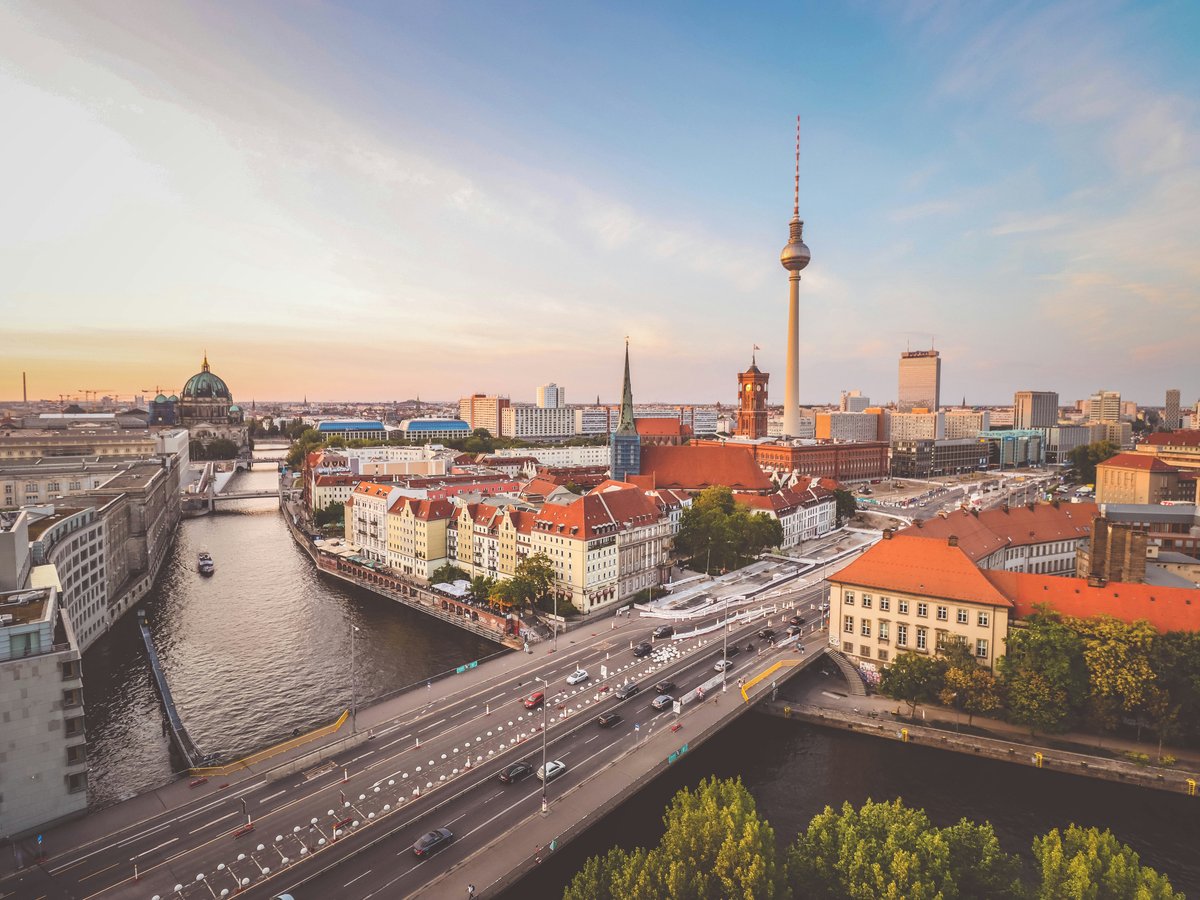
Stay in Berlin in February
65 hotels in the Trip.com pool for Berlin, from US$16 a night.
Opens Trip.com on Fri 5 Feb to Sun 7 Feb 2027; change the dates there.
February in Berlin is defined by one thing above all else. The Berlinale, one of the world's three major film festivals alongside Cannes and Venice, takes over the city for roughly 10 days in mid-February. If you're not here for that, you're looking at short days with only about 9 hours of daylight, an average high of 6.4°C (44°F), and a sky that tends to settle into a flat, unbroken grey for weeks at a time. To be fair, this is Berlin at its most affordable and least crowded, and the city's indoor life, its galleries, concert halls, and Kneipen, is built for exactly this kind of weather. You'll find Berliners wrapped in wool, moving between overheated cafes and cold U-Bahn platforms, largely unbothered.
The cold is real but rarely extreme. Temperatures dip to around -0.2°C (32°F) at night, and the occasional freeze turns puddles on the Landwehrkanal towpath into patches of ice. Snow falls sometimes but seldom sticks for more than a day or two. The dampness, though, has a way of getting into your bones that dry cold at -10°C would not. Wind off the Spree near Friedrichshain cuts through a light jacket in seconds.
That said, February has a particular appeal if you like culture without crowds. Museumsinsel is nearly empty on weekday mornings. The Gemäldegalerie in the Kulturforum might have 20 people in it on a Tuesday afternoon. Markthalle Neun in Kreuzberg still runs its Thursday Street Food market, and the smell of slow-roasted pork and fresh Flammkuchen fills the old brick hall while rain taps the glass roof above. Berlin in February is not for sunbathers. It is for people who like cities when they're turned inward.
Why visit in February
- The Berlinale draws world-premiere screenings to venues across the city for roughly 10 days in mid-February, with public tickets starting around 15 EUR for most screenings.
- Hotel rates in Mitte and Charlottenburg tend to drop 30-40% below summer averages, and Airbnb prices in Kreuzberg and Neukölln follow a similar pattern.
- Major museums like the Alte Nationalgalerie and the Hamburger Bahnhof are nearly empty on weekday mornings, so you can stand in front of a Caspar David Friedrich without someone's phone in your face.
- Berlin's indoor culture peaks in winter. The Berliner Philharmonie, Volksbühne, and dozens of smaller venues in Schöneberg and Prenzlauer Berg run full schedules through February.
- Restaurant reservations that would require 2 weeks' notice in June are often available same-day. Places like the restaurants along Oranienstraße in Kreuzberg have open tables even on Friday evenings.
Worth knowing
- Daylight is limited to roughly 9 hours, with sunrise around 7:30 and sunset by 17:00. Walking tours and outdoor sightseeing feel rushed after about 15:00.
- The persistent grey overcast is not occasional. Berlin in February averages around 2-3 hours of sunshine per day, and some weeks produce none at all.
- Parks like Tiergarten and Treptower Park are bare-branched and muddy. The city's famous outdoor cafe culture is entirely dormant.
- Wind chill near the river and open plazas like Alexanderplatz can make 4°C feel closer to -3°C. The kind of damp cold that no amount of layering fully defeats.
Best for
Think twice if
February in Berlin is cold, damp, and grey. The average high sits at 6.4°C (44°F) and the average low at -0.2°C (32°F), with about 54mm of rainfall spread across 12 days. Humidity hovers around 82%, which makes the cold feel heavier than the numbers suggest. Snow is possible but tends to turn to slush within a day. The wind near the Spree and across open areas like Potsdamer Platz adds a bite that catches tourists off guard. Sunshine, when it appears, is weak and low-angled, casting long shadows across the Brandenburger Tor by mid-afternoon.
Seasonal caution
- Temperatures regularly dip below 0°C (32°F) at night and occasionally during the day, with wind chill pushing perceived temperatures several degrees lower near the river and open plazas.
- Black ice forms on sidewalks and bike paths after overnight freezes, particularly in shaded areas along the Landwehrkanal and under S-Bahn bridges. Watch your footing on cobblestone streets in Mitte.
Year-round climate
Averages from the last 5 years.
| Month | Avg high (°C) | Avg low (°C) | Rainfall (mm) |
|---|---|---|---|
| Jan | 5 | 0 | 60 |
| Feb | 6 | 0 | 54 |
| Mar | 11 | 1 | 35 |
| Apr | 14 | 5 | 36 |
| May | 19 | 9 | 52 |
| Jun | 25 | 14 | 57 |
| Jul | 25 | 15 | 92 |
| Aug | 25 | 15 | 60 |
| Sep | 21 | 12 | 37 |
| Oct | 15 | 8 | 54 |
| Nov | 8 | 3 | 55 |
| Dec | 5 | 1 | 57 |
Headline events
Berlinale (Berlin International Film Festival)
Mid-February, roughly February 12-22
One of the world's top three film festivals, the Berlinale screens roughly 400 films across 30+ venues over 10-11 days in mid-February. Public tickets are available for most screenings, and the competition films premiere at the Berlinale Palast near Potsdamer Platz. The festival draws about 300,000 ticket sales annually, and the atmosphere around Potsdamer Platz during those 10 days is the closest Berlin gets to a red-carpet city. Worth noting that public screenings sell out fast for competition titles, but you can usually find same-day tickets for Panorama and Forum section films.
Best things to do in February
Attend Berlinale public screenings
cultureThe Berlinale runs roughly 400 films across venues including the Berlinale Palast at Potsdamer Platz, the Haus der Berliner Festspiele in Wilmersdorf, and several cinemas in Mitte and Kreuzberg. Public tickets cost around 15 EUR for most screenings. The Forum and Panorama sections tend to show more adventurous work than the main Competition, and their tickets are easier to get.
The Berlinale takes place exclusively in February, typically mid-month over 10-11 days.Booking tipTickets go on sale online about a week before the festival. Competition screenings sell out in minutes. Set an alarm for the on-sale time and have backup picks ready. Forum and Generation sidebar sections are easier to get into.
Gallery hopping in Mitte and Kreuzberg
cultureFebruary is opening season for Berlin's commercial galleries, with many launching their first exhibitions of the year. The cluster around Auguststraße and Linienstraße in Mitte includes KW Institute for Contemporary Art, Eigen + Art, and roughly 30 smaller spaces within a 10-minute walk. Most openings are Thursday evenings and are free with wine.
Galleries launch their annual programs in late January and February, so you're seeing fresh exhibitions before the art-world crowd arrives for Gallery Weekend in April.Booking tipNo booking needed for galleries. KW Institute charges around 8 EUR admission, but most commercial galleries are free.
Museumsinsel without the crowds
cultureThe five museums on Museum Island in Mitte, including the Pergamonmuseum (currently under partial renovation), Neues Museum, and Alte Nationalgalerie, see a fraction of their summer foot traffic in February. The Nefertiti bust at the Neues Museum, which draws queues of 30+ in July, might have 3 people in the room on a February Tuesday morning.
February is Berlin's lowest-tourism month. Museum visit counts drop roughly 50-60% from peak summer, so you get genuinely uncrowded access to major collections.Booking tipThe 3-day Museumsinsel pass costs around 29 EUR and covers all five museums. Buy online to skip the ticket queue, though in February the queue is rarely more than 5 minutes.
Warm up in Berlin's historic bathhouses
wellnessStadtbad Neukölln, built in 1914, has a restored Art Nouveau swimming hall with ornate tile work and a vaulted ceiling. Vabali Spa near Hauptbahnhof offers a larger sauna and pool complex. The German sauna tradition is textile-free, which catches some visitors off guard, but February's cold makes a 90°C sauna followed by a cold plunge feel transformative.
Outdoor cold makes the contrast of heated pools and saunas at their most appealing. Stadtbad Neukölln and Vabali are less crowded on February weekday afternoons than during the November-December holiday rush.Booking tipVabali can fill up on weekend afternoons. Weekday visits before 14:00 are quieter. Entry runs around 25-35 EUR for a half-day depending on the facility.
Explore the Gemäldegalerie at the Kulturforum
cultureThis gallery near Potsdamer Platz holds one of Europe's strongest collections of 13th-to-18th-century European painting, including works by Vermeer, Rembrandt, Caravaggio, and Dürer. The building itself is purpose-built for viewing art, with controlled natural light. In February you might share an entire wing with 2 other visitors.
February's low tourism means near-private viewing of a world-class collection. The controlled interior lighting also makes it ideal for grey days when natural light outside is flat and weak.Booking tipAdmission is around 12 EUR. Free on the first Sunday of each month, though that day draws slightly larger crowds.
CTM Festival for experimental music
musicCTM (Club Transmediale) is an annual festival for adventurous electronic and experimental music, running in late January through early February at venues including HAU Hebbel am Ufer in Kreuzberg and Berghain's Kantine. Performances range from noise to ambient to club music. It often overlaps with Transmediale, the digital-art festival.
CTM typically spans late January into the first week of February, making it a February event for early-month visitors.Booking tipFestival passes sell out. Individual event tickets are more available but popular headliners go fast. Check the CTM website in December for the lineup announcement.
Markthalle Neun Street Food Thursday
foodEvery Thursday evening from 17:00 to 22:00, this restored 1891 market hall in Kreuzberg fills with 30-40 food stalls. In February, expect hearty winter dishes. The hall's iron-and-brick architecture holds heat well, and the smell of grilled meats, fresh bread, and spiced sauces fills the space. Dishes typically run 5-10 EUR.
The indoor format makes it ideal for February's cold evenings. Winter vendors lean into stews, dumplings, and warm drinks that would feel out of place at the summer edition.Booking tipNo booking needed. Arrive by 17:30 to avoid the 19:00 peak. The market is at Eisenbahnstraße 42-43 in Kreuzberg.
Catch a concert at the Berliner Philharmonie
musicThe Berlin Philharmonic's season runs through February with 3-4 concerts per week in Hans Scharoun's 1963 concert hall near Potsdamer Platz. The acoustics are consistently rated among the world's best. Tuesday lunchtime concerts (Lunchkonzerte) are shorter, cheaper, and a good introduction if you're not sure about a full evening program.
The orchestra's winter season is in full swing, and February dates are easier to get tickets for than the December holiday concerts or the spring gala performances.Booking tipTickets range from about 15 EUR for restricted-view seats to 150+ EUR for premium positions. Book 3-4 weeks ahead for weekend concerts. Weeknight performances often have availability closer to the date.
What to eat in February
On menus now
Grünkohl mit Pinkel
Curly kale stewed low and slow with smoked sausage, typically Pinkelwurst or Kohlwurst. February is the tail end of Grünkohl season, which traditionally runs from the first frost through late February. The cold is said to sweeten the kale by converting its starches to sugar. Restaurants in Charlottenburg and Schöneberg tend to keep it on the menu through the month.
Eintopf
Berlin's answer to a cold February evening. These one-pot stews range from Kartoffelsuppe (potato soup with Würstchen) to Erbsensuppe (split pea with smoked pork). Markthalle Neun vendors and old-school Gasthäuser in Moabit serve versions that have likely not changed in 40 years. Thick, unpretentious, and effective against the cold.
Street food peaks
Berliner Pfannkuchen
These jam-filled doughnuts appear in every Bäckerei across the city starting in January and peak around Fasching in February. Filled with plum, apricot, or raspberry jam and dusted with powdered sugar. Each bakery has its own recipe, and locals have strong opinions about which filling is correct. Expect to pay 1.50-2.50 EUR each.
What to drink
Glühwein and Eierpunsch
The Christmas market season ended in late December, but many Kneipen and a few smaller winter markets keep serving Glühwein (mulled red wine) and Eierpunsch (a warm, foamy egg-and-wine drink) through February. Eierpunsch is sweeter and richer, almost dessert-like. Around 3-5 EUR per cup at most bars.
In markets
Winter root vegetables at weekly markets
The Winterfeldtmarkt in Schöneberg and the Türkenmarkt along the Maybachufer in Neukölln sell local Topinambur (Jerusalem artichoke), Steckrübe (swede), Pastinake (parsnip), and black radish through February. These are Brandenburg-grown, in season, and cheap. The vendors at Winterfeldtmarkt will tell you how to cook them if you ask.
Regular events in February
Transmediale
Annual festival for digital art and culture, typically running in late January through early February at HKW (Haus der Kulturen der Welt) in Tiergarten. Exhibitions, talks, and performances exploring the intersection of art, technology, and society. Single-event tickets and festival passes available.
Late January through first week of FebruaryFasching/Karneval celebrationsFree
Berlin's Carnival is far more subdued than Cologne's or Düsseldorf's, but a few neighborhoods hold small parades and costume parties. Kreuzberg and Neukölln bars run Karneval-themed nights. The timing shifts with the church calendar, with Rosenmontag falling in February or early March depending on the year.
Variable, typically mid-to-late February (depends on Easter date)Lange Nacht der Museen (if scheduled)
Berlin's Long Night of Museums occasionally falls in late January or February, though the main edition is typically in August. When it runs in winter, roughly 80 museums stay open until 02:00 with a single 18 EUR ticket covering admission and shuttle buses between venues.
Late January or February (check annual schedule)Winterfeldtmarkt Saturday marketFree
The weekly outdoor market on Winterfeldtplatz in Schöneberg runs year-round on Wednesdays and Saturdays, with the Saturday edition being the larger one. In February, expect seasonal root vegetables, local cheeses, fresh bread, and stands selling hot soup and Glühwein. Around 100 stalls in summer, closer to 60-70 in winter.
Every Wednesday and Saturday, year-roundBest places this February
Hamburger Bahnhof, Museum für Gegenwart
museumThis former railway station in Moabit houses Berlin's premier contemporary art collection, including major works by Beuys, Warhol, and Kiefer. The main hall's soaring ceilings and industrial architecture feel especially striking on grey February days when the diffused light through the glass roof creates an even, almost photographic quality. Near-empty in February.
MoabitMarkthalle Neun
marketThe 1891 iron-and-brick market hall in Kreuzberg operates daily with permanent food vendors, but Thursday's Street Food market (17:00-22:00) is the main draw. In February, the warm interior, the sound of sizzling pans, and the density of cooking smells make it feel like the city's living room. Regular weekday vendors sell bread, cheese, meat, and seasonal produce.
KreuzbergKW Institute for Contemporary Art
galleryLocated on Auguststraße in Mitte, KW is Berlin's oldest institution for contemporary art and often opens its first major exhibition of the year in late January or February. The courtyard cafe, Cafe Bravo, serves decent coffee and is a good warm-up stop between galleries on the Auguststraße circuit.
MitteTempelhofer Feld
parkThe former airport runway turned public park is windswept and stark in February, but that's part of its appeal. The flat, open expanse under a low grey sky has a particular bleakness that some visitors find beautiful in a way that summer crowds obscure. Wrap up warm. The wind across the old tarmac is unobstructed for nearly 2 kilometres.
Neukölln/TempelhofClärchens Ballhaus
nightlifeThis historic ballroom in Mitte, originally opened in 1913, was restored and reopened in recent years. It hosts dance evenings, concerts, and events in an ornate, slightly faded interior that smells of old wood and plaster. February evenings here feel like stepping into a warmer century. Check the schedule for swing, tango, or ballroom nights.
MitteWinterfeldtplatz and surrounding Schöneberg streets
neighborhoodThe Saturday market fills the square with produce, flowers, and street food, and the surrounding streets on Goltzstraße and Akazienstraße are lined with independent bookshops, cafes, and restaurants. The neighborhood has a more settled, residential feel than Kreuzberg or Mitte, and February's quietness suits it.
SchönebergSammlung Boros (Boros Collection)
museumA private contemporary art collection housed inside a converted World War II bunker in Mitte. The 3-metre-thick concrete walls keep the interior at a constant cool temperature year-round. Tours are the only way in, and February's lower demand means shorter wait times for booking. Tours run about 90 minutes and cost around 15 EUR.
Mitte
Your packing checklist
Tick items off as you pack. Your progress saves in this browser.
All packed — have a great trip.
Insider tips
The BVG Tageskarte (day ticket) costs around 8.80 EUR and covers all U-Bahn, S-Bahn, tram, and bus rides in zones A and B for 24 hours. In February, you'll use transit more than in summer because walking between areas in the cold gets tiring fast. A 7-day ticket at around 36 EUR pays for itself by day 4 of heavy use.
Berlinale tickets for popular screenings sell out in the first online wave, but returns and last-minute releases appear on the Berlinale website starting about 3 hours before showtime. Locals check the app repeatedly the afternoon of a screening they want. The short-film programs in the Shorts section almost never sell out and are an easy way into the festival atmosphere.
Berlin's Bäckereien (bakeries) vary enormously in quality. The Berliner Pfannkuchen from a proper bakery like Zeit für Brot in Mitte or Albatross in Prenzlauer Berg bear almost no resemblance to the mass-produced ones at train-station chains. The dough should be light and slightly yeasty, not dense. Expect 2-3 EUR for a good one.
The Berliner Unterwelten tours explore the city's underground bunkers, tunnels, and Cold War-era infrastructure. February is their quietest period, and the underground temperature stays at a constant 8-10°C regardless of weather above. Tours run about 90 minutes and cost around 15 EUR. The Tour 1 route under Gesundbrunnen station is the most popular.
If a Kneipe (neighborhood bar) has a Stammtisch sign on a table, that table is reserved for regulars. Sit elsewhere. In Kreuzberg and Neukölln, most bar staff speak English, but in old-school Kneipen in Wedding or Moabit, you might need basic German or a lot of pointing.
Avoid these mistakes
- Packing for the thermometer instead of the wind chill. The 6°C average high feels like 1-2°C near the Spree, across Potsdamer Platz, and on Tempelhofer Feld. Tourists in fashion jackets without wind layers tend to retreat to their hotels by 15:00. Dress for the perceived temperature, not the forecast number.
- Planning a full outdoor walking itinerary. A 4-hour walking tour that works in June becomes genuinely unpleasant in February's damp cold. Build your days around 2-3 indoor anchors (a museum, a market, a concert) with short outdoor transitions between them. The East Side Gallery along the Spree, for example, is a 1.3km open-air walk with no shelter.
- Assuming the Berlinale is only for industry insiders. Roughly a third of all screenings are open to the public at around 15 EUR per ticket. The Forum and Panorama sections screen critically acclaimed films to general audiences in regular cinemas across the city. You do not need a press pass.
- Eating dinner too early. Berlin restaurants in neighborhoods like Kreuzberg and Friedrichshain often don't fill up until 20:00-21:00, and kitchens typically stay open until 22:30 or later. Arriving at 18:00 means eating in an empty room, which is fine if you prefer that, but you'll miss the atmosphere.
Practical tips for February
Berlin's public transit (BVG/S-Bahn) runs reliably in February, but delays happen more often than in summer due to occasional icy rails and equipment issues in cold weather. The U-Bahn runs until roughly 00:30 on weeknights and all night on Friday and Saturday nights. Download the BVG app for real-time departures. Most museums close on Mondays, with the notable exception of a few on Museumsinsel. The Berlinale mid-month means that restaurants near Potsdamer Platz fill up during festival evenings. Book dinner near festival venues 2-3 days ahead during Berlinale week. Credit cards are more widely accepted than they were 5 years ago, but some smaller Kneipen, bakeries, and market stalls in Neukölln and Wedding still operate cash-only. Carry at least 30-40 EUR in cash. Tipping in Berlin is typically 5-10% at sit-down restaurants, rounded up to a convenient amount. You tell the server the total you want to pay when they bring the card reader, rather than leaving cash on the table. Berlin Tegel Airport closed in 2020. All flights arrive at BER (Berlin Brandenburg Airport), connected to the city center by the FEX express train to Hauptbahnhof in about 30 minutes for around 4 EUR.
FAQ
Is February a good time to visit Berlin?
It depends on what you're after. February is cold, grey, and short on daylight, with an average high of 6.4°C (44°F) and only about 9 hours between sunrise and sunset. It is not the month for strolling through Tiergarten or sitting at outdoor cafes. That said, it is likely the cheapest month to visit, with hotel rates 30-40% below summer, and the Berlinale film festival in mid-February gives the city a genuine cultural charge. If you prioritize museums, galleries, concerts, and food over outdoor sightseeing, February works. If you want the full Berlin experience with parks, street life, and long evenings on the canal, wait for May or September.
What is the weather like in Berlin in February?
Cold and damp. The average high is 6.4°C (44°F) and the average low is -0.2°C (32°F), with about 54mm of rain across 12 days. Humidity sits around 82%. Snow is possible but rarely heavy or lasting. The bigger issue is the persistent overcast. Berlin in February averages only 2-3 hours of sunshine per day, and some stretches produce none. Wind chill near the Spree and across open plazas like Alexanderplatz makes it feel colder than the numbers suggest. Pack as you would for any Northern European winter city.
Is Berlin crowded in February?
No. February is the quietest month for tourism in Berlin. The major museums on Museumsinsel see roughly half the visitors they get in July and August. You can walk into most restaurants without a reservation on weeknights. The one exception is Berlinale week in mid-February, when hotels near Potsdamer Platz and Mitte fill up and festival venue neighborhoods get noticeably busier. Even then, the crowds are concentrated around screening times and festival hubs, not spread across the whole city.
Do I need to book Berlinale tickets in advance?
For Competition screenings and high-profile premieres, yes. Those sell out within minutes of going on sale, typically about a week before the festival opens. For the Forum, Panorama, and Shorts sections, you can often find tickets a day or two before, and sometimes at the door. The Berlinale website and app show real-time availability and release returns starting roughly 3 hours before each screening. A practical strategy is to pick 2-3 target films to secure early and leave the rest flexible.
What should I wear in Berlin in February?
Dress in warm, windproof layers. A thermal base layer under a sweater and a windproof winter coat handles most conditions. Insulated, waterproof boots with rubber soles are important because sidewalks get icy and slushy. Wool scarf, lined gloves, and a hat are not optional. Indoors, Berlin buildings are heated to 22-24°C, so you'll be peeling layers on and off all day. Choose a coat you can open easily and skip bulky knitwear that's hard to stuff into a bag at a museum cloakroom.
Things to Do in Berlin in February
 Free cancellation
 Discover Berlin Half-Day Walking Tour
City tour: 3.5 hours, free cancellation.
via Viator Free cancellation
 Berlin: Sachsenhausen Concentration Camp Tour in English
Day trip: 5.5 hours, free cancellation.
via Viator Free cancellation
 Third Reich Berlin: Hitler and WWII Walking Tour
City tour: 3 hours, free cancellation.
via Viator Free cancellation
 Communist East Berlin and Berlin Wall Small Group Walking Tour
City tour: 2 hours, free cancellation.
via Viator Free cancellation
 Sachsenhausen Concentration Camp Memorial Tour (Max. 15 Guests)
City tour: 6 hours, free cancellation.
via Viator Free cancellation
 Cold War, Berlin Wall, Spies and the East Side Gallery
City tour: 3 hours, free cancellation.
via ViatorFind a flight to Berlin
Live fares to Berlin appear here once cookies are accepted.
Last verified by automated review (v1.7.2) on . What is automated review?