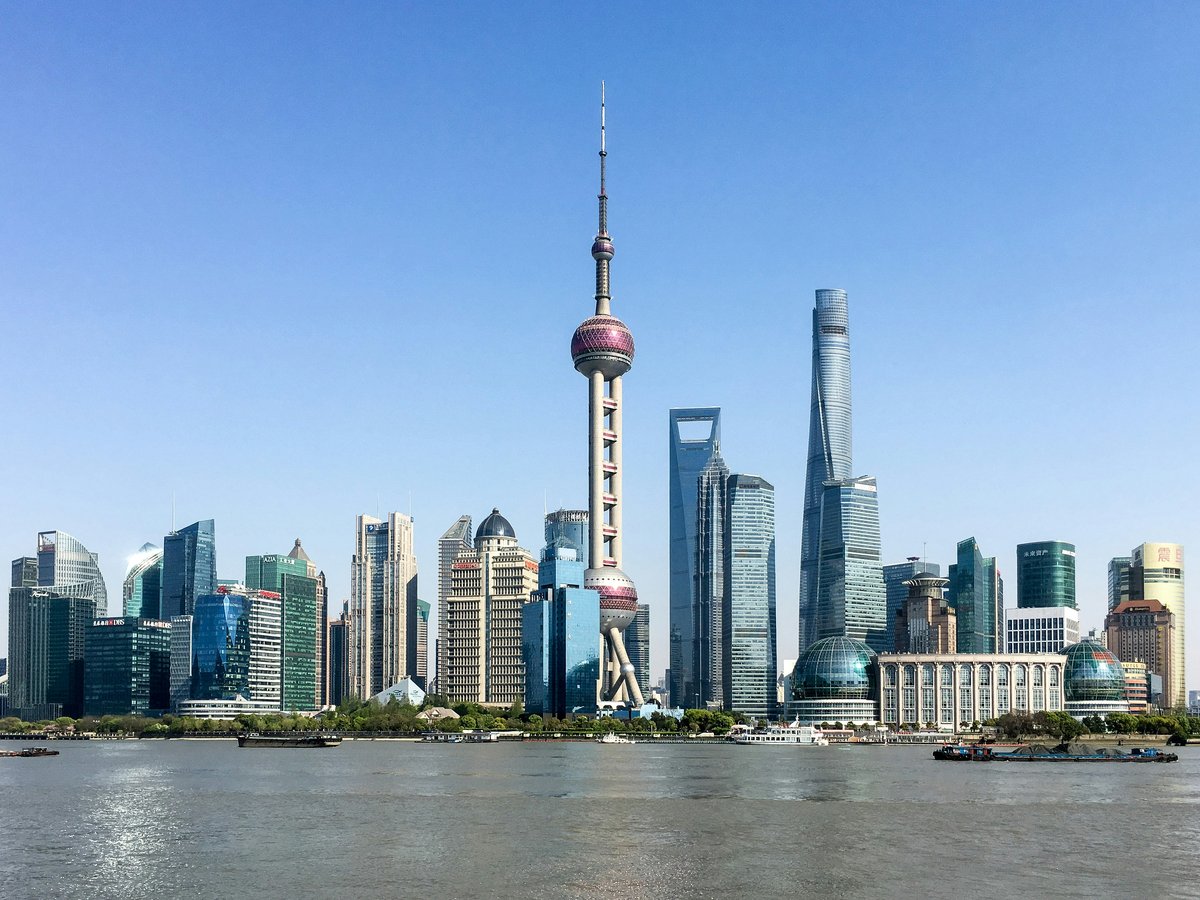
Shanghai tends to surprise people who arrive expecting nothing but skyscrapers and traffic. The city sits on the Yangtze River Delta, a flat alluvial plain that stretches to the East China Sea, and while the terrain rarely rises above 4 meters, the green space is more generous than you might expect. The Huangpu River cuts through the center, Chongming Island fills the Yangtze's mouth to the north, and the low Sheshan hills break the flatness about 30 kilometers southwest of downtown. Spring, roughly mid-March through May, and autumn, from October into November, are the comfortable windows. Summer in Shanghai is genuinely punishing. July and August regularly hit 37°C with humidity that makes 500 meters feel like a workout. That said, the subtropical climate means everything stays green year-round, and even January, which averages around 4°C, is mild enough for a long riverside walk in Pudong. The outdoor culture here leans more toward early-morning tai chi in Fuxing Park, evening runs along the Binjiang Greenway, and weekend escapes to Moganshan or Chongming than toward technical mountaineering. You work with flatness, not against it.
Outdoor activities
-
Cycling the Binjiang Greenway
The Binjiang Greenway runs roughly 45 kilometers along both banks of the Huangpu River, connecting the Bund on the Puxi side to stretches of waterfront in Pudong. The path is paved and mostly flat, passing old shipyard conversions near the West Bund, the Long Museum, and the Power Station of Art. Shared bike systems like Hellobike and Meituan Bike have docking stations every few hundred meters. On weekday mornings you'll have the Pudong side almost to yourself. Weekend afternoons on the Puxi stretch get crowded near Lujiazui, so start early. The smell of river water and diesel from passing barges is constant. You'll hear the foghorns of cargo ships near Wusongkou where the Huangpu meets the Yangtze.
- Difficulty
- Easy
- Duration
- 3-5 hours for a full loop
- Best season
- October to November, or March to April
-
Rock Climbing at Base Camp Shanghai
Shanghai has a small but committed indoor climbing scene. Base Camp in Jing'an District is one of the more established gyms, with bouldering walls up to about 4.5 meters and lead walls around 12 meters. Routes change every few weeks. A day pass typically runs around 120-160 CNY. The community tends to organize weekend trips to real rock at spots near Ningbo or deeper into Zhejiang Province, which is how most Shanghai-based climbers find outdoor crag partners. Worth noting, the gym staff generally speak enough English to help with rental gear and basic route-setting info.
- Difficulty
- Beginner to Advanced (graded routes)
- Duration
- 2-3 hours per session
- Best season
- Year-round (indoor)
-
Running the Century Park Loop
Century Park in Pudong covers about 140 hectares, and the perimeter loop is close to 5 kilometers on paved paths. The interior trails add another 3-4 kilometers of softer ground through wooded sections. Early mornings before 7:00 are best. The park opens at 6:00 from March through November. Entry costs 10 CNY. You'll see retirees doing sword forms near the lake, and the bird calls in the eastern wetland section are surprisingly loud for a park surrounded by Lujiazui office towers. The air quality is noticeably better inside the tree cover than on the surrounding roads.
- Difficulty
- Easy
- Duration
- 45 minutes to 1.5 hours
- Best season
- March to May, October to November
-
Chongming Island Cycling
Chongming Island, the third-largest island in China, sits at the mouth of the Yangtze about 60 kilometers north of central Shanghai. A network of bike paths runs through Dongping National Forest Park and along the island's northern wetlands. The terrain is completely flat. Rental bikes are available near the forest park entrance for around 30-50 CNY per day. The ride from Dongping through the surrounding farmland and out toward Xisha Wetland Park covers roughly 25 kilometers one way. The air smells different up here, more salt marsh and mud flat than city. You might spot egrets and grey herons in the reed beds near Dongtan Wetland. The Shanghai-Chongming tunnel and bridge make access easy by car or bus from the city center, about 90 minutes.
- Difficulty
- Easy to Moderate
- Duration
- Full day
- Best season
- April to May, September to October
-
Kayaking on Dianshan Lake
Dianshan Lake sits in Qingpu District on Shanghai's western edge, about 45 minutes by car from central Puxi. It covers roughly 62 square kilometers and is Shanghai's largest natural freshwater lake. A few outfitters near Zhujiajiao Ancient Town rent sit-on-top kayaks for around 80-150 CNY per hour. Mornings before 10:00 tend to have calmer water. The lake is shallow, mostly 2-3 meters deep, so conditions stay manageable for beginners. On clear days you can see all the way to the low hills of Kunshan across the Jiangsu border. Mind you, motorboat traffic picks up on weekends near the resort clusters along the southern shore.
- Difficulty
- Easy to Moderate
- Duration
- 2-4 hours
- Best season
- April to June, September to October
Day hikes
-
Sheshan National Forest Park
Sheshan is the closest thing Shanghai has to a hill. The West Hill (Xishan) tops out at about 100 meters, making it the highest natural point in the municipality. The climb takes maybe 20-30 minutes on stone steps through bamboo and camphor forest. At the top sits the Sheshan Basilica, a Catholic church built in 1871 and expanded in 1925, which is worth the walk regardless of your interest in religion. The East Hill (Dongshan) has a small astronomical observatory built in 1900 by the Jesuits. Both hills are in Songjiang District, about 35 kilometers from central Shanghai, reachable by Metro Line 9 to Sheshan Station. The park entrance is free. The bamboo canopy keeps the path shaded even in July.
- Difficulty
- Easy. Stone steps, about 100 meters elevation gain.
- Duration
- 1.5-2 hours for both hills
- Best season
- March to May, October to November
-
Moganshan (Mount Mogan)
Moganshan is the weekend escape for Shanghai's outdoor crowd. The mountain sits in Deqing County, Zhejiang Province, about 200 kilometers southwest of Shanghai, roughly 3 hours by car or high-speed rail to Deqing Station followed by a 40-minute taxi. The peak reaches 758 meters. Trails wind through dense bamboo forest, past old stone villas from the 1920s-30s when the mountain was a colonial-era summer retreat. The main hiking loop from the village area to the summit and back covers about 8 kilometers. The bamboo forest produces a particular sound in the wind, a dry clicking mixed with the rustling, that you won't hear anywhere near Shanghai. Temperatures at the top run 5-7°C cooler than the city, which makes it a genuine relief in summer.
- Difficulty
- Moderate. Sustained uphill sections, uneven stone paths, roughly 500 meters total elevation gain.
- Duration
- 4-6 hours for the main loop
- Best season
- April to June, September to November
-
Tianmu Mountain
Tianmu Mountain sits about 250 kilometers from Shanghai in Lin'an District, Hangzhou. West Tianmu (Xi Tianmu Shan) peaks at 1,506 meters and has genuine old-growth forest. Some of the trees are estimated at over 1,000 years. The main trail from the entrance gate to the summit follows stone steps and wooden boardwalks through a forest of ancient ginkgo, Japanese cedar, and various endemic species. The round trip covers roughly 10 kilometers with about 800 meters of elevation gain. It gets steep in the upper third. The trail is well-marked but slippery after rain. The forest floor smells of damp wood and decomposing leaves year-round. Entry to the scenic area costs around 140 CNY. Access is best by car, about 3.5 hours from Shanghai.
- Difficulty
- Moderate to Strenuous. 800 meters elevation gain, steep stone steps in the upper sections.
- Duration
- 5-7 hours round trip
- Best season
- April to May, October to November
-
Zhujiajiao to Dianshan Lake Walk
This is less a hike and more a long flat walk, but it works when you want fresh air without the drive to Zhejiang. Start in Zhujiajiao Ancient Town in Qingpu District, about 50 kilometers from central Shanghai. Walk south from the town along canal paths and farm roads toward the northern shore of Dianshan Lake. The route covers roughly 6-8 kilometers one way depending on your path choices. The terrain is completely flat, passing through small agricultural plots, fish ponds, and the occasional cluster of village houses. The canals smell faintly of silt and aquatic vegetation. Weekend mornings you'll share the path with local anglers and elderly couples out walking.
- Difficulty
- Easy. Flat, mostly paved or packed dirt.
- Duration
- 3-4 hours round trip
- Best season
- March to May, October to November
Water activities
-
Huangpu River Cruise (Passenger Ferry)
The tourist cruises are fine, but the cheapest and arguably most interesting way to be on the Huangpu is the regular commuter ferry between Puxi and Pudong. The Dongchang Road to Jinling Road crossing costs 2 CNY and takes about 10 minutes. You stand on an open deck with commuters, scooters, and the occasional delivery cart, watching container ships pass close enough to read the hull markings. The river smells of brackish water and engine oil. For a longer ride, the Wusongkou ferry runs north toward the Yangtze confluence. The tourist boats charge 120-180 CNY for a 1-hour evening loop past the Bund and Lujiazui, which is admittedly a good view of the skyline at night.
- Difficulty
- Easy
- Duration
- 10 minutes (commuter ferry) to 1 hour (tourist cruise)
- Best season
- Year-round, evening cruises best March to November
-
Rowing and Paddleboarding at Dishui Lake
Dishui Lake is a circular, entirely man-made lake in the Lingang area of southeast Pudong, about 70 kilometers from the city center. It has a diameter of roughly 2.5 kilometers and a small island at its center. The surrounding development is still fairly sparse, which means the water is usually calm and the area quiet. A few rental operations along the northern shore offer stand-up paddleboards and kayaks, typically 80-120 CNY per hour. The lake is shallow and protected from ocean wind by the surrounding land, making it suitable for beginners. The area still feels like a half-built new town, which gives it an oddly empty quality on weekdays.
- Difficulty
- Easy
- Duration
- 1-3 hours
- Best season
- April to October
-
Chongming Dongtan Wetland Birdwatching by Boat
Dongtan Wetland on the eastern tip of Chongming Island is one of the most important migratory bird stopovers on the East Asian-Australasian Flyway. During peak migration in October through December, the mudflats and reed marshes host species including the hooded crane, black-faced spoonbill, and several hundred thousand shorebirds. Guided boat tours run from a visitor center near the wetland edge and cover the channels between reed beds. Binoculars are essential. The boats are small electric craft, quiet enough not to flush the birds. Morning departures around 6:00-7:00 are best for activity. Entry to the wetland park is around 50 CNY.
- Difficulty
- Easy
- Duration
- 2-3 hours
- Best season
- October to December for migration, April to May for spring passage
-
Swimming at Jinshan City Beach
Jinshan City Beach, about 70 kilometers south of central Shanghai in Jinshan District, is the closest thing the municipality has to a proper seaside swimming spot. The beach is man-made, with imported sand along Hangzhou Bay. The water is murky, as you'd expect from the bay, and tends toward brown rather than blue. To be fair, the facilities are well-maintained. There's a roped swimming area with lifeguards from June through September, changing rooms, and showers. Entry to the beach area costs around 20-50 CNY depending on the season. The summer water temperature sits around 25-28°C. Weekend crowds in July and August are significant.
- Difficulty
- Easy
- Duration
- Half day
- Best season
- June to September
Parks & gardens
-
Fuxing Park
FreeFuxing Park in the Former French Concession covers about 8.9 hectares and dates to 1909 when the French municipal council laid it out in a formal European style. The plane trees lining the central avenue are over a century old, and their canopy blocks most of the summer sun. Mornings here are a spectacle of local life. Groups practice ballroom dancing near the central fountain, amateur opera singers rehearse near the south gate, and card games run continuously on stone tables under the trees. The park sits between Sinan Road and Gaolan Road, surrounded by some of Shanghai's best-preserved colonial architecture.
Highlights: Century-old plane tree avenue, morning ballroom dancing, proximity to Sinan Mansions and the Former Residence of Sun Yat-sen on nearby Xiangshan Road
-
Shanghai Botanical Garden
The Shanghai Botanical Garden in Xuhui District spans about 81 hectares, considerably larger than most visitors expect. The orchid greenhouse holds over 500 species and is probably the single best collection in eastern China. The bonsai garden has specimens dating to the Qing dynasty. Paths wind through themed sections including a medicinal herb garden, a bamboo grove, and a rose garden with around 600 cultivars. Entry to the main grounds is 15 CNY, with an additional 15 CNY for the greenhouse complex. It rarely feels crowded except during the spring flower festival in April.
Highlights: Orchid greenhouse with 500+ species, Qing-era bonsai collection, 600-cultivar rose garden, April spring flower festival
-
Gongqing Forest Park
Gongqing Forest Park covers about 131 hectares in Yangpu District, making it one of the largest green spaces in central Shanghai. The canopy is dense enough that summer temperatures inside the park can feel 3-4°C cooler than the surrounding streets. The park has a small lake with rowboat rentals for around 40 CNY per hour, a ropes course, and a barbecue area that's popular with families on weekends. The eastern section is quieter, with unpaved trails through mixed forest of camphor, cedar, and metasequoia. Entry is 15 CNY.
Highlights: 131-hectare mixed forest, rowboat lake, ropes course, barbecue areas, noticeably cooler microclimate in summer
-
Binjiang Forest Park
Binjiang Forest Park sits at the northern tip of Pudong where the Huangpu River bends toward its confluence with the Yangtze. It covers about 120 hectares. The location means you get actual river breezes and views of cargo ships making the turn. The park has a stretch of sandy riverbank, which is as close to a beach as Shanghai proper gets. The forest sections are relatively young plantings, maybe 20-30 years, but dense enough to block the city noise. A 2-kilometer waterfront path runs along the eastern edge. Entry is 20 CNY.
Highlights: Sandy riverbank, cargo ship views at the Huangpu-Yangtze confluence, 2-kilometer waterfront trail, actual river breezes
-
Zhongshan Park
FreeZhongshan Park in Changning District is 20 hectares of mature landscaping built around a mix of Chinese and English garden styles. The park dates to 1914. The large central lawn fills up with kite-flyers on windy autumn afternoons. A marble boat pavilion sits on the small lake in the park's southeast corner. The surrounding area, particularly Yuyuan Road and Xinhua Road, has some of Shanghai's best-preserved garden lane houses, which makes the walk to and from the park worthwhile on its own.
Highlights: 1914-era grounds, central lawn for kite-flying, marble boat pavilion, adjacent heritage lane houses on Yuyuan Road
-
Houtan Wetland Park
FreeHoutan Park runs about 1.8 kilometers along the Huangpu in Pudong, built on a former industrial site for the 2010 World Expo. The park uses constructed wetlands to filter Huangpu River water through terraced pools planted with native reeds, water hyacinth, and iris. The contrast between the industrial remnants, old steel frames and weathered concrete, and the wetland vegetation growing through them gives the place a texture most Shanghai parks lack. It connects to the southern end of the Binjiang Greenway.
Highlights: Constructed wetland filtration system, Expo-era industrial remnants, 1.8-kilometer Huangpu riverfront, connection to Binjiang Greenway
Practical tips
- Heat and Humidity
- Shanghai's summer heat is not a minor inconvenience. July and August average 35°C with humidity above 80%, and the UV index frequently hits 8-10. Carry at least 1.5 liters of water for any activity over an hour. A sun hat and SPF 50 sunscreen are non-negotiable from May through September. Heat exhaustion is a real risk on exposed paths like the Binjiang Greenway at midday. Schedule outdoor activities before 9:00 or after 16:00 in peak summer.
- Air Quality
- Check the AQI before heading out. Shanghai averages around 70-90 on the US EPA scale, but winter inversions and occasional agricultural burning can push readings above 150. On days above 100, consider limiting strenuous outdoor exercise. The aqicn.org site gives real-time readings for stations across the city. Parks with dense tree cover like Gongqing Forest Park tend to read 10-20 points lower than roadside monitors.
- Trail Conditions Near Shanghai
- Most trails at Sheshan and on Chongming Island are paved or have stone steps. Moganshan and Tianmu Mountain have rougher sections with uneven stone, exposed roots, and slippery moss after rain. Lightweight hiking shoes with good tread are sufficient for anything in this region. Full boots are unnecessary. Bring trekking poles for Tianmu Mountain if you have knee concerns, as the descent is steep on hard stone steps. Trail markers exist but are inconsistent at Moganshan. Download offline maps before going.
- Getting to Trailheads
- Metro Line 9 reaches Sheshan directly. Chongming Island is accessible by bus from Shanghai Science and Technology Museum station, about 90 minutes. Moganshan requires a high-speed train to Deqing (about 50 minutes from Hongqiao Station) plus a taxi. Tianmu Mountain is best reached by car. Didi, the ride-hailing app, works throughout the region but drivers to remote trailheads sometimes cancel. Having the destination written in Chinese characters helps.
- Gear and Supplies
- Decathlon has multiple locations in Shanghai, including a large store in Pudong near Century Park, and covers most basic outdoor needs at reasonable prices. For more technical gear, Sanfo Outdoor on Nanjing West Road has been in operation since the late 1990s and stocks brands like The North Face, Osprey, and MSR. Convenience stores along trails outside Shanghai are scarce. Buy water and snacks in the city before departing.
- Mosquitoes and Insects
- Shanghai's subtropical moisture means mosquitoes are active from April through October. They're worst near water, so expect them at Dianshan Lake, Chongming wetlands, and anywhere along canals. Bring DEET-based repellent or picaridin. The local brand Six God (六神) makes a widely available floral-water repellent that works surprisingly well and costs about 15 CNY at any Family Mart or Lawson.
FAQ
Is Shanghai a good city for outdoor activities despite being so flat?
Shanghai works well for cycling, running, water sports, and urban park walks. The flatness limits hiking, but Sheshan's 100-meter hill is a quick fix, and Moganshan is under 3 hours by train. The real strength is the waterfront infrastructure. The Binjiang Greenway alone gives you 45 kilometers of paved riverside paths. For serious mountain hiking you'll need to travel to Zhejiang or Anhui Province, but weekend trips from Shanghai are straightforward.
What is the best time of year for outdoor activities in Shanghai?
October and November are the sweet spot. Temperatures range from 15-25°C, humidity drops, air quality tends to improve, and the autumn foliage at Sheshan and Moganshan is at its best. March through May is the second-best window, though April can be rainy. Avoid July and August for anything strenuous unless you're heat-adapted. The local outdoor community largely hibernates from June through September, moving to indoor climbing gyms and pools.
Do I need to speak Mandarin to access hiking trails near Shanghai?
At Sheshan, signage is bilingual and the metro gets you there without any language needed. Moganshan has enough international visitors that basic English works at guesthouses and restaurants in the main village area. Tianmu Mountain is more local. Ticket windows, trail signs, and bus schedules are primarily in Chinese. Having key phrases written in Chinese characters on your phone, especially your destination and return plans, helps significantly outside of central Shanghai.
Can you swim in the Huangpu River or the ocean near Shanghai?
Swimming in the Huangpu is not recommended and is technically prohibited in central sections. The water quality has improved since the early 2000s but still carries significant sediment and urban runoff. For ocean swimming, Jinshan City Beach on Hangzhou Bay has a lifeguarded area open June through September, though the water is murky. Dishui Lake and indoor pools are cleaner alternatives for actual swimming.
How crowded are Shanghai's parks on weekends?
The popular parks, particularly Fuxing Park, Century Park, and the Bund-adjacent sections of the Binjiang Greenway, get very busy on weekends, especially during Golden Week in early October and during cherry blossom season in late March. Gongqing Forest Park and Binjiang Forest Park, being farther from the city center, stay more manageable. Weekday mornings at any park are a completely different experience. Arriving before 8:00 on a Saturday helps at the popular spots.
Are there any permits needed for hiking near Shanghai?
Sheshan National Forest Park is free and requires no permit. Moganshan charges an entry fee of around 80 CNY and limits vehicle access during peak periods, but no hiking permit is needed. Tianmu Mountain charges around 140 CNY entry to the scenic area. Chongming's wetland parks have entry fees between 30-50 CNY. None of these currently require advance booking for individual hikers, though Dongtan Wetland boat tours may need same-day reservation during the October migration peak.
Last verified by automated review (v1.7.2) on . What is automated review?