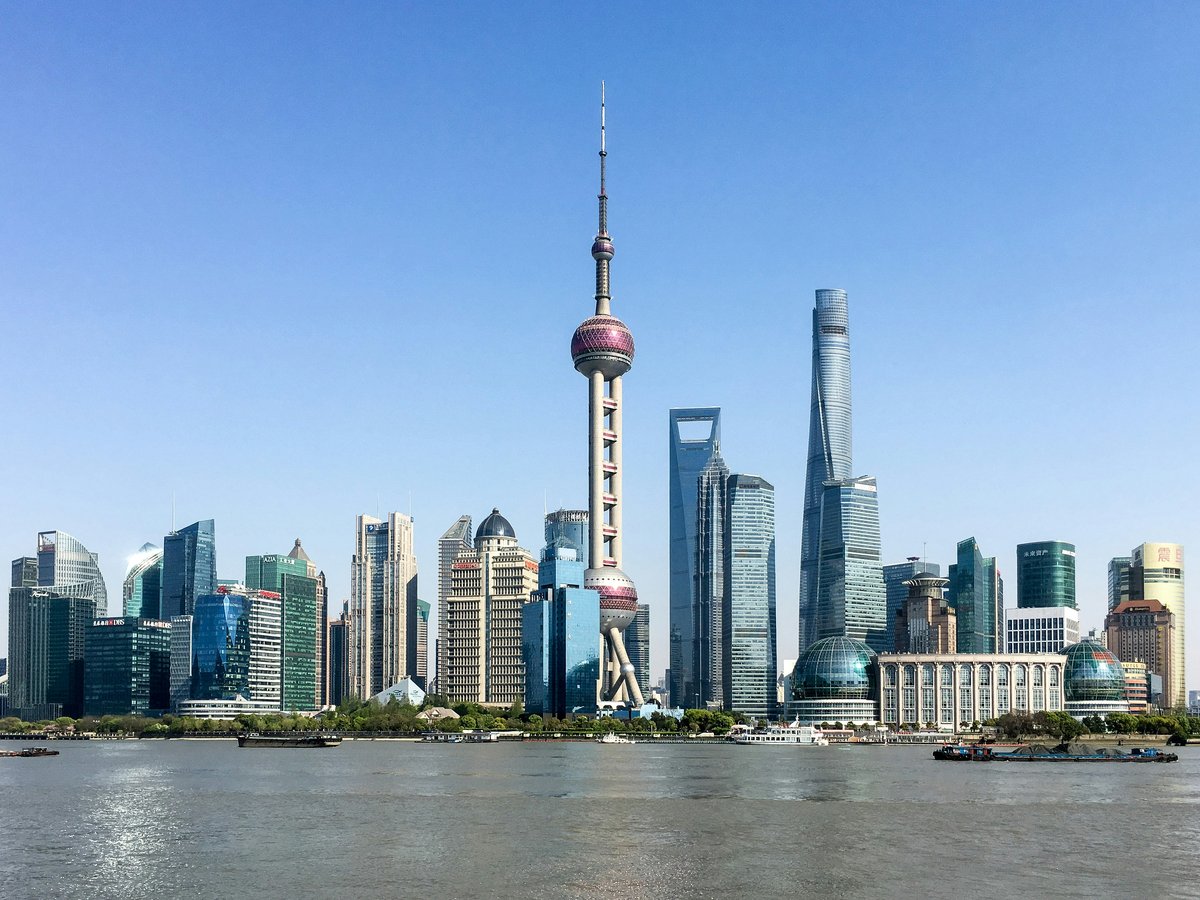
Shanghai splits roughly along the Huangpu River. Pudong sits east, all glass towers and wide boulevards built mostly after 1990. Puxi sprawls west, where the city's older bones show through layers of renovation and neglect. Within Puxi, the former foreign concessions (French, International Settlement) form a rough band through the center, running from the Bund westward through Jing'an and south into what locals still call the French Concession. North of Suzhou Creek, Hongkou and Yangpu carry a grittier, more residential energy. The metro connects everything efficiently. 14 lines currently operate, with stations rarely more than a 10-minute walk apart in central districts. Most visitors anchor somewhere between the Bund and the French Concession, though Jing'an has quietly become the better base for first-timers who want walkability without the weekend tourist crush.
Neighborhoods
-
The Bund and East Nanjing Road
Colonial-era bank buildings line the waterfront for 1.5 kilometers along Zhongshan East No.1 Road. The architecture is heavy, European, built to impress in the 1920s and 1930s. At night the Pudong skyline across the river turns into a light show, and the promenade fills with couples and photographers. Behind the Bund, East Nanjing Road pedestrian street runs 1.2 kilometers of retail that feels like it peaked around 2005. The side streets between Nanjing Road and Fuzhou Road hold more interest now. You'll smell roasted chestnuts from street vendors in cooler months, hear the constant river horn blasts.
- Best for
- First-time visitors who want the postcard Shanghai experience, architecture buffs, photographers chasing the Pudong skyline at dusk
- Key streets
- Zhongshan East No.1 Road (the Bund promenade itself), Fuzhou Road for bookshops and stationery, Yuanmingyuan Road for restored 1930s facades, Sichuan Middle Road for local lunch spots away from the tourist flow
-
French Concession
Plane trees arch over narrow streets lined with 1920s lane houses. The area roughly spans from Huaihai Middle Road south to Jiaotong University, and from Shaanxi South Road west to Hengshan Road. It feels smaller than people expect. Walking end to end takes maybe 40 minutes. The pace is slower here, partly because the streets are too narrow for major bus routes. Mornings smell like fresh scallion oil from breakfast shops. Weekends the main drags (Wukang Road, Anfu Road) flood with young Shanghainese taking photos in front of every restored doorway. Weekday mornings are different. Quiet, almost residential.
- Best for
- Couples, design-minded travelers, anyone who wants to walk everywhere, coffee addicts (there are currently over 80 specialty coffee shops within 2 square kilometers here)
- Key streets
- Wukang Road for the Normandie Apartments and the plane tree canopy, Anfu Road for independent boutiques and Anfu Road 322 (a small-theater complex), Yongkang Road for casual dining (the bar era ended in 2016 when licenses were pulled), Fuxing West Road for quieter residential lanes
-
Jing'an
The district runs from the old Jing'an Temple (rebuilt, now gold-plated and slightly surreal against the surrounding office towers) north and west toward the rail corridor. Nanjing West Road forms the spine. It carries a corporate energy during the week. Tall buildings, busy lunch crowds, Starbucks every 200 meters. But the residential lanes between Nanjing West and Wuding Road hold pockets of old Shanghai. Tiled roofs, drying laundry, the clatter of mahjong tiles through open windows on summer evenings. The area around Kangding Road still has affordable Sichuan restaurants where lunch costs 25-35 RMB per person.
- Best for
- Business travelers, first-timers who want central access without committing to the French Concession prices, solo travelers who value walkable density
- Key streets
- Nanjing West Road for the HKRI Taikoo Hui mall and Jing'an Temple, Wuding Road for newer restaurants and wine bars, Shaanxi North Road for the transition zone between Jing'an and the French Concession, Changde Road for Eileen Chang's former apartment block (the Eddington House, number 195)
-
Pudong (Lujiazui)
The financial district sits directly across from the Bund. Three supertall towers define the skyline. Jin Mao (421 meters, 1999), Shanghai World Financial Center (492 meters, 2008), and Shanghai Tower (632 meters, 2015). At street level, Lujiazui feels more like a conference center campus than a neighborhood. Wide roads, pedestrian underpasses, scattered malls. The residential compounds behind the towers house finance workers and expat families. It is clean, orderly, and somewhat sterile. The riverside park offers the best free view back toward the Bund, and the ferry across costs 2 RMB.
- Best for
- Business travelers with meetings in Pudong, families wanting space and newer apartments, anyone who prioritizes hotel points (the major chains cluster here)
- Key streets
- Century Avenue for the metro interchange and IFC Mall, Lujiazui Ring Road for the tower observation decks, Binjiang Avenue for the riverside promenade walk
-
Hongkou
North of Suzhou Creek, Hongkou carries a different weight. This was the designated area for Jewish refugees during the 1930s and 1940s. Around 20,000 European Jews sheltered here between 1933 and 1945. The Shanghai Jewish Refugees Museum on Changyang Road documents this period. Today the neighborhood is residential and middle-class, with fewer tourists and lower prices than anything south of the creek. Duolun Road, a short cultural street, holds bookshops and a handful of small museums in converted lane houses. Lu Xun Park fills with ballroom dancers every morning. The food skews northern Chinese and Shanghainese home-cooking.
- Best for
- History-minded travelers, budget-conscious visitors who still want a central location, anyone interested in Shanghai's Jewish refugee history
- Key streets
- Duolun Road for the literary and cultural walk, Sichuan North Road for local commerce, Haining Road for cheap Shanghainese breakfast (you'll find cifantuan and soy milk shops open from 5:30am), Zhoushan Road in the former ghetto area
-
Xuhui (south of the French Concession)
Xuhui stretches south from Hengshan Road down to the Xujiahui commercial intersection. The northern portion blends into the French Concession gradually. You might not notice you have crossed the boundary. Further south, around Xujiahui, it becomes a major shopping and transit hub. The area around Shanghai Stadium and Wanping Road holds mid-range hotels and actual residential life. Grocery stores, hardware shops, noodle places with plastic stools. The campus of Shanghai Jiaotong University brings student energy. Evenings along Tianping Road are quiet enough to hear cicadas in summer.
- Best for
- Mid-budget travelers who want French Concession proximity without the premium, families near Xujiahui's malls and metro connectivity, anyone staying longer than a week
- Key streets
- Tianping Road and Wulumuqi South Road for the French Concession overflow (same plane trees, 30% lower rents), Caoxi North Road near the stadium for hotel clusters, Hengshan Road for the few remaining live music bars
-
Old City (Nanshi / Yu Garden area)
The oldest core of Shanghai. Narrow alleys and low buildings cluster around the Yu Garden, a 2-hectare classical garden built in 1559 during the Ming dynasty. The surrounding bazaar area has been rebuilt into a tourist shopping zone. Fangbang Middle Road, once the main commercial street, now sells tea sets, scarves, and calligraphy brushes. It feels performative. But step one block off the tourist loop and you hit real residential lanes where elderly Shanghainese still hang laundry between buildings and the air smells of black vinegar and sesame oil from kitchen windows.
- Best for
- Short visits rather than accommodation (few good hotels here), first-timers checking off Yu Garden, anyone interested in pre-concession Shanghai architecture
- Key streets
- Fangbang Middle Road for the tourist bazaar (arrive before 9am to avoid crowds), Dajing Road for a remaining section of the old city wall, Henan South Road for the transition into the Bund area, Wenmiao Road for the Confucian Temple and its Sunday book market
-
Changning and Gubei
West of Jing'an, Changning district holds the Hongqiao airport area and the Gubei residential zone. Gubei specifically caters to Japanese, Korean, and Taiwanese expat families. You will find signs in Japanese, Korean grocery stores, and izakaya-style restaurants clustered along Ronghua East Road and Shuicheng Road. The area feels suburban by Shanghai standards. Wide sidewalks, gated compounds, international schools. Hongqiao Tiandi, a small commercial development near the Hongqiao transport hub, tries to replicate Xintiandi's formula at lower density. It is practical rather than exciting.
- Best for
- Families with school-age children, travelers with early Hongqiao airport departures, anyone wanting a quieter base with strong Japanese and Korean dining options
- Key streets
- Shuicheng Road for Japanese restaurants and groceries, Hongqiao Road for the older commercial strip, Ronghua East Road for Korean BBQ and late-night options, Yan'an West Road for transit access
-
Yangpu
Further northeast, past Hongkou, Yangpu is a former industrial district turning into a university and creative quarter. Fudan University's main campus sits here, along with Tongji University. The area around Daxue Road near Fudan has cheap eats, bookshops, and student bars. The Yangpu waterfront along the Huangpu River is undergoing a long-term redevelopment. Former textile mills and warehouses are becoming galleries and co-working spaces. It is still rough around the edges. Construction noise, unfinished paths, temporary fencing. But the 5.5-kilometer waterfront walk that is currently open offers industrial views that feel nothing like the Bund.
- Best for
- Budget travelers, university visitors, architecture students interested in industrial adaptive reuse, anyone who dislikes tourist infrastructure
- Key streets
- Daxue Road near Fudan for student life and 15-RMB noodle bowls, Guoding Road for used bookstores, the Yangpu Riverside section between Qinhuangdao Road and Anpu Road for the converted warehouse district
FAQ
What is the best neighborhood in Shanghai for first-time visitors who want to walk everywhere?
Jing'an or the northern French Concession, specifically the area between Nanjing West Road and Huaihai Middle Road. Both districts sit on metro lines 1, 2, 7, and 12, making transfers easy. Hotel prices in Jing'an tend to run 15-20% lower than equivalent French Concession properties. The French Concession has prettier streets for walking but worse metro coverage in its southern lanes. Either way, you are within 15 minutes of the Bund on foot or one metro stop.
Is Pudong worth staying in if I do not have business meetings there?
Probably not for most visitors. Lujiazui hotels are newer and often cheaper per square meter, but you will spend 20-30 minutes crossing the river every time you want to reach restaurants, nightlife, or historic sites in Puxi. The ferry helps, but it stops at 10pm. The Pudong riverside walk is worth a half-day visit, and the Shanghai Tower observation deck (top floor ticket 180 RMB) gives you the best aerial view of the city. Stay in Puxi, visit Pudong.
How does Shanghai's layout compare to other Chinese cities for navigation?
Shanghai is easier than Beijing (no ring-road logic to learn) but harder than Shenzhen or Chengdu (both grid-based). The Huangpu River gives you a constant orientation point. If you can see or sense the river, you know which way is east. The former concession streets run at odd angles because they followed pre-existing canal paths that were filled in during the 1910s and 1920s. Metro station names often reference the nearest intersection (Shaanxi South Road, Changshu Road) which helps with surface navigation.
Which Shanghai neighborhood has the best food scene for someone who wants local Shanghainese cooking rather than international restaurants?
Hongkou and the Old City (Nanshi) both lean heavily local. For specific Shanghainese dishes, try the breakfast shops along Haining Road in Hongkou for cifantuan (sticky rice rolls, 5-8 RMB) and doujiang (hot soy milk, 3 RMB). In the Old City, the small restaurants on Sipailou Road serve hongshao rou (red-braised pork) and kao fu (braised wheat gluten) at 25-40 RMB per dish. The French Concession has excellent food too but skews international and costs 2-3 times more per meal.
Is Shanghai safe to walk around at night, and are there neighborhoods to avoid after dark?
Shanghai is generally safe for night walking across all central districts. Violent crime against tourists is extremely rare. The Bund promenade stays busy until midnight. French Concession streets are well-lit and populated until 11pm most nights. Yangpu's industrial waterfront sections lack lighting in undeveloped stretches, so stick to the lit path. The main late-night concern is scam bars near East Nanjing Road where touts invite foreigners for tea or drinks, then present bills of 2,000-5,000 RMB. Decline any stranger invitations near the pedestrian street.
Last verified by automated review (v1.7.2) on . What is automated review?