Best Time to Visit Brussels, by Season
Brussels averages 5.9°C highs in January and 23.3°C in August. The best month depends entirely on what you want from the trip. This is the honest trade-off between weather, crowds, and price for all twelve months, with one best window named for each kind of traveller.
Published · Updated
1 January and February Drop Below 6°C. Budget Travellers, This Is Your Window
Roasting waffles and hot oil from the friteries along Rue des Bouchers hit sharper in cold air than they ever do in summer. January in Brussels is grey and damp, and the city leans into it rather than pretending otherwise.
January averages a high of 5.9°C and a low of 1.3°C. February improves slightly, with highs reaching 8.8°C and lows of 2.9°C. The gap between the two months runs about 2.9°C on the highs, and it feels larger than the number suggests. By late February the light starts to shift. Sunset pushes past 18:00 and the worst of the raw chill lifts.
To be fair, these are not extreme temperatures. Brussels doesn't freeze the way Prague or Warsaw does. But Atlantic moisture makes 5.9°C feel penetrating. The Grand Place's open cobblestones funnel wind straight through the square. The Parc du Cinquantenaire becomes a place you cross, not a place you linger. The Marolles flea market at Place du Jeu de Balle still runs on weekend mornings, and the regulars still come, but you'll see them in ski-lodge layers.
The trade-off for visiting Brussels in January and February is worth examining. These are the emptiest months. The Manneken Pis stands there for you and maybe four other tourists rather than forty. The Musées Royaux des Beaux-Arts corridors feel spacious. Hotel pricing in Brussels tends to hit its annual floor in these two months.
Who is this window for? Budget travellers who genuinely prefer indoor-heavy days. The beer bars in the Ilot Sacré quarter, the chocolate shops along Grand Sablon, the Musées Royaux. All of it works at 5.9°C if you plan around warm interiors. It is not for anyone who wants to eat on the Grand Place terraces or photograph the Atomium in good light.
February's 8.8°C high sits 2.9°C above January's 5.9°C. In a damp Atlantic city, that margin separates uncomfortable from manageable.
January's 5.9°C with Atlantic humidity feels closer to 2°C on the Grand Place. That is the honest Brussels winter.
2 March Promises 11.7°C and Delivers Mud. April Gets You to 13.8°C and Actual Spring
Puddles on the cobblestones outside Sainte-Catherine church reflect a weak sun that comes and goes over the Quartier des Marolles. March in Brussels feels like a weather experiment the city has not finalized.
March averages a high of 11.7°C and a low of 3.7°C. That is a meaningful jump from February's 8.8°C, nearly 3°C on the highs. But the low tells a different story. At 3.7°C overnight, only 0.8°C above February's 2.9°C, mornings still bite. You will want the winter coat for any walk before 10:00 along the Rue Royale.
April shifts the equation. Highs climb to 13.8°C, lows to 5.2°C. The 2.1°C lift from March on the highs matters less than what it changes around the city. The Parc de Bruxelles starts to green up. Café terraces along Place Sainte-Catherine push their chairs outside for the first time since October. Mind you, 13.8°C is still jacket weather by any standard. But it is jacket weather in sunshine rather than in drizzle, and Brussels residents treat those as entirely different seasons.
The practical difference between March and April comes down to outdoor hours. At 11.7°C and frequently overcast, March steers you toward the covered passages. The Galeries Royales Saint-Hubert, the Art Nouveau interiors at the Horta Museum in Saint-Gilles. Comfortable, but your itinerary looks a lot like January's. April's 13.8°C opens the walking routes. The Bois de la Cambre works for a two-hour wander. The Atomium plaza is tolerable without huddling.
Worth noting, the gap between April's 13.8°C and May's 18.3°C is the steepest single-month climb in the Brussels year, a full 4.5°C. If you are choosing between late April and early May, that gap argues strongly for pushing your trip one week later. April at 13.8°C is pleasant. May at 18.3°C is comfortable. The 4.5°C divide is where you stop reaching for the jacket.
3 May Averages 18.3°C and Brussels Knows It. This Is the Month
Terraces on Place du Grand Sablon fill by noon, coffee cups catching actual warmth from the sun. Pigeons compete for croissant crumbs in real light. May in Brussels is a city that has finally stopped apologizing for its weather.
May averages a high of 18.3°C and a low of 9.3°C. Those numbers need context. The 18.3°C high sits 4.5°C above April's 13.8°C, the steepest single-month climb of the Brussels year. The 9.3°C low means evenings are genuinely mild. You will walk back from dinner in the Marolles without reaching for a sweater for the first time since September.
This is also Brussels before the tourism machinery shifts into high gear. June's 22.6°C highs bring the tour buses and the pre-booked groups. May sits in the gap between the two modes. Warm enough for full outdoor days at 18.3°C. Cool enough that Brussels still belongs to the people who live there.
The Grand Place works differently in May than in any other month. At 18.3°C the terraces are open but not packed three rows deep. You can sit facing the guild houses without someone's selfie stick in your sightline. The Parc du Cinquantenaire fills with office workers eating lunch on the grass. The Bois de la Cambre paths are walkable for hours. None of that happens at April's 13.8°C. All of it becomes contested territory at June's 22.6°C.
That said, May is not flawless. The 9.3°C lows mean mornings still feel cool, especially along the Senne canal path before 09:00. Rain remains a factor in Brussels through every month of the year. But 18.3°C with occasional showers beats April's 13.8°C with frequent grey skies, and it beats June's warmer temperatures paired with guaranteed crowds.
For the traveller who wants one month, the data points here. September's 20.6°C highs are the only serious competitor, and that comparison gets its own section.
The 4.5°C jump from April to May is the steepest single-month climb in the Brussels year. That is where jacket weather ends and terrace weather begins.
4 June Through August Cluster at 22-23°C. So Does Half of Europe
Heat radiates off the pale stone of the Palais de Justice. A busker near the Bourse plays guitar to a crowd that is half listening and half fanning themselves with city maps. Summer in Brussels runs warmer and louder than the city's grey reputation suggests.
June averages a high of 22.6°C and a low of 13.2°C. July nudges to 22.8°C and 14.3°C. August, the warmest month in the Brussels year, reaches 23.3°C highs and 14.8°C lows. The three months cluster within a 0.7°C band on the highs, which means the weather difference between them is negligible. The crowd difference between June and August is not.
June still carries a trace of May's shoulder-season energy. Tourist numbers are rising but Brussels has not tipped into the managed-crowd mode of July and August. If summer is your only option, June's 22.6°C with shorter queues at the Musées Royaux beats August's 23.3°C with twice the wait at the Grand Place terraces.
July brings Belgian National Day on the 21st and the Grand Place fills with celebrations. July's temperatures average 22.8°C, functionally identical to June's 22.6°C, but hotel rates tend to climb. You pay a July premium for 22.8°C when June delivered 22.6°C.
August at 23.3°C is Brussels at its most contradictory. The warmest month, but many locals leave the city entirely. Some neighborhood restaurants close for annual holiday. The tourist sites fill while the residential quarters empty. The Marolles flea market at Place du Jeu de Balle keeps its weekend schedule, but with fewer stalls from local vendors.
The honest read on Brussels in summer is this. Three months of warm, reliably mild weather. Lows never drop below June's 13.2°C, so evenings are comfortable throughout. But 22.6°C to 23.3°C is not Mediterranean heat. May's 18.3°C and September's 20.6°C bracket the summer months closely enough to question whether peak-season pricing is worth paying.
5 September Still Hits 20.6°C and Nobody Seems to Notice
Fallen leaves crunch underfoot on the paths through the Bois de la Cambre. The light turns golden around 17:00 over Brussels, lower and warmer than a month ago. September and October are the city easing into something quieter.
September averages a high of 20.6°C and a low of 12.4°C. Compare that against August's 23.3°C high and 14.8°C low. The drop runs 2.7°C on the highs, but 20.6°C is still warm enough for a full outdoor day. You will sit on the terrace at Place du Grand Sablon in a light layer rather than a T-shirt. That is the only concession September in Brussels asks.
October shifts more decisively. Highs fall to 16.1°C, lows to 9.8°C. That is a 4.5°C drop from September's 20.6°C, the same magnitude as the April-to-May jump that transforms spring. The difference is direction. In spring, 4.5°C up feels like liberation. In autumn, 4.5°C down feels like a closing window.
The practical split between September and October is sharp. September is summer-adjacent. Outdoor dining along Rue de Flandre works fine. The Parc du Cinquantenaire is pleasant all afternoon. The Grand Sablon chocolate-shop terraces catch the afternoon sun. You will walk the Art Nouveau houses in Saint-Gilles at a comfortable 20.6°C pace. By October, at 16.1°C, the outdoor window narrows to midday. Morning walks near the Atomium need a proper jacket. Evening plans shift indoors.
September's 12.4°C low drops only 2.4°C from August's 14.8°C. Evenings at 12.4°C stay mild enough to linger at Place Sainte-Catherine after dinner. October's 9.8°C low is a different matter. The chill arrives around 19:00 and stays.
For the traveller weighing September against May, the numbers surprise. May's 18.3°C high is 2.3°C below September's 20.6°C. September is the warmer month. May wins on daylight and the momentum of a city waking up. September wins on temperature and calm. Both beat summer on the crowd-to-weather ratio.
September's 20.6°C high is warmer than May's 18.3°C. Most visitors to Brussels never figure that out.
6 November Drops to 10.1°C and December to 7.5°C. The Christmas Markets Fill That Gap
Strings of warm light loop across the Grand Place facades. Mulled wine steam mixes with cold air that smells like cinnamon and sugar waffles on Place Sainte-Catherine. November and December in Brussels turn that sensory combination into a strategy, and it works.
November averages a high of 10.1°C and a low of 5.4°C. December drops further, to 7.5°C highs and 3.3°C lows. The slide from October's 16.1°C to November's 10.1°C is steep. A 6°C loss in a single month, the sharpest decline of the Brussels year. You feel it crossing the Parc de Bruxelles. The trees go bare. Outdoor terraces on the Grand Place fold their chairs away.
But the Plaisirs d'Hiver Christmas market, which usually opens in late November and runs into early January, reshapes Brussels. Stalls line the streets around the Bourse and Place Sainte-Catherine. The Grand Place light show projects patterns across the guild house facades on most evenings. Whether that display is worth enduring December's 7.5°C and the crowds it draws depends entirely on your tolerance for both.
The honest take on the Brussels Christmas market is that the city does it well but not uniquely. Strasbourg, Cologne, and Vienna all compete in this space. What Brussels offers is the market combined with everything it does well year-round. The beer bars near the Ilot Sacré quarter, the chocolate shops on Grand Sablon, the Musées Royaux des Beaux-Arts. Those indoor anchors work better at 7.5°C than any outdoor alternative.
December's 3.3°C low sits only 2°C above January's 1.3°C. Late December and early January are nearly identical in temperature. If the Christmas market window does not interest you, there is no weather reason to choose November at 10.1°C or December at 7.5°C over January at 5.9°C or February at 8.8°C. The cold is comparable. January's 5.9°C versus December's 7.5°C is a 1.6°C gap you likely will not notice through a winter coat.
For market-goers, the first week of December tends to be the window. Stalls are fully set up, December's 7.5°C high is bearable for a few hours, and the peak holiday crowds arrive later in the month.
7 The Verdict. One Best Window for Budget, Comfort, Culture, and Food Travellers
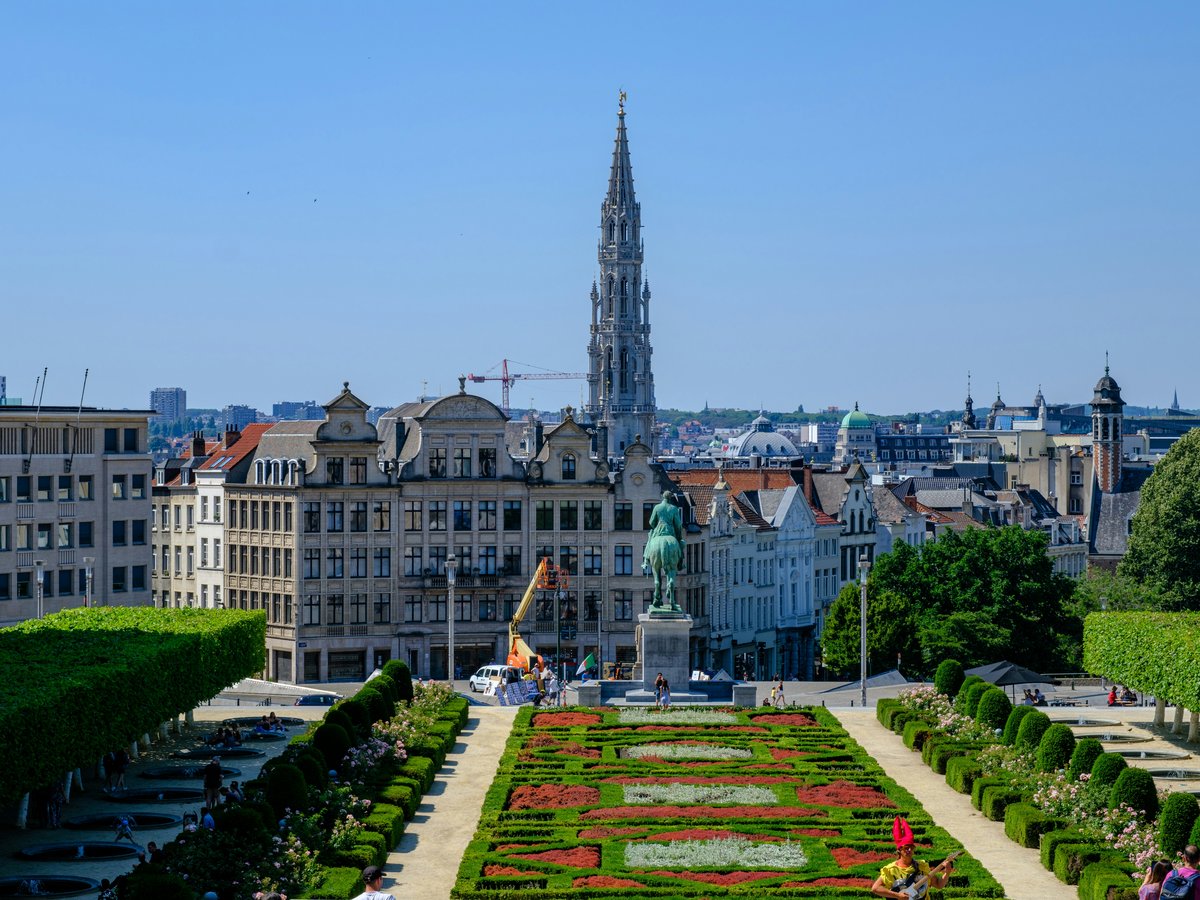
The view from Mont des Arts on a clear May morning catches the Grand Place spires in the first real warmth of the year. At 18.3°C the air holds still long enough that you stop shifting weight from foot to foot. That 18.3°C morning is the feeling the rest of this guide circles around.
For the budget traveller, January and February deliver the lowest pricing alongside the coldest temperatures in the Brussels year. January's 5.9°C high and 1.3°C low demand an indoor-focused trip, but museum passes and hotel rates reflect the low demand. February's 8.8°C high is marginally more livable. If you can tolerate the cold, these two months stretch a euro further than any other window in Brussels.
For the comfort-first traveller, the answer is September, not May. September averages 20.6°C highs and 12.4°C lows, warmer than May's 18.3°C highs and 9.3°C lows. The evening gap matters. May's 9.3°C low means you want a jacket by 20:00. September's 12.4°C lets you linger at an outdoor table on Place du Grand Sablon past sundown. Both months dodge the peak-season crowds, but September's warmer numbers give it the edge for anyone who prioritizes physical comfort above all else.
For the culture-focused traveller, early June is the pick. At 22.6°C highs and 13.2°C lows, the weather supports long walking days between the Musées Royaux, the Horta Museum in Saint-Gilles, and the Magritte Museum. The European institutions in the Quartier Européen are still in session, which adds energy to Brussels. Late May is the runner-up, 4.3°C cooler than June's 22.6°C on the highs but noticeably lighter on tourists.
For the food-focused traveller, October at 16.1°C offers a counterintuitive advantage. Outdoor dining at that temperature is limited to midday hours. But the cooler weather pushes Brussels dining culture indoors, which is where the city excels. The brasseries near Grand Place, the bistros around Place du Châtelain, the seafood restaurants at Place Sainte-Catherine. October's 9.8°C lows close the terraces and send you where the kitchens do their best work.
The single best week, forced to name one, is the last week of May. Highs near 18.3°C, lows near 9.3°C. June's 22.6°C is only 4.3°C warmer but comes with higher prices and longer queues at every site in Brussels.
The last week of May. Highs near 18.3°C, lows near 9.3°C. June is only 4.3°C warmer but comes with the queues.
Last verified by automated review (v1.7.0_onboard-brussels-flagship-2026-06-06) on . What is automated review?