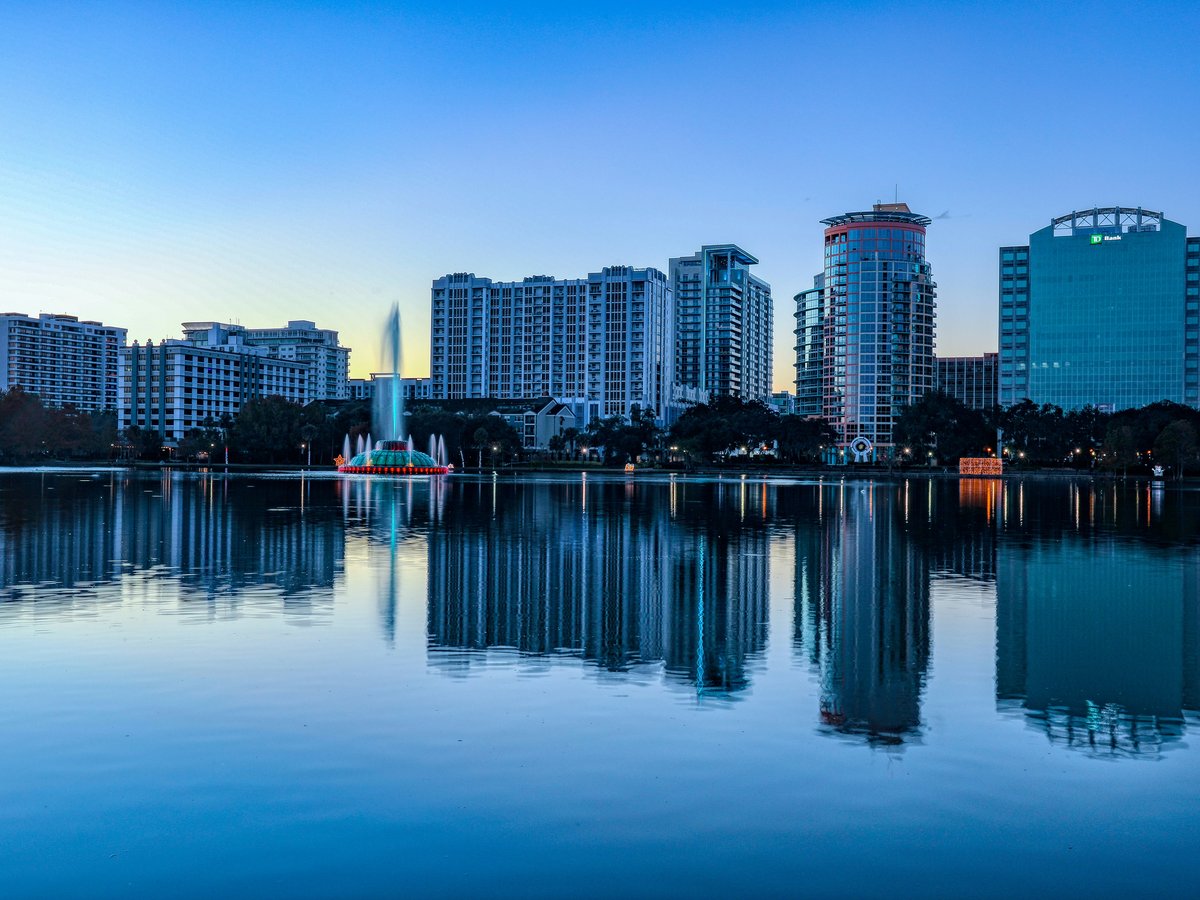
Orlando tends to confuse first-time visitors because the city most people picture, the International Drive tourist corridor, sits about 10 miles southwest of the actual city center. The real Orlando spreads outward from a compact downtown clustered around Orange Avenue and Lake Eola, with distinct neighborhoods fanning north, east, and south along a few key commercial streets. Mills Avenue runs north through the Vietnamese restaurant district. Edgewater Drive anchors the residential College Park area to the northwest. Park Avenue in Winter Park, technically its own municipality, sits about 4 miles north and feels like a different city entirely. The I-4 expressway cuts diagonally through everything, and most locals navigate by lakes and highway exits rather than compass directions. If you are deciding where to stay, the core question is whether you want to be near the theme parks or near the city that locals inhabit. Those are two very different Orlandos, separated by a 25-minute drive on a good day.
Neighborhoods
-
Downtown Orlando
Downtown still feels mid-transformation. Glass condo towers from the 2020s stand next to 1920s brick buildings along Orange Avenue. Lake Eola Park, a 43-acre green space with its iconic illuminated fountain, anchors the eastern edge. On weekday afternoons, the streets are quieter than you might expect for a metro of 2.6 million. That changes after 6 PM on weekends, when Wall Street Plaza and Church Street fill up.
- Best for
- Business travelers, concert and event goers, anyone who wants to walk to restaurants and bars without rideshare dependency
- Key streets
- Orange Avenue between Church Street and Central Boulevard is the main commercial spine. Wall Street Plaza (a short pedestrian block off Orange) has 5 or 6 bars packed side by side. Church Street east of I-4 still has some of the old Church Street Station architecture from the 1880s.
-
Thornton Park
Walk 5 minutes east of Lake Eola and the feeling shifts immediately. Thornton Park is brick streets, bungalows from the 1920s and 1930s, and a small commercial strip along Washington Street with about a dozen restaurants and shops. It is quiet. Not suburban quiet, but the kind of neighborhood where people walk their dogs at 9 PM past houses with screened-in porches and overgrown jasmine. The pace drops noticeably from downtown despite being a 7-minute walk away.
- Best for
- Couples and solo travelers who want walkable restaurants without the noise of a nightlife district
- Key streets
- Washington Street between Summerlin Avenue and Hyer Avenue holds most of the restaurants and cafes. Summerlin Avenue heading south passes some of the best-preserved bungalows in central Orlando.
-
Mills 50
The stretch of Mills Avenue from Colonial Drive north to Virginia Drive is Orlando's densest concentration of Vietnamese restaurants, likely 20 or more within a half-mile. The area earned the Mills 50 designation from the city's Main Street program around 2012. Strip malls with hand-painted signs sit next to newer murals and a few craft cocktail spots. The smell of pho broth and lemongrass drifts out of open kitchen vents at all hours. It is loud, a little rough around the edges, and arguably the best eating neighborhood in central Florida.
- Best for
- Food-focused travelers, budget-conscious visitors who want authentic restaurants at $8 to $15 per plate, people who prefer grit over polish
- Key streets
- Mills Avenue itself, especially the 4 blocks between Colonial Drive (State Road 50) and Virginia Drive. Colonial Drive heading east toward Bumby Avenue has more Vietnamese bakeries and grocery shops.
-
Winter Park
Winter Park incorporated as its own city in 1887 and still operates independently with its own police force and a population around 31,000. Park Avenue, the central commercial street, is lined with live oaks, independent boutiques, and restaurants with sidewalk seating. Rollins College, founded in 1885, sits at the south end and gives the area a leafy, college-town atmosphere. The architecture runs from 1920s Mediterranean Revival to mid-century modern homes along the chain of lakes. Summer mornings smell like cut grass and gardenias.
- Best for
- Families with older kids, couples who want walkable shopping and dining, anyone visiting the Charles Hosmer Morse Museum of American Art (which holds the world's largest collection of Tiffany glass)
- Key streets
- Park Avenue from Fairbanks Avenue north to Canton Avenue is the main draw, about 8 blocks of shops and restaurants. Hannibal Square, 3 blocks west, has a growing restaurant cluster and the Hannibal Square Heritage Center documenting Winter Park's Black history.
-
College Park
College Park sits northwest of downtown, separated by I-4. Edgewater Drive, the main commercial street, has an almost small-town feel with a hardware store, a few diners, and locally owned shops between Princeton Street and Par Street. The residential streets behind Edgewater are canopied by mature oaks, and the houses range from 1940s frame bungalows to larger mid-century ranch homes. It is the kind of neighborhood where people leave their garage doors open and wave from their driveways. Quiet. Almost eerily so for being 2 miles from downtown.
- Best for
- Families with young kids, visitors looking for a residential feel with a few good breakfast spots within walking distance
- Key streets
- Edgewater Drive from Princeton Street south to Par Street is the main stretch. Dartmouth Street and Harvard Street (yes, the streets have Ivy League names, the whole neighborhood does) are particularly tree-covered residential blocks.
-
Audubon Park Garden District
Corrine Drive between Bumby Avenue and Bennett Road anchors this east-side neighborhood. East End Market, a food hall in a converted warehouse, opened in 2013 and became the anchor for a stretch of small restaurants, a record shop, and a plant nursery. The neighborhood itself is residential and flat, with mid-century homes and lots of mature landscaping. Saturday mornings, the Audubon Park Community Market sets up in Stardust Video and Coffee's parking lot. The whole area has a crunchy, co-op energy without being performative about it.
- Best for
- Travelers who want to eat well and browse independent shops, anyone who gravitates toward farmers market culture and local food producers
- Key streets
- Corrine Drive from Bumby Avenue east to Bennett Road. East End Market sits at 3201 Corrine Drive. The residential streets south of Corrine, especially those bordering the Audubon Park itself, are good for afternoon walks.
-
International Drive
I-Drive is the Orlando most tourists picture. It runs roughly 11 miles from the Orange County Convention Center north to the attractions near Universal Boulevard. The road is wide, loud, and lined with hotels, chain restaurants, souvenir shops, and attractions like the 400-foot ICON Park observation wheel. Sidewalks exist but walking feels hostile in the summer heat. The I-Drive Trolley runs the length of the corridor for $0.25. The area is functional rather than beautiful, designed entirely around moving visitors between hotels and parks.
- Best for
- Theme park visitors who want maximum proximity to Universal Orlando and SeaWorld, convention attendees, families prioritizing park access over neighborhood character
- Key streets
- International Drive itself, especially the stretch between Sand Lake Road (where the better chain restaurants cluster) and Universal Boulevard. Sand Lake Road heading west, locally called Restaurant Row, has around 50 restaurants including a concentration of Asian dining.
-
Ivanhoe Village
Ivanhoe Village occupies a short stretch of Orange Avenue as it curves north from downtown along the shore of Lake Ivanhoe. It is maybe 6 blocks long. Antique shops that have been there for 20 years sit next to newer wine bars and a brewery. The buildings are low, mostly 1 or 2 stories, and the area has a slightly forgotten quality that works in its favor. Lake Ivanhoe itself has a paved walking path, and you can see the downtown skyline from the north shore. The neighborhood is small enough that you can cover it on foot in 45 minutes.
- Best for
- Antique hunters, craft beer drinkers, visitors who want an easy walk between downtown and a quieter lakeside area
- Key streets
- Orange Avenue between Princeton Street and Virginia Drive. The antique shops cluster on the east side of Orange. Virginia Drive east toward Mills Avenue connects Ivanhoe Village to Mills 50, making a good afternoon walking route of about 1.5 miles.
-
Lake Nona
Lake Nona is Orlando's newest major development, a planned community about 20 minutes southeast of downtown near Orlando International Airport. The Tavistock Development Company has been building it since the mid-2000s. Lake Nona Town Center opened around 2019 with restaurants, a performance lawn, and a Boxi Park made of shipping containers. The area feels clean, manicured, and intentionally designed. The Lake Nona Medical City campus houses the VA Medical Center, a UCF medical school, and several research facilities. It is suburban in character but walkable within the town center.
- Best for
- Visitors with business at Medical City or the airport, families who prefer new construction hotels and planned retail over older urban neighborhoods
- Key streets
- Tavistock Lakes Boulevard is the main artery. Lake Nona Town Center sits near the intersection of Nemours Parkway and Laureate Boulevard. Boxi Park at 6877 Tavistock Lakes Boulevard has around 10 food vendors in repurposed containers.
FAQ
Where should I stay in Orlando if I want to avoid the tourist areas?
Downtown Orlando, Thornton Park, or Winter Park will all feel distinctly different from the International Drive corridor. Downtown puts you within walking distance of Lake Eola, restaurants on Orange Avenue, and the Amway Center for events. Winter Park is the most polished option, with Park Avenue shopping and the Morse Museum. Thornton Park is the quietest of the three and works well for couples. All are 20 to 35 minutes from the major theme parks by car, depending on I-4 traffic.
Is it possible to get around Orlando without a car?
Within individual neighborhoods, yes. Downtown, Thornton Park, Winter Park's Park Avenue, and Mills 50 are all walkable on their own. The SunRail commuter train connects downtown Orlando to Winter Park in about 15 minutes for $3.75 round trip, which is useful. But getting between the theme parks, the airport, and central Orlando without a car is slow and transfer-heavy on the LYNX bus system. The I-Drive Trolley covers that corridor for $0.25. Rideshares from downtown to Universal run about $12 to $18. Most visitors still end up renting a car.
Which Orlando neighborhood has the best food scene?
Mills 50 likely has the highest concentration of interesting, affordable food in central Florida. The Vietnamese restaurants along Mills Avenue between Colonial Drive and Virginia Drive include places that have been operating for 20 to 30 years. For a broader range, Sand Lake Road west of I-4, known locally as Restaurant Row, has around 50 restaurants spanning Korean, Japanese, Thai, Indian, and Brazilian cuisines. Winter Park's Park Avenue leans more upscale. Audubon Park's East End Market is small but well curated with 6 to 8 vendors.
How far are the theme parks from downtown Orlando?
Walt Disney World's Magic Kingdom is about 22 miles southwest of downtown, roughly 30 to 45 minutes depending on I-4 conditions. Universal Orlando Resort is closer at about 10 miles, typically 15 to 25 minutes. SeaWorld sits between the two at around 12 miles. I-4 traffic is notoriously unpredictable. A 20-minute drive at 10 AM can become 55 minutes at 5 PM. If you are splitting time between parks and the city, staying near Universal or on I-Drive splits the difference geographically.
What is the weather like in Orlando and when should I visit?
Orlando averages 233 sunny days per year and summer highs regularly reach 92 to 95 degrees Fahrenheit with humidity above 70 percent. From June through September, expect a near-daily afternoon thunderstorm, usually between 3 and 5 PM, that drops heavy rain for 30 to 45 minutes before clearing. October through April is drier and cooler, with highs in the 70s and low 80s. January lows can dip into the low 40s, which catches visitors off guard. Late September through mid-November tends to be the sweet spot for fewer crowds and tolerable heat.
Is Winter Park part of Orlando or a separate city?
Winter Park is an independent municipality with its own city government, police department, and fire services. It incorporated in 1887 and has a population of about 31,000. It borders Orlando's northeast side, and the line between the two is invisible if you are driving. Locals typically refer to Winter Park as its own place, not a neighborhood of Orlando. The SunRail train connects Winter Park station to downtown Orlando in about 15 minutes, and the two downtowns are roughly 4 miles apart by road.
Last verified by automated review (v1.7.2) on . What is automated review?