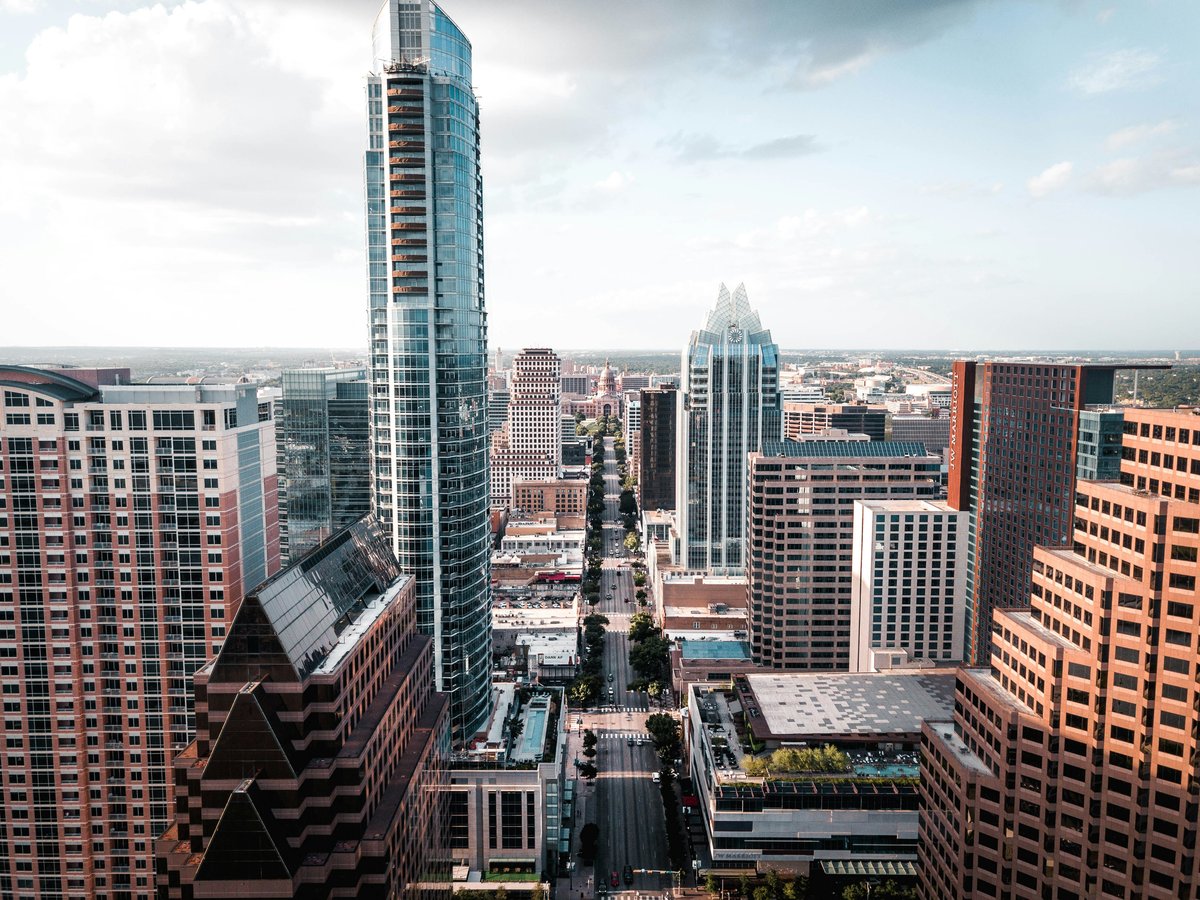
Austin spreads out along the Colorado River (locals call the dammed section Lady Bird Lake) in a loose north-south sprawl that fights against the limestone hills to the west and the blackland prairie to the east. Interstate 35 still functions as the city's informal dividing line. West of it, you'll find the older money neighborhoods, the university, and the hill country terrain. East of it, the historically Black and Latino neighborhoods that have been reshaping themselves since the early 2010s tech boom pushed rents past $1,800 for a one-bedroom. Downtown sits in a compact grid between the river and the Capitol building on Congress Avenue, maybe 15 blocks north to south. The city has grown to roughly 1.1 million people, but the core neighborhoods where visitors spend most of their time still fit inside a surprisingly tight radius of about 5 miles from the Congress Avenue Bridge. Public transit exists on paper. Capital Metro's bus system and the one MetroRail line running north to Leander cover some ground, but you'll likely need a car or heavy rideshare use outside downtown. The scooters help for short hops, and the Ann and Roy Butler Hike-and-Bike Trail along Lady Bird Lake connects several neighborhoods on foot if you don't mind the heat from May through October.
Neighborhoods
-
Downtown / Congress Avenue
The Capitol dome anchors the north end of Congress Avenue, and from there the street runs south about 12 blocks to the bridge. This is where the hotels cluster, where Sixth Street crosses through, and where most first-time visitors orient themselves. The architecture is a strange mix of 1880s limestone storefronts (the Driskill Hotel at 604 Brazos dates to 1886) and glass condo towers that went up after 2015. During the day, the pace is office-worker brisk. At night, especially Thursday through Saturday, the Dirty Sixth block between Congress and I-35 turns into a wall of sound from competing bar speakers. West Sixth, closer to Lamar Boulevard, tends to pull an older, slightly less rowdy crowd.
- Best for
- First-time visitors who want walkable access to live music, restaurants, and the Sixth Street scene without needing a car
- Key streets
- Congress Avenue from the Capitol south to the bridge, East 6th Street (Dirty Sixth) between Congress and I-35, West 6th Street between Congress and Lamar, Rainey Street south of Cesar Chavez
-
South Congress (SoCo)
South Congress runs from the bridge south toward Ben White Boulevard, roughly a mile and a half of sidewalk retail, food trailers, and low-slung mid-century buildings. The strip still has some of its pre-2010 weirdness. Uncommon Objects at 1512 South Congress has been selling taxidermy and vintage signage since 1991. But the rents have pushed out a lot of the independent shops, and you'll now find more curated boutiques selling $90 candles alongside the remaining holdouts. The Hotel San José at 1316 South Congress set the tone for the area's aesthetic in 2000. Foot traffic is heavy on weekends, especially between noon and 4 PM.
- Best for
- Couples and solo travelers who want to walk between restaurants, vintage shops, and people-watching without the bar-crawl intensity of Sixth Street
- Key streets
- South Congress Avenue from the bridge to Oltorf Street, the side streets around Elizabeth Street and Monroe Street for quieter residential blocks, the stretch near the Continental Club at 1315 South Congress
-
East Austin / East Cesar Chavez
East of I-35, the grid flattens out and the lots get wider. This was historically Austin's Black and Mexican-American core, centered around East 11th and East 12th streets. The Tejano murals on the side of buildings along East Cesar Chavez Street still mark the older cultural layer. Gentrification here has been fast and visible since about 2012. Former auto shops now house natural wine bars, and a 1940s bungalow next to a $750,000 modern infill build is a common sight. The food trailer parks on East Cesar Chavez and along East 6th near Comal Street remain some of the best cheap eating in Austin. Taqueria prices start around $2.50 a taco.
- Best for
- Travelers in their 20s and 30s looking for the restaurant and bar scene that locals frequent, especially the stretch along East 6th from I-35 to about Chicon Street
- Key streets
- East Cesar Chavez from I-35 east to Pleasant Valley Road, East 6th Street east of I-35 (sometimes called East Sixth to distinguish it from Dirty Sixth), East 11th and East 12th streets near the Rosewood neighborhood
-
South Lamar / Zilker
South Lamar Boulevard runs parallel to South Congress about a mile west, from Lady Bird Lake down to Ben White. The corridor sits between Zilker Park (the 350-acre green space that hosts Austin City Limits Festival each October) and the Barton Creek Greenbelt. The neighborhood has a more residential, family-oriented feel than SoCo, with older ranch-style homes from the 1950s and 1960s mixed with newer townhome developments. The Alamo Drafthouse South Lamar at 1120 South Lamar was one of the original locations. Restaurants along here tend toward the mid-range. $15-25 entrees are common.
- Best for
- Families and outdoors-oriented visitors who want proximity to Barton Springs Pool (the spring-fed pool stays at 68 degrees year-round), Zilker Park, and the Greenbelt hiking trails
- Key streets
- South Lamar Boulevard from Barton Springs Road south to Oltorf, Barton Springs Road from Lamar east toward the pool entrance, the Barton Creek Greenbelt trailheads off of Spyglass Drive and Loop 360
-
North Loop / Hyde Park
North of the UT campus, Hyde Park is Austin's first suburb, platted in 1891. The houses along Avenue G and Avenue H are mostly Queen Anne and Craftsman styles from the early 1900s, many with deep front porches. North Loop Boulevard, about a mile further north near 53rd Street, has a tight two-block commercial strip with used record shops (Breakaway Records), vintage clothing stores, and the kind of coffee shops where people still sit for 3 hours with a laptop. The pace is notably slower than downtown. You might hear a rooster. The neighborhood has largely resisted the high-rise development that hit downtown and East Austin.
- Best for
- Budget-conscious travelers and anyone who prefers a quiet, residential neighborhood with local shops over nightlife. Hyde Park also suits UT visitors since campus is a 10-minute bike ride south.
- Key streets
- North Loop Boulevard between Avenue F and Duval Street, Guadalupe Street (the Drag) along the west edge of UT campus, Avenue B and the Shipe Park area in central Hyde Park
-
Clarksville / Old West Austin
Clarksville occupies a few hilly blocks west of Lamar between 5th and 15th streets. It was founded by freed slaves in the 1870s, and a handful of the original wood-frame houses still stand along West 10th and West 11th streets. The neighborhood is now one of Austin's most expensive, with home prices regularly clearing $1.5 million. It feels like a pocket from another era. The streets are narrow and canopied by live oaks. Jeffrey's at 1204 West Lynn has been doing fine dining here since 1975, and Josephine House at 1601 Waterston Avenue does a popular weekend brunch (book 3 days ahead). The neighborhood is walking distance to downtown but somehow quiet enough to hear cicadas in summer.
- Best for
- Visitors willing to pay more for a central, walkable, and calm base with excellent restaurants. It's particularly good for anyone who wants to be near both downtown and the Lamar corridor without being in the middle of either.
- Key streets
- West Lynn Street from 5th to 15th, Waterston Avenue near the Josephine House cluster, the block around Nau's Enfield Drug at 1115 West Lynn (operating since 1951)
-
Mueller
Mueller is Austin's large planned community built on the old Robert Mueller Municipal Airport site, about 4 miles northeast of downtown. The development started in the late 2000s and it feels intentionally designed in a way that parts of Austin don't. Wide sidewalks, a central lawn area called the Mueller Lake Park, and a mix of townhomes, single-family houses, and apartment complexes. The old air traffic control tower still stands at the Thinkery children's museum. The Sunday farmers market at the Browning Hangar (a converted airport hangar) runs year-round and draws big crowds. It feels more like a small-town main street than anywhere else in Austin.
- Best for
- Families with young children who want a self-contained neighborhood with playgrounds, the Thinkery museum, wide sidewalks, and easy access to grocery stores (the H-E-B at Mueller opened in 2019)
- Key streets
- Aldrich Street (the main retail strip), Mueller Boulevard around the lake park, Simond Avenue near the Browning Hangar farmers market
-
The Domain / North Austin
The Domain sits about 10 miles north of downtown near the intersection of MoPac (Loop 1) and Braker Lane. It opened in 2007 and it's essentially an outdoor shopping center that grew into a mixed-use district with apartments, offices, and hotels. Apple, Meta, and Google all have offices within a few miles. The architecture is new-build corporate. Rock Rose, the pedestrian street running through the newer Domain Northside section, has restaurants, bars, and a weekend crowd that's distinctly different from the downtown scene. Younger tech workers, mostly. Hotel prices here run 20-30% lower than downtown equivalents.
- Best for
- Business travelers headed to the north Austin tech corridor, budget-conscious visitors who don't mind being far from downtown, and anyone who prefers chain restaurants and predictable retail to the older core neighborhoods
- Key streets
- Rock Rose Avenue in Domain Northside, the main Domain Drive loop past the retail anchors, Burnet Road south of the Domain for a more local-feeling strip of restaurants and shops between 45th and Koenig Lane
FAQ
What is the best neighborhood in Austin for first-time visitors?
Downtown or South Congress tend to work best for a first visit. Downtown puts you within walking distance of Sixth Street, the Capitol, and the Congress Avenue Bridge bat colony (roughly 1.5 million Mexican free-tailed bats fly out at sunset from March through October). South Congress offers a more relaxed pace with better daytime activities. Both are manageable without a car, though you'll still want rideshare for anything past a 15-minute walk, especially in summer when temperatures sit above 100 degrees Fahrenheit for weeks at a time.
Is it worth staying in East Austin instead of downtown?
East Austin currently has the more interesting food and bar scene for locals, particularly along East 6th Street east of I-35 and the East Cesar Chavez corridor. Hotel options are limited compared to downtown, but several boutique spots have opened since 2018, including the East Austin Hotel at 1108 East 6th Street. The tradeoff is that you're a $10-15 rideshare from West Austin attractions like Zilker Park and Barton Springs, and walking to downtown means crossing under I-35, which is loud and not particularly pleasant. If restaurants and nightlife matter more to you than proximity to parks and the river, East Austin is the better pick.
How walkable is Austin compared to other major US cities?
Austin is less walkable than cities like New York, Chicago, or San Francisco. Within individual neighborhoods like downtown, SoCo, or East Cesar Chavez, you can cover the main sights on foot in reasonable comfort (except during peak summer heat). But getting between neighborhoods almost always requires a car, rideshare, or scooter. The Butler Hike-and-Bike Trail connects several areas along the river, and the Red Line MetroRail runs from downtown north to Leander, but the bus system has gaps. Most visitors rent a car or budget $30-50 per day for rideshare.
Which Austin neighborhoods have the best food scenes?
East Austin and the South Lamar corridor currently have the densest concentration of interesting restaurants. East Austin leans toward tacos, barbecue, and newer chef-driven spots. Franklin Barbecue at 900 East 11th Street still draws a 2-3 hour line starting around 8 AM (they open at 11 and usually sell out by 1 PM). For a less painful barbecue experience, la Barbecue at 2401 East Cesar Chavez typically has a shorter wait. The Burnet Road corridor in north-central Austin has been building quietly, with a good mix of ramen, Thai, and Mexican spots between 45th Street and Koenig Lane. South Congress has strong options but tends to be pricier, with entrees averaging $22-35 at the sit-down restaurants.
When is the best time of year to visit Austin?
March and October are the two sweet spots. March brings South by Southwest (SXSW runs for about 10 days in mid-March) and wildflower season, with bluebonnets peaking along the highways outside the city. Temperatures sit around 70-80 degrees. October has Austin City Limits Festival across two weekends in Zilker Park and similar weather. June through August is genuinely brutal. Highs regularly hit 105 degrees Fahrenheit, and 2023 saw over 45 consecutive days above 100. The shoulder months of April, May, November, and early December offer lower hotel rates and comfortable temperatures in the 65-85 range.
Is the Sixth Street bar scene worth visiting or is it overrated?
Dirty Sixth (the block between Congress and I-35) is loud, crowded, and heavily geared toward college-age drinkers. Most locals avoid it after their mid-20s. That said, a few spots hold up. The Elephant Room at 315 Congress Avenue is a basement jazz club that's been open since 1991, and it still books solid acts 6 nights a week with a $5-10 cover. East Sixth, the stretch east of I-35, is where locals in their late 20s and 30s tend to go. Whisler's at 1816 East 6th has a mezcal bar upstairs and a Thai food trailer in the back garden. West Sixth between Congress and Lamar pulls a slightly more polished crowd. Worth walking through on a Friday night at minimum, even if you don't stay long.
Last verified by automated review (v1.7.2) on . What is automated review?