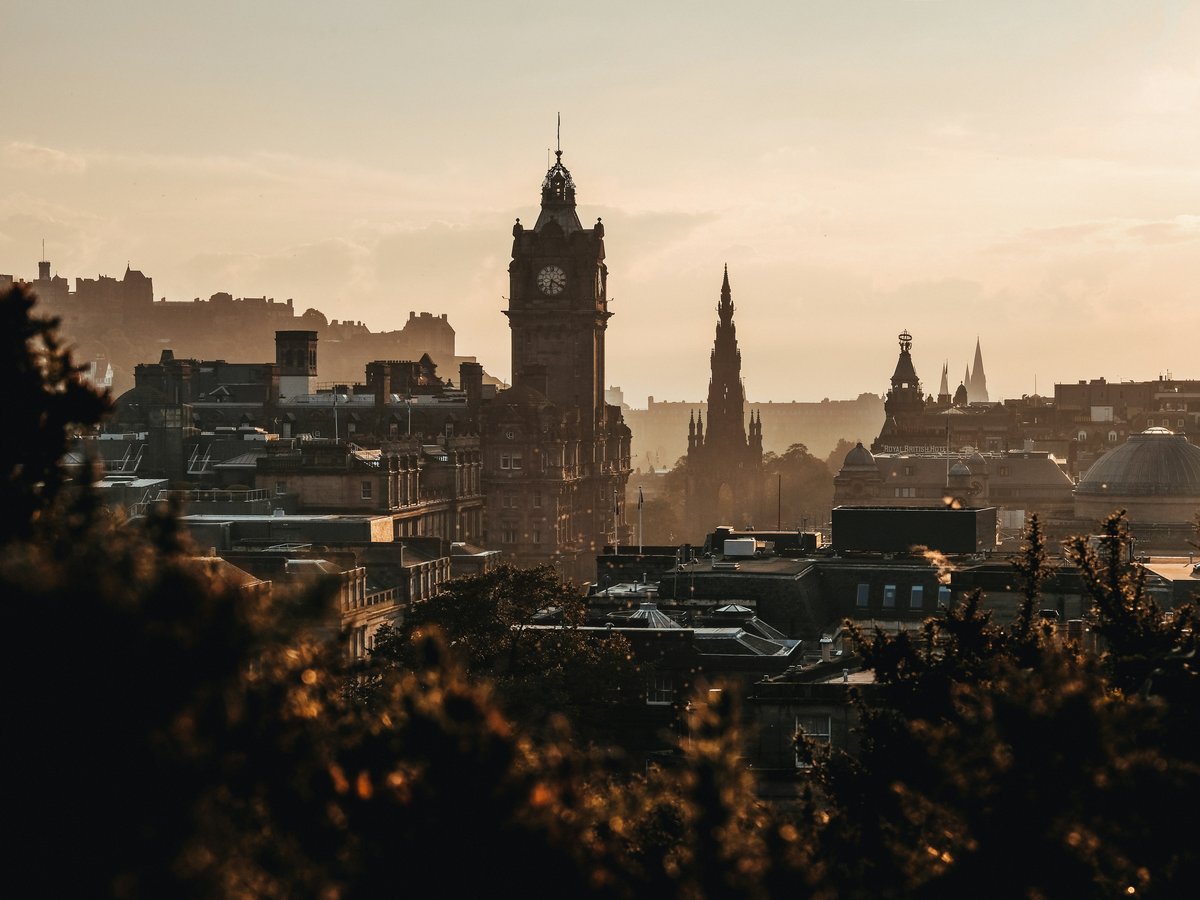
Stay in Edinburgh in September
48 hotels in the Trip.com pool for Edinburgh, from US$22 a night.
Opens Trip.com on Fri 25 Sep to Sun 27 Sep 2026; change the dates there.
September in Edinburgh is the morning after the party. The Festival Fringe wraps up in late August, and within days the city sheds something like a million extra visitors. Streets along the Royal Mile that were shoulder-to-shoulder suddenly have space to walk at a normal pace. The temporary stages come down, the flyer-pushers vanish, and Edinburgh settles back into something closer to its actual self.
Weather-wise, you're looking at average highs around 16.5°C (62°F) and lows near 10.5°C (51°F): still perfectly walkable, though the wind off the Firth of Forth has a way of making it feel colder than the numbers suggest. You'll likely see rain on about 13 days across the month, but these tend to be brief showers rather than the day-long grey soaks that October and November bring. Daylight is shrinking noticeably (you lose roughly two hours of it from the start to the end of September) but there's still enough to fill long days on foot.
The real argument for September is the combination: reasonable weather, prices that drop sharply after August's gouging, and a city that feels lived-in rather than overrun. Early autumn creeps into the parks toward month's end, with the Royal Botanic Garden and Holyrood Park showing the first copper and gold in the canopy. If you want Edinburgh without the festival chaos, this is probably your last comfortable window before winter starts closing in.
Why visit in September
- Hotel rates drop significantly from August's festival peak: the same rooms that were booked out months in advance during the Fringe become widely available at much lower rates, with good options opening up across Stockbridge, New Town, and Leith
- The city's cultural infrastructure (National Museum of Scotland, Scottish National Gallery, Edinburgh Castle) is still fully open but without August queue times: what took 45 minutes to enter in August might take 10 in September
- Comfortable walking weather for Arthur's Seat, Calton Hill, and the Water of Leith: warm enough during the day but without the sweat of southern European summers
- Early autumn foliage starts appearing in the Royal Botanic Garden and along the Meadows by mid-to-late September, and the low-angle light makes the sandstone architecture glow in a way it simply doesn't in summer
- Seasonal Scottish produce peaks: wild brambles in hedgerows, chanterelle mushrooms on restaurant menus, grouse and venison appearing in gastropubs across Leith and Bruntsfield
Worth knowing
- Rain is a near-certainty: 86mm across roughly 13 days means you will get wet at some point, and Edinburgh's hilltop exposure means rain often arrives sideways with wind
- The Festival Fringe is over, which means the electric, chaotic energy of August is completely gone: if that's what you came for, you've missed it by a week or two
- Daylight contracts from around 14 hours at the start of September to under 12 by month's end: late afternoon golden hour shifts noticeably earlier each week, and evenings feel properly autumnal
- Some seasonal outdoor attractions and tour operators scale back to winter schedules after the first week, so boat trips to Inchcolm Island and certain Highlands day tours may run less frequently
Best for
Think twice if
September marks the shift from Scottish summer into autumn. Days typically start cool: around 10.5°C (51°F), and climb to roughly 16.5°C (62°F) by early afternoon, though overcast days might not make it past 14°C. Humidity sits around 80%, which you feel less as muggy heat and more as a persistent dampness in the air, the kind that makes wool smell like wool. Rainfall averages 86mm across about 13 days, usually arriving as showers rather than all-day downpours, though the odd multi-day grey spell happens. Wind is the overlooked factor: Edinburgh's exposed position means even a mild day can feel sharp if you're standing on Arthur's Seat or crossing the Forth bridges.
Year-round climate
Averages from the last 5 years.
| Month | Avg high (°C) | Avg low (°C) | Rainfall (mm) |
|---|---|---|---|
| Jan | 6 | 2 | 74 |
| Feb | 8 | 3 | 74 |
| Mar | 10 | 4 | 69 |
| Apr | 11 | 4 | 60 |
| May | 15 | 8 | 91 |
| Jun | 18 | 11 | 58 |
| Jul | 19 | 13 | 91 |
| Aug | 19 | 12 | 70 |
| Sep | 17 | 11 | 86 |
| Oct | 13 | 9 | 123 |
| Nov | 10 | 5 | 89 |
| Dec | 8 | 4 | 108 |
Best things to do in September
Climb Arthur's Seat in early autumn light
outdoorThe 251-metre volcanic peak right in the city centre offers panoramic views across Edinburgh, the Firth of Forth, and out toward the Pentland Hills. September's lower sun angle creates long shadows across the crags and turns the gorse a deeper gold. The climb takes about 45 minutes from Holyrood and the paths are well-trodden, though the final scramble gets slippery after rain.
September temperatures around 14–17°C are close to ideal for the climb: warm enough to be comfortable, cool enough that you're not overheating on the steep sections. August crowds have thinned noticeably.Booking tipNo booking needed. Go early morning for the best light and fewest people: by mid-morning on weekends it gets busy even in September.
Walk the Water of Leith from Balerno to Leith
outdoorThis 20-kilometre riverside path runs from the Pentland Hills foothills right down to the docks at Leith, passing through Dean Village, Stockbridge, and past the Royal Botanic Garden. The path follows the river through wooded gorges where you can hear the water rushing below, and September brings the first hints of yellow and orange to the tree canopy overhead.
Early autumn colour along the tree-lined path, comfortable walking temperatures, and noticeably fewer people than summer months. The light filtering through the turning leaves is particularly good through Dean Village.Booking tipFree and open access. The full walk takes around five hours: most people pick a section. Stockbridge to the Botanic Garden is a good shorter option.
Explore the Scottish National Gallery
cultureThe gallery on the Mound houses Scotland's national collection of fine art, from Renaissance altarpieces to Impressionist landscapes. The building itself (a neoclassical sandstone temple) catches the September light on its columns in a way that's worth pausing for before you even go inside. The collection includes Raeburn, Ramsay, and a strong holding of French paintings.
Post-festival calm means you can stand in front of a painting without someone's backpack in your peripheral vision. The gallery runs a programme of autumn exhibitions that typically launches in September.Booking tipFree entry to the permanent collection. Check their website for any ticketed special exhibitions.
Sunday morning at Stockbridge Market
foodThis weekly market fills the cobbled lane of Saunders Street in Stockbridge with stalls selling Scottish cheeses, sourdough, fresh oysters, venison burgers, and seasonal produce. The smell of woodsmoke and coffee hangs in the cool air. September brings the first of the autumn produce (brambles, chanterelles, root vegetables) and the atmosphere shifts from summer bustle to something more unhurried.
September is when the autumn produce arrives (wild mushrooms, game, brambles) and the market reflects the seasonal shift. Cooler weather makes the hot food stalls particularly appealing.Booking tipNo booking. Open Sundays roughly 10am to 5pm. Arrive before 11am for the best selection and a less crowded browse.
Visit Edinburgh Castle in post-festival quiet
cultureThe castle perched on its volcanic plug dominates the city skyline, and the interior holds the Scottish Crown Jewels, the Stone of Destiny, and the medieval Great Hall with its original hammerbeam roof. The views from the ramparts take in the entire city spread out below, from the New Town grid to the Firth of Forth beyond.
Queue times drop substantially after August. The Edinburgh Military Tattoo grandstands on the esplanade come down in early September, restoring the approach to the castle to its normal state. Autumn light on the volcanic rock face is worth seeing.Booking tipBook tickets online in advance: you'll still save time at the gate even in September.
Wander the Royal Botanic Garden
outdoorSeventy acres of landscaped gardens and glasshouses on the north side of the city, with views back toward the castle and Arthur's Seat. The Victorian Palm House is warm and humid inside: a welcome contrast on a cool September day. Outside, the rock garden, the Chinese Hillside, and the arboretum are where the earliest autumn colour tends to appear.
Mid-to-late September brings the first real autumn colour to the garden: copper beeches, acers turning red, and the low sunlight catching the late-flowering borders. It's one of the best free autumn walks in the city.Booking tipFree entry to the gardens. The glasshouses have a small entry fee. Open daily from 10am.
Explore Leith's food and drink scene
foodEdinburgh's port district has quietly become the city's most interesting eating neighbourhood. The old warehouses and dock buildings along The Shore now hold a concentration of seafood restaurants, wine bars, and independent cafes. The smell of salt air mixes with coffee and baking bread along Commercial Street. It's a working neighbourhood that happens to have very good food.
September is when restaurants settle into autumn menus (game, mushrooms, root vegetables) after the frantic festival service period. Chefs have more time and better produce. The post-Fringe calm means you can get a table without booking weeks ahead.Booking tipReservations still recommended for dinner, especially Friday and Saturday. Lunch is generally easier to walk into.
Hike the Pentland Hills
outdoorThis range of rolling hills starts just six miles south of the city centre and feels like proper Scottish countryside: heather-covered ridges, reservoirs tucked into valleys, and views that stretch to the Highlands on clear days. The air smells of peat and wet grass. Routes range from easy reservoir loops to full ridge walks covering 15 kilometres or more.
September temperatures are comfortable for sustained walking without overheating. The heather is still in its late purple bloom through early September, and the hills are notably quieter once the summer visitors leave.Booking tipFree access. Lothian buses run to Flotterstone and Balerno, both good starting points. Check weather forecasts: conditions change fast on exposed ridges.
What to eat in September
In season: fruit
Scottish brambles
Wild blackberries reach their peak along hedgerows and parkland edges throughout September: you'll spot locals picking them in Holyrood Park and along the Water of Leith. They show up in crumbles, jams, and cocktails across the city. The flavour is tarter and more complex than cultivated blackberries. Worth seeking out at Stockbridge Market too.
On menus now
Grouse
The shooting season opened on the Glorious Twelfth of August, and by September Scottish grouse appears regularly on gastropub and restaurant menus. Rich, dark, distinctly gamey: often roasted simply and served with bread sauce and game chips. Places in Leith and Stockbridge tend to handle it with more care than the tourist-facing spots on the Royal Mile.
Cullen skink
This thick, creamy soup of smoked haddock, potato, and onion is a Scottish staple that feels particularly right as evenings turn cooler. The smoky warmth of good Cullen skink (the kind where you can taste the fish stock underneath) is September comfort food. Most traditional pubs and seafood restaurants serve their own version.
Scottish venison
The red deer stalking season is well underway by September, and fresh Scottish venison starts appearing across Edinburgh's better kitchens. Leaner and more mineral-tasting than farmed deer, it's typically served as loin or in slow-cooked stews. The flavour has a wildness to it that pairs well with bramble-based sauces: a very September combination.
In markets
Wild chanterelle mushrooms
Foraged from Scottish woodlands, golden chanterelles appear on Edinburgh restaurant menus through September. They have an apricot-like aroma and a texture somewhere between firm and silky. Look for them at Stockbridge Market on Sundays or in dishes at restaurants sourcing from Highland foragers.
Regular events in September
Doors Open DaysFree
Edinburgh's contribution to European Heritage Days: hundreds of buildings that are normally closed to the public open their doors for free over a weekend in late September. Banks, private houses, government buildings, churches, and industrial sites all participate. It's a chance to see interiors you'd never otherwise access, from Georgian drawing rooms to Victorian engine halls.
Last weekend of SeptemberScottish International Storytelling Festival
Running from late September into October, this festival fills the Scottish Storytelling Centre on the Royal Mile and venues across the Old Town with live storytelling performances, workshops, and ceilidhs. The emphasis is on oral tradition (Scottish, Gaelic, and international) performed in intimate settings where you're close enough to see every expression on the teller's face.
Late September into OctoberEdinburgh MelaFree
Scotland's biggest multicultural festival, typically held in Leith Links in early-to-mid September. Music, dance, and food from South Asian, African, and Caribbean communities, with a programme that mixes established performers with local acts. The food stalls alone are worth the trip: the smell of spices carries across the park.
Early to mid-SeptemberStockbridge Market autumn seasonFree
The weekly Sunday market shifts into autumn mode through September, with stalls increasingly featuring game, wild mushrooms, root vegetables, and warming street food. It's a neighbourhood fixture that reflects Edinburgh's seasonal food calendar in real time.
Every SundayBest places this September
Arthur's Seat and Holyrood Park
outdoorThe volcanic peak and surrounding parkland offer the most dramatic landscape within any British city. September's lower crowds and comfortable temperatures make it one of the best months for the climb. The views from the summit take in the entire city, the Firth of Forth, and on clear days the Highlands to the north.
HolyroodRoyal Botanic Garden Edinburgh
parkSeventy acres of world-class botanical collections with some of the city's best early autumn colour. The Victorian glasshouses provide warm refuge on cool days, and the view back toward the castle from the north end of the garden is one of Edinburgh's quiet treasures.
InverleithDean Village and the Water of Leith
neighborhoodThis former milling village sits in a gorge of the Water of Leith just minutes from the West End, and feels like stepping out of the city entirely. Stone buildings, a rushing river, and a wooded path that connects to Stockbridge. September light filtering through the canopy above the river is particularly good in the late afternoon.
Dean VillageCalton Hill
viewpointA shorter, easier climb than Arthur's Seat but with arguably the more photogenic view: the full sweep of Princes Street, the castle on its rock, and the Firth of Forth beyond. The collection of monuments at the summit (the unfinished National Monument, the Nelson Monument, the old observatory) catches the warm September evening light.
CaltonThe Shore, Leith
neighborhoodThe old harbour area where the Water of Leith meets the Firth of Forth. Converted warehouses now hold restaurants, pubs, and galleries, but it still feels like a working waterfront neighbourhood rather than a tourist zone. The salt air and cry of gulls remind you this is a port city.
LeithScottish National Museum
museumThe museum on Chambers Street covers everything from natural history to Scottish innovation, and the grand Victorian hall at its centre is one of Edinburgh's finest interior spaces. Free entry and genuinely engaging for adults: the science and technology floors are particularly well done. September means school groups return but tourist crowds thin.
Old TownGreyfriars Kirkyard
historicOne of Edinburgh's oldest burial grounds, tucked behind the National Museum. The weathered tombstones date back centuries and the atmosphere (especially on a misty September morning when the damp stone smells of lichen) is genuinely atmospheric without needing any ghost-tour embellishment. The kirkyard also offers an unexpected view of the castle.
Old TownCramond
coastalA coastal village on Edinburgh's western fringe where the River Almond meets the Forth. At low tide you can walk the concrete causeway out to Cramond Island: check tide times carefully, people do get stranded. The beach, the old Roman fort site, and the walk along the riverbank through the wooded gorge make it a full half-day trip.
Cramond
Your packing checklist
Tick items off as you pack. Your progress saves in this browser.
All packed — have a great trip.
Insider tips
The first week of September still carries a faint festival hangover: a few Fringe venues are still dismantling, some late-run shows might be on, and certain restaurants are still running their August service style. By the second week the city has fully exhaled.
Edinburgh's Old Town closes (the narrow alleyways running off the Royal Mile) are worth exploring deliberately rather than just passing through. Many have their own character, unexpected views, and the acoustics change as you step into them. Advocates Close and Dunbar's Close Garden are particularly good.
The 26 bus runs from the airport to the city centre and takes about the same time as the tram for a fraction of the cost. It drops you on Princes Street right in the middle of things.
If you're walking Arthur's Seat, approach from the Dunsapie Loch side rather than the Holyrood end: it's a gentler gradient and the views open up more gradually. The path from the east is also less crowded.
Stockbridge on a Sunday is arguably the best neighbourhood experience in Edinburgh: market in the morning, brunch at one of the cafes on Raeburn Place, then a walk along the Water of Leith. It feels like a village that happens to be in a capital city.
September sunset from Calton Hill is one of Edinburgh's great free experiences. The sun sets roughly behind the castle from this angle, and the sky over the Forth can turn extraordinary colours. Bring a warm layer: it gets cold quickly once the sun drops.
Avoid these mistakes
- Packing only for the temperature on paper: 16°C sounds mild, but Edinburgh's wind chill and hilltop exposure can make it feel significantly colder. The combination of damp air and gusty wind is the thing that catches people out, not the thermometer reading.
- Assuming the Festival Fringe is still running: it ends in late August, and by the first week of September nearly everything has packed up. If you're specifically coming for festival atmosphere, check the exact dates before booking.
- Trying to walk everywhere in the Old Town without accounting for the hills: Edinburgh is built on volcanic ridges and the elevation changes are steep. The closes drop sharply from the Royal Mile to the Cowgate, and Arthur's Seat is a proper hill. Pace yourself and wear appropriate shoes.
- Only visiting the Royal Mile: it's the tourist spine, but Edinburgh's character lives in its neighbourhoods. Stockbridge, Leith, Bruntsfield, and Morningside each have distinct personalities and better food-to-tourist ratios.
- Not checking tide times before walking to Cramond Island: the causeway floods at high tide and people regularly get stranded. The coastguard has to rescue visitors every year. Check the posted tide tables at the start of the causeway.
Practical tips for September
September is a transitional month in Edinburgh, and dressing in layers is the practical key to enjoying it. The weather can shift several times in a single day: bright morning sun giving way to a grey, windy afternoon before clearing again by evening. Carry a waterproof layer even on days that look clear at breakfast. Public transport runs on its normal schedule, with the Lothian bus network covering most of the city reliably. If you're planning Highlands day trips, book ahead for the first two weeks: some operators are still running summer schedules but with reduced capacity as they transition. The Lothian buses app and a contactless bank card are all you need for city transport, no need to buy a separate travel card for short stays. Restaurants in Leith and Stockbridge tend to book up for weekend dinners even in September, so reserve a day or two ahead for anywhere specific. The Edinburgh Pass is generally not worth it unless you're visiting multiple paid attractions in a single day: many of the best things to do (walking, parks, galleries) are free.
FAQ
Is September a good time to visit Edinburgh?
September is one of the better months to visit Edinburgh, sitting comfortably in the top five. You get the combination of post-festival calm, lower prices, comfortable walking weather, and early autumn colour: without the extreme cold or short daylight hours that come from November onward. The main trade-off is rain, which is a near-certainty at some point during your stay. If you can tolerate a few wet spells, the overall experience is arguably better than peak summer because the city feels like itself rather than a festival venue.
How cold does Edinburgh get in September?
Average highs sit around 16.5°C (62°F) and lows around 10.5°C (51°F), but the numbers don't tell the whole story. Edinburgh's exposure to North Sea wind means the perceived temperature often feels several degrees cooler, particularly on hilltops and exposed areas like Calton Hill or Arthur's Seat. On overcast, windy days, highs might not feel much above 12–13°C. Layers and a windproof jacket matter more than the raw temperature suggests.
Does it rain a lot in Edinburgh in September?
You can expect rain on roughly 13 of the 30 days, with total rainfall around 86mm. That said, September rain in Edinburgh tends to come as passing showers rather than all-day downpours: an hour of drizzle followed by clearing skies is a typical pattern. The occasional multi-day grey spell happens, but it's less persistent than October or November. A good waterproof jacket and the willingness to duck into a pub or museum when a shower hits are all you really need.
Is the Edinburgh Fringe still on in September?
No. The Edinburgh Festival Fringe and the Edinburgh International Festival both finish in late August. By the first few days of September, the temporary venues are being dismantled, the flyer-distributors have gone, and the Royal Mile returns to something like its normal state. If you're specifically coming for festival atmosphere, you need to visit in August. September's appeal is precisely that the festival is over: the city is calmer, cheaper, and more navigable.
What should I pack for Edinburgh in September?
The essentials are a proper waterproof shell jacket (not a light fashion raincoat: something that handles wind-driven rain), layers you can add and remove through the day, and broken-in walking shoes with grip for cobblestones and hill paths. A warm scarf, wool socks, and a compact umbrella round things out. The key principle is adaptability: September days in Edinburgh can cycle through sunshine, wind, and rain multiple times, so you want to be able to adjust without going back to your accommodation.
Things to Do in Edinburgh in September
 Free cancellation
 The World Famous Underground Ghost Tour
City tour: 1.2 hours, free cancellation.
via Viator Free cancellation
 Loch Ness, Scottish Highlands, Glencoe and Pitlochry Tour
Day trip: 12.5 hours, free cancellation.
via Viator Free cancellation
 Edinburgh: Loch Ness, Glencoe and The Highlands
Day trip: 12.5 hours, free cancellation.
via Viator Free cancellation
 Loch Ness & Highlands Small-Group Tour from Edinburgh with Cruise
Day trip: 12 hours, free cancellation.
via Viator Free cancellation
 Edinburgh: Glenfinnan Viaduct, Glencoe & Fort William
Day trip: 12 hours, free cancellation.
via Viator Free cancellation
 1 Day Loch Ness, Glen Coe & the Scottish Highlands from Edinburgh
Day trip: 12 hours, free cancellation.
via ViatorFind a flight to Edinburgh
Live fares to Edinburgh appear here once cookies are accepted.
Last verified by automated review (v1.7.2) on . What is automated review?