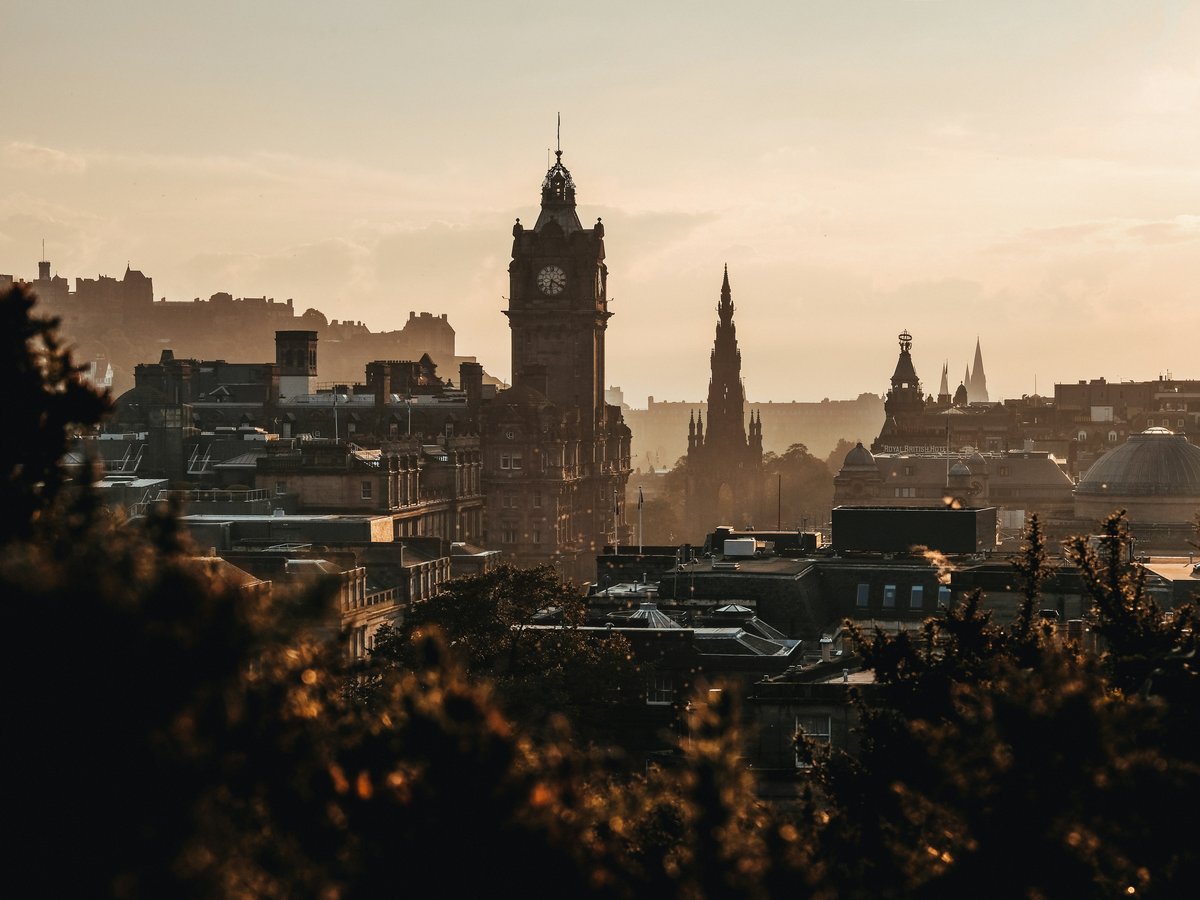
Edinburgh is essentially two cities stacked on top of each other, split by a valley that's now Princes Street Gardens. To the south, the Old Town climbs a volcanic ridge from Holyrood Palace up to the Castle: medieval, vertical, built on top of itself for centuries. To the north, the New Town spreads out in a rational Georgian grid, all symmetry and sandstone. That divide still shapes how the city feels. Head south from the ridge and you drop into the leafy residential neighborhoods of Bruntsfield and Morningside. Go north past the New Town and you'll find Stockbridge tucked along the Water of Leith. Keep going northeast and you reach Leith, the old port, which has quietly become the best eating neighborhood in Scotland. The whole city is walkable if you don't mind hills, and you will encounter hills. Buses cover what your legs won't, and the new tram line runs from the airport through the west end to York Place. One thing worth knowing: Edinburgh during Festival season (August) and Edinburgh the rest of the year are practically different cities. Prices, crowds, noise levels, even the personality of certain neighborhoods shifts dramatically. If you're choosing where to stay, that timing matters as much as the location itself.
Neighborhoods
-
Old Town
Narrow closes, stone tenements stacked six or seven stories high, and a permanent smell of hops drifting from the breweries that once lined the Cowgate. The Royal Mile gets all the attention, but the real Old Town is in the wynds and courtyards off to either side: places like Advocate's Close or Riddle's Court, where the tourists thin out and you can hear your own footsteps on the cobbles. It's loud in summer, quieter than you'd expect in winter. The architecture is genuinely medieval in places, with bits of the 15th century still visible if you look up.
- Best for
- First-time visitors who want to be in the thick of it, history obsessives, people who don't mind steep stairs and cobblestones
- Key streets
- The Royal Mile (really four streets: Castlehill, Lawnmarket, High Street, Canongate), Victoria Street curving down to the Grassmarket, Cockburn Street for record shops and independent cafes, and the Cowgate for late-night bars
-
New Town
Wide streets, symmetrical Georgian townhouses in honey-colored sandstone, and a kind of composed elegance that feels like the 18th century never quite left. It's quieter than the Old Town, more polished, with a faint air of Edinburgh's professional class: law firms, private members' clubs, the occasional Bentley parked on Heriot Row. That said, it's not stuffy. George Street has shifted from banking headquarters to cocktail bars over the past decade, and the lanes between Queen Street and George Street (Rose Street, Thistle Street) hide some genuinely good small restaurants. The sound here is different: less busker chaos, more clinking glasses and church bells.
- Best for
- Couples, anyone who wants walkable luxury without feeling like they're in a tourist zone, shoppers drawn to Multrees Walk and George Street
- Key streets
- George Street for bars and restaurants, Princes Street for the views (not the shopping, which is mostly chain stores), Queen Street for the Scottish National Portrait Gallery, Dundas Street running downhill toward Stockbridge with its independent galleries
-
Stockbridge
Feels like a village that Edinburgh grew around and never quite absorbed. The Water of Leith runs through it, lined with trees and a walkway that takes you all the way to the coast at Leith or inland to the Dean Village. The main drag along Raeburn Place is lined with delis, bookshops, charity shops that have good stock, and bakeries. Sunday mornings the Stockbridge Market sets up on Saunders Street and the whole neighborhood smells like fresh bread and woodsmoke from the street food stalls. Architecture is a mix of Georgian terraces and slightly scruffier Victorian tenements. Pace is slow. Dogs everywhere.
- Best for
- Families with young children, people who want a local feel within walking distance of the center, anyone who'd rather browse a farmers market than queue for a castle
- Key streets
- Raeburn Place for shops and cafes, St Stephen Street for antique dealers and the basement bar Bailie Bar, Hamilton Place, and the Glenogle Road path along the Water of Leith
-
Leith
Edinburgh's port neighborhood, separated from the city center for most of its history and only officially absorbed in 1920: a fact some Leithers still seem mildly irritated about. The docks have been cleaned up but Leith hasn't been sanitized. You'll find Michelin-starred restaurants two streets from bookmakers and old pubs with sticky carpets. The Shore (where the Water of Leith meets the old harbor) is probably the most pleasant stretch of waterside eating in Scotland right now, with restaurants like The Kitchin and Martin Wishart anchoring the serious end. But the cheaper places are often just as good. Constitution Street and Leith Walk are rougher around the edges, still transitional, with a mix of Polish delis, Ethiopian restaurants, and old-school chippies. It smells like the sea when the wind blows right.
- Best for
- Foodies on any budget, people who prefer grit to polish, anyone who wants to eat at Scotland's best restaurants without the stuffiness, craft beer enthusiasts
- Key streets
- The Shore for waterside dining, Leith Walk running uphill to the city center (long, busy, full of surprises), Constitution Street, Commercial Street near the new tram terminus, and Great Junction Street for the less curated but more honest side of the neighborhood
-
Bruntsfield and Morningside
South Edinburgh's comfortable residential stretch, running along a ridge with views toward the Pentland Hills. Bruntsfield is the younger end: students from the university, young professionals, independent coffee shops on Bruntsfield Place and Leven Street. The open green of Bruntsfield Links still has a free public pitch-and-putt that locals use on summer evenings, and the ice cream queue at S. Luca or various spots on the main strip is a seasonal ritual. Cross over to Morningside Road and the tone shifts older, more settled. Charity shops with cashmere in the window, a proper butcher, a fishmonger. There's a gentle hum of domestic life here that the tourist neighborhoods lack entirely. Both areas are flat by Edinburgh standards, which your knees will appreciate.
- Best for
- Families, longer stays of a week or more, anyone who wants a neighborhood that functions as a neighborhood rather than a destination, runners who want easy access to the Meadows and Bruntsfield Links
- Key streets
- Bruntsfield Place for cafes and restaurants, Morningside Road for independent shops, Merchiston Crescent for the quiet residential streets, and the Meadows path system connecting to the Old Town in about fifteen minutes on foot
-
Dean Village
A pocket of quiet that catches everyone off guard. Two minutes' walk from the west end of Princes Street, you drop down a steep lane and suddenly you're standing by a river in what looks like a rural mill village. The Water of Leith runs through between old grain warehouses and 17th-century stone cottages. It's tiny (you can walk the whole thing in ten minutes) but the sense of being transported is real. The sound of the weir drowns out the city. Light filters through the trees in a way that feels deliberately staged but isn't. Not really a place to stay (there are almost no commercial properties), but you should know it exists.
- Best for
- A morning walk or afternoon escape, photographers, anyone staying in the west end of the New Town who wants a quiet spot to read by the river
- Key streets
- Bell's Brae descending into the village, Miller Row along the water, and the walkway continuing under the magnificent Dean Bridge (Thomas Telford, 1832) toward the Scottish National Gallery of Modern Art
-
Tollcross
A junction neighborhood that doesn't try to impress you but quietly provides everything you might need. Tollcross sits at the intersection of Home Street, Leven Street, and Lauriston Place: a crossroads between the Old Town, Bruntsfield, and the canal. The architecture is mixed: some Georgian, some Victorian tenements, a few unfortunate 1960s blocks. What it has is an unusually dense cluster of independent restaurants, pubs, and the Cameo cinema, one of Edinburgh's best independent picture houses. Home Street in particular has turned into a proper eating street (Thai, Japanese, Middle Eastern, a good wine bar) without anyone really making a fuss about it. The Meadows are a five-minute walk south.
- Best for
- Budget-conscious visitors who still want good food and nightlife, anyone who finds the Old Town too crowded and the New Town too pricey, theatre and cinema goers
- Key streets
- Home Street and Leven Street for eating and drinking, Lauriston Place past the art college, Lochrin Place by the canal basin, and Brougham Street connecting to the Meadows
-
Southside and Newington
Edinburgh University territory. Newington Road and Clerk Street form the spine, running south from the Old Town past the Festival Theatre and into a long stretch of B&Bs, curry houses, and student flats. It's not a destination neighborhood in the way Leith or Stockbridge might be, but it has a practical usefulness: centrally located, well served by buses, cheaper than most areas north of the Meadows. The Summerhall arts complex, in a converted veterinary school, has become one of the more interesting cultural venues in the city, especially during the Festival. Nicholson Street has a growing cluster of decent Korean and Chinese restaurants that locals know about but guidebooks tend to skip. The buildings are Victorian tenements, mostly four stories, with the occasional unexpected garden tucked behind.
- Best for
- Budget travelers, students, Festival-goers who want affordable accommodation within walking distance of the Fringe venues, anyone who prioritizes bus connections over atmosphere
- Key streets
- Nicholson Street and Clerk Street running south, Nicolson Square near the Festival Theatre, Causewayside for its quieter residential feel, and the paths through the Meadows connecting to Bruntsfield and Marchmont
-
Portobello
Edinburgh's seaside suburb, about three miles east of the center. A proper sandy beach (which still surprises people who don't expect one in Edinburgh) backed by a promenade, a stretch of independent shops on the High Street, and a residential grid of Victorian and Edwardian houses. The water is cold, obviously, but on a still summer day the beach fills up and the whole place takes on a mildly surreal holiday atmosphere. The High Street has gathered a handful of genuinely good spots in recent years: The Espy pub overlooking the sea, a few decent brunch places, an independent bookshop. It's quiet in winter (windswept, even) but that has its own appeal. The light on the Firth of Forth in the low winter sun is something.
- Best for
- Families with children in summer, anyone wanting a break from the city center, sea swimmers and runners who want the promenade, people looking for a quieter base who don't mind a 25-minute bus ride into town
- Key streets
- Portobello High Street for shops and cafes, the Promenade running the length of the beach, Bath Street near the old swimming baths (now restored), and Joppa Road at the eastern end where things get quieter
FAQ
Which Edinburgh neighborhood is best for first-time visitors?
The Old Town puts you right at the center of things: the Castle, the Royal Mile, most of the major museums are either in it or a short walk away. You'll pay more for accommodation and it gets loud during Festival season, but for a first visit of three or four days, it's hard to argue against staying on or near the Royal Mile. If the prices put you off, Tollcross and the Southside are ten to fifteen minutes on foot and significantly cheaper.
Is Leith safe for tourists and worth the journey from the center?
Leith is safe, yes. Its rough reputation is decades out of date at this point, though it still has edges, which is part of what makes it interesting. The Shore area in particular is one of the best places to eat in Scotland. It's about a 25-minute walk downhill from the east end of Princes Street, or a short bus or tram ride. If you're interested in food at all, you should spend at least an evening there. The walk down Leith Walk itself is worth doing once: it's a long, busy street with a character all its own.
Where should I stay during the Edinburgh Festival in August?
During the Festival, the Old Town and Southside become ground zero for Fringe venues, street performers, and crowds. If you want to be immersed in it, stay there, but book months in advance and expect to pay two or three times normal rates. For a saner base, Stockbridge and Bruntsfield are close enough to walk to venues but quiet enough to sleep. Portobello is a good budget option with the bus running regularly into the center. Leith works too, especially now the tram reaches it, though you'll spend more time in transit.
Can you get around Edinburgh without a car?
You really don't need one, and parking is expensive and limited in the center. The bus network run by Lothian Buses is reliable and covers the whole city: a day ticket currently costs a few pounds. The tram connects the airport to the city center and now extends to Leith. Most of the central neighborhoods are walkable from each other in fifteen to thirty minutes, though you'll want comfortable shoes because the hills and cobblestones are real. A car is only useful if you're heading out to the Highlands or the Borders.
What's the difference between staying in Old Town versus New Town?
Old Town is vertical, medieval, atmospheric, and tourist-heavy. Narrow alleys, uneven cobblestones, pubs in basement vaults. New Town is horizontal, Georgian, elegant, and quieter: wide streets, high ceilings, a more residential feel even in its commercial stretches. Old Town puts you closer to the Castle, the Mile, and the Fringe venues. New Town puts you closer to good cocktail bars, the shopping on George Street, and easy access to Stockbridge. Both are equally central. The choice is mostly about what kind of city you want to wake up in.
Are there good neighborhoods for eating on a budget in Edinburgh?
Leith Walk from top to bottom is lined with affordable places: Ethiopian, Turkish, Polish, Chinese, old-fashioned chippies. Nicholson Street on the Southside has a growing Korean and Chinese cluster that's genuinely good and priced for students. Home Street in Tollcross has affordable Thai and Japanese. Bruntsfield Place has cafes where a solid lunch costs under ten pounds. The Old Town and New Town tend to be pricier, though even there you'll find pub lunches that won't break you. The key is getting slightly off the Royal Mile, even one street over, prices drop noticeably.
Last verified by automated review (v1.7.2) on . What is automated review?