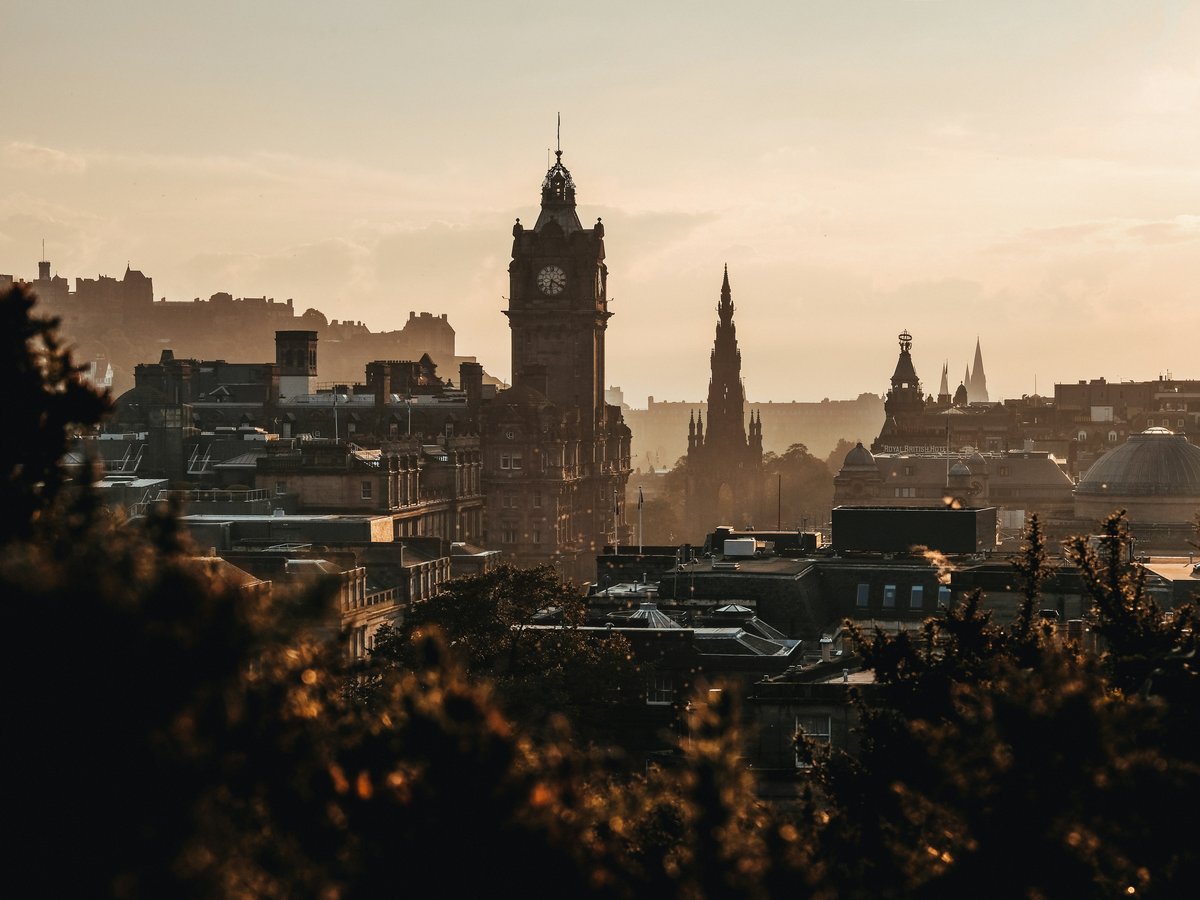
Edinburgh is a city built on volcanoes. That sounds dramatic, but it's literally true: Arthur's Seat is the remnant of a 340-million-year-old volcano sitting right in the middle of town, and Castle Rock is another plug of ancient basalt. The result is a city where proper hills, crags, and wild coastline are woven into the urban fabric in a way that still catches you off guard. You can be sitting in a pub on the Royal Mile and twenty minutes later find yourself scrambling up exposed rock with the Firth of Forth stretching out below. The Pentland Hills roll along the southern edge of the city, there's a genuine sandy beach at Portobello, and the Water of Leith cuts a surprisingly green corridor from the western suburbs all the way to the port at Leith. Edinburgh's weather, mind you, has a reputation for a reason: four seasons in a day is not an exaggeration, and the wind on exposed hilltops can be genuinely fierce. But that changeable quality is part of the character. On a clear day, when the haar lifts off the Forth and the light hits the crags just right, there's nowhere in the UK quite like it for getting outside.
Outdoor activities
-
Arthur's Seat summit scramble
The classic Edinburgh outdoor experience, and it earns that status. The route from Holyrood Palace up past St Margaret's Loch and along the ridge to the 251-metre summit is steep enough to get your heart going but short enough to fit into a morning. The final push involves some hands-on-rock scrambling that might surprise you: it's not a stroll. On a clear day you can see across to Fife and out to the Bass Rock. The Salisbury Crags path is a gentler alternative that traverses below the main cliffs with views straight down into the city. Expect company on weekends. The wind at the top can be bitter even in summer, so bring a layer.
- Difficulty
- Moderate: some rocky scrambling near the summit
- Duration
- 1.5 to 2.5 hours round trip from Holyrood
- Best season
- April through October, though locals go year-round
-
Pentland Hills mountain biking
The Pentlands run for about 25 kilometres along Edinburgh's southern boundary, and they're laced with trails that range from smooth fire roads to rocky singletrack. Glentress and Innerleithen get all the mountain biking press, but the Pentlands are right there: you can cycle from the city centre to Bonaly and be on dirt within the hour. The trails around Flotterstone and Harlaw are good starting points. Conditions get boggy after rain, which is to say frequently, so fat tyres help. Worth noting that you share paths with walkers and the odd horse, so keep your speed in check on blind corners.
- Difficulty
- Easy to moderate depending on route choice
- Duration
- 2 to 4 hours
- Best season
- May through September for drier trails
-
Water of Leith Walkway cycling
This 20-kilometre path follows the river from Balerno on the western edge of Edinburgh all the way down to Leith. It's mostly traffic-free and surprisingly rural in stretches: the section through Colinton Dell feels properly wooded and remote, with old mill ruins along the banks. The path surface varies: some tarmac, some packed earth, a few sections that turn muddy after rain. It's flat to gently downhill if you start from Balerno, which is the smart move. You'll pass through Stockbridge and Dean Village, where you might want to stop for coffee. Not a thrill ride, but a genuinely pleasant way to see a different side of the city.
- Difficulty
- Easy: mostly flat, suitable for all fitness levels
- Duration
- 1.5 to 2 hours one way by bike
- Best season
- Year-round, though autumn colours along the river are particularly good
-
Rock climbing at Salisbury Crags
The crags below Arthur's Seat have been a climbing venue for well over a century. The rock is columnar dolerite, and the routes range from single-pitch beginner climbs to more serious multi-pitch lines. There are seasonal climbing restrictions on parts of the crag between March and August to protect nesting peregrine falcons: check the current notices at Holyrood Park. The rock can be greasy when damp, which is not infrequent. Several Edinburgh climbing clubs run outdoor sessions here if you want experienced company. Cat Nick and the Long Row are popular areas. You'll want your own gear or a guide; there's no rental on site.
- Difficulty
- Routes from Diff to E3: something for most ability levels
- Duration
- Half day
- Best season
- Late summer through autumn for dry rock and no bird restrictions
-
Trail running on Blackford Hill and the Braids
Blackford Hill and the connected Braid Hills sit just south of the city centre and offer a compact network of trails that Edinburgh's running community relies on. The terrain is a mix of grass, packed earth, and some rocky sections on Blackford that keep your feet honest. From the top of Blackford you get a clean sightline to Arthur's Seat and across to the Pentlands: it's a good spot to pause and catch your breath. The Royal Observatory sits on the summit, which gives you a landmark to navigate by. A loop taking in both hills is roughly 8 to 10 kilometres depending on your route, with enough elevation change to feel like a proper workout. Early morning runs up here before the dog walkers arrive have a particular quality to them.
- Difficulty
- Easy to moderate: mixed terrain with some short steep sections
- Duration
- 45 minutes to 1.5 hours depending on distance
- Best season
- Year-round, though trails get slippery in winter
-
Cycling the Innocent Railway path
This old rail line, converted to a shared-use path, runs from the south side of Holyrood Park out to the suburbs at Brunstane. It passes through a tunnel under the St Leonard's area (bring lights, it's dark in there) and emerges into a surprisingly green corridor. The surface is decent tarmac for most of it. It connects to the wider Edinburgh cycle network, so you can loop back via Portobello and the coast if you want to extend the ride. Not long, maybe 5 kilometres end to end, but it's a useful connector and a quirky bit of Edinburgh's industrial history. The tunnel has its own microclimate: damp, cool, and faintly echoey.
- Difficulty
- Easy: flat and paved
- Duration
- 30 to 45 minutes one way
- Best season
- Year-round
Day hikes
-
Scald Law via Flotterstone in the Pentland Hills
Scald Law is the highest point in the Pentlands at 579 metres, and the route from the Flotterstone car park is the most popular way up. The path climbs steadily through open moorland past Turnhouse Hill before reaching the broad summit. It's exposed moorland walking (no shelter, no trees) so you feel the weather fully. The views from the top stretch from the Forth bridges to the Borders hills on a clear day. The path is well-worn but can be boggy in the lower sections after rain. You can extend the walk into a horseshoe taking in Carnethy Hill and the Kirk Road descent, which adds maybe 90 minutes. The Flotterstone Inn at the base does a reasonable pint afterwards.
- Difficulty
- Moderate: steady climb with 450m of ascent, some boggy sections
- Duration
- 3 to 4 hours for the out-and-back; 5 hours for the horseshoe
- Best season
- May through October for drier ground and longer daylight
-
North Berwick Law
A 187-metre volcanic plug about 40 minutes east of Edinburgh by train, and one of the best short hikes near the city. The path from the car park spirals up through gorse and grassland to a summit crowned by a whale jawbone arch and the remains of a wartime lookout. The views from the top are disproportionately good for the height: the Bass Rock gannet colony sits offshore, and you can see along the East Lothian coast in both directions. The final section is steep and rocky, with some hands-on scrambling. The town of North Berwick itself has good fish and chips and a surprisingly nice beach. A solid half-day out from Edinburgh.
- Difficulty
- Easy to moderate: short but steep, with some rocky ground near the summit
- Duration
- 1 to 1.5 hours up and down
- Best season
- Spring through autumn; the gorse blooms yellow in May and the gannets are on the Bass Rock from February to October
-
Allermuir Hill from Bonaly
Starting from the Bonaly car park at the edge of the city, this route climbs through a strip of woodland before opening onto the moorland flanks of Allermuir Hill at 493 metres. The path is clear but steep in places, and you gain the height quickly. From the top, Edinburgh spreads out below you to the north, and the Pentland ridge extends south. It's a satisfying walk that feels much more remote than the thirty-minute bus ride from the city centre would suggest. The descent via Caerketton Hill makes a good loop and adds views toward the Borders. Bonaly reservoir, passed on the way up, is a peaceful spot if you want to sit for a while.
- Difficulty
- Moderate: roughly 350m of ascent on clear paths
- Duration
- 2.5 to 3.5 hours for the loop via Caerketton
- Best season
- April through October
-
John Muir Way: Dunbar to North Berwick section
John Muir was born in Dunbar, and this stretch of the long-distance path bearing his name follows the East Lothian coast between Dunbar and North Berwick: about 22 kilometres of cliff-top walking, sandy beaches, and farmland. The route passes the ruins of Tantallon Castle perched on its sea cliff, which is worth a stop. You'll see fulmars and kittiwakes nesting on the cliffs in summer. The terrain is mostly level, with short steep sections where the path drops to beach level and climbs back up. Both ends are on the train line, making logistics simple. The path surface varies from boardwalk to sand to grass, and some sections are exposed to coastal wind. Not technically hard, but the distance and the wind make it a proper day out.
- Difficulty
- Moderate: long distance, mostly flat but exposed to coastal weather
- Duration
- 6 to 8 hours one way
- Best season
- May through September for the longest daylight and calmest coastal weather
-
Blackford Hill and Hermitage of Braid loop
This is the low-commitment option for days when you want fresh air but not a full expedition. Starting from the Hermitage of Braid car park, you walk through the wooded glen (which is genuinely pretty, with a burn running through it and old stone bridges) before climbing to the open summit of Blackford Hill. The Royal Observatory dome sits on top, and the views of Arthur's Seat and the castle are excellent. You can extend the loop to include the Braid Hills for more distance over open grassland. The entire walk stays within the city, which means you're never far from a bus stop if the weather turns. Total chaos if you're here during peak dog-walking hours, mind you.
- Difficulty
- Easy: well-maintained paths, gentle gradients
- Duration
- 1 to 2 hours depending on loop length
- Best season
- Year-round: the woodland is sheltered in bad weather and the autumn colours are strong
Water activities
-
Sea kayaking on the Firth of Forth
Paddling out from Granton or South Queensferry onto the Firth of Forth is a different way to see the city entirely. The water is tidal and can be cold even in summer: a wetsuit or drysuit is non-negotiable. Several outfitters in Edinburgh run guided trips, which is the sensible option if you don't know the tidal patterns. Routes toward Inchcolm Island pass the Forth Bridge and give you the gannet-level perspective of the coastline. The island has a medieval abbey and a colony of seals that tend to watch kayakers with mild curiosity. Conditions on the Firth can change quickly; wind against tide creates a choppy mess, so check the forecast and the tidal charts. The best paddles are on calm mornings before the wind picks up.
- Difficulty
- Moderate to difficult: tidal waters, cold temperatures, requires experience or a guide
- Duration
- Half day for a guided trip; 2 to 4 hours self-guided
- Best season
- June through September for the mildest water temperatures and longest daylight
-
Swimming at Portobello Beach
Edinburgh has a proper sandy beach, and it's reachable by bus in about 25 minutes from the centre. Portobello stretches for about three kilometres along the Forth, and the water quality has improved considerably over the past decade. That said, it's the North Sea: water temperatures peak around 14 or 15 degrees in August, so calling it refreshing is generous. The outdoor swimming community here is committed, with groups meeting year-round including through the winter, which takes a certain kind of resolve. The promenade behind the beach has cafés, an amusement arcade that's seen better days, and fish and chip shops. On a hot summer day (they happen, maybe six times a year) the beach is packed.
- Difficulty
- Easy: sheltered bay, gentle waves, sandy bottom
- Duration
- As long as you can handle the cold
- Best season
- July and August for the warmest water; the hardy swim year-round
-
Stand-up paddleboarding at Cramond
Cramond, at the western edge of the city where the River Almond meets the Forth, is a popular spot for SUP. The estuary is relatively sheltered, and at low tide you can paddle across to Cramond Island, though you need to watch the tides carefully, because the causeway floods and people regularly get stranded. The water here is calmer than the open Firth, making it more forgiving for beginners. A couple of local operators offer board rental and lessons from the Cramond foreshore. The harbour area itself is picturesque: whitewashed houses, an old inn, and a Roman fort site. Afterwards, the walk along the shore promenade to Silverknowes is a nice wind-down.
- Difficulty
- Easy to moderate: sheltered water, but tidal awareness is essential
- Duration
- 1 to 3 hours
- Best season
- May through September
-
Canoeing and kayaking the Union Canal
The Union Canal runs from Edinburgh's Fountainbridge area westward through the city and out toward Falkirk, and it's dead flat, no locks until the very end. This makes it one of the easiest paddling environments you'll find, and a genuinely relaxing way to spend a few hours. The canal passes through surprisingly green corridors, under stone bridges, and past narrowboat moorings. You can paddle out toward the Almond Aqueduct, which carries the canal 26 metres above the River Almond valley: paddling across a bridge is a strange sensation. Several outfitters along the towpath rent kayaks and canoes by the hour. The water is still and sheltered from wind, so it works even on days when the Forth is too rough.
- Difficulty
- Easy: flat water, no current, sheltered from wind
- Duration
- 1 to 4 hours depending on distance
- Best season
- April through October
-
Wild swimming at Threipmuir Reservoir
Out in the Pentland Hills, Threipmuir and the connected Harlaw Reservoir sit in a basin of open moorland about 30 minutes from central Edinburgh by car. The water is clean, cold, and dark: fed by hill burns running off the surrounding slopes. There's no formal swimming facility, and this is wild swimming in the proper sense: no lifeguards, no changing rooms, just you and the water and possibly a few other swimmers who've had the same idea. The reservoir banks are accessible from the Harlaw car park, and the south-facing shore of Threipmuir catches whatever sun is going. Water temperatures are cool even in midsummer, probably 12 to 16 degrees. The setting, surrounded by open hills with curlews calling overhead, makes the cold worthwhile.
- Difficulty
- Moderate: cold water, no facilities, requires swimming competence
- Duration
- 1 to 2 hours including the walk in
- Best season
- June through August for tolerable water temperatures
Parks & gardens
-
Royal Botanic Garden Edinburgh
FreeSeventy acres of gardens just north of the city centre in Inverleith. The place has been here since 1670, which gives it a maturity you can feel: the trees are enormous, the planting is layered and settled rather than fussy. The rock garden is genuinely impressive, built into a natural slope with streams running through it. The glasshouses are Victorian structures housing tropical and arid collections. On a warm day, the lawn facing Inverleith House fills up with people reading and dozing, with the castle visible on the skyline behind them. Entry to the gardens is free; the glasshouses have a charge.
Highlights: The rock garden, the Chinese Hillside garden, Victorian Temperate Palm House, and the view of the castle skyline from Inverleith House lawn
-
Holyrood Park
FreeA genuine piece of Scottish highland dropped into the middle of a capital city. Over 250 hectares of crags, lochs, grassland, and the ruins of St Anthony's Chapel perched above St Margaret's Loch. Arthur's Seat dominates, but the park is much more than its summit: the path around Dunsapie Loch is a quiet walk with nesting swans, and the Radical Road below Salisbury Crags gives you the geology without the climb. You'll see skylarks over the grassland in spring and sometimes a kestrel hunting along the crags. It feels genuinely wild in places, which is strange given you can hear traffic from certain angles.
Highlights: Arthur's Seat summit, Salisbury Crags, St Margaret's Loch, Dunsapie Loch, ruins of St Anthony's Chapel, and the geological exposures at Hutton's Section
-
Princes Street Gardens
FreeSplit into east and west sections by The Mound, these gardens sit in the valley that was once the Nor Loch: effectively the city's old sewage lake, which is a thought to hold onto as you picnic on the grass. The west garden is the larger and more interesting half, with mature trees, a bandstand, and the Scott Monument looming overhead. The Ross Fountain sits at the western end. During August, the gardens become part of the Festival infrastructure, which changes the character entirely. The rest of the year, they're a green pause between the Old Town ridge and the New Town grid. Good for sitting, less so for anything strenuous.
Highlights: Scott Monument views, Ross Fountain, the floral clock near the east entrance, and the castle looming directly overhead from the central lawn
-
Inverleith Park
FreeAcross the road from the Botanics, Inverleith Park is the more casual, community-minded sibling. The pond in the centre usually has a population of swans and ducks that local kids feed. There's a decent-sized playing field, allotments along the eastern edge, and sundial garden. The views south to the castle and Arthur's Seat from the higher ground are among the best in the city: there's a reason wedding photographers like this spot. Less polished than the Botanics, more lived-in, the kind of park where Saturday morning football happens alongside dog walks and pram circuits.
Highlights: Castle and Arthur's Seat panorama from the south-facing slope, the pond, allotments, and the sundial garden
-
The Meadows and Bruntsfield Links
FreeA long, flat expanse of open grass south of the Old Town that functions as Edinburgh's communal back garden. In summer, when the university exams end, it fills with barbecues and frisbee games and impromptu cricket. The tree-lined paths (mostly elm and cherry) are good for a run or a walk, though it's flat enough that calling it exercise feels generous. Bruntsfield Links, at the western end, is one of the oldest short-hole golf courses in the world and still free to play in summer. The atmosphere here on a warm evening, with the smell of charcoal and cut grass, is as close to continental as Edinburgh gets.
Highlights: Free pitch-and-putt on Bruntsfield Links in summer, the cherry blossom avenue in spring, and the Saturday Farmers' Market at the east end
-
Calton Hill
FreeA small volcanic hill at the east end of Princes Street, and you can walk up it in ten minutes from the pavement. The collection of monuments on top: the unfinished National Monument, the Nelson Monument, the Dugald Stewart Memorial: gives the summit the feel of an open-air sculpture gallery. It's a sunset spot for the whole city; on clear evenings, the summit gets crowded with people facing west. The views take in Arthur's Seat, the Forth, the Old Town ridge, and on good days the Highlands to the north. Worth noting the paths can be icy in winter and the exposed summit catches serious wind.
Highlights: Panoramic views from the Dugald Stewart Memorial, the unfinished National Monument, Nelson Monument, and the old City Observatory
Practical tips
- Layering for Edinburgh weather
- Edinburgh's weather can shift from sunshine to horizontal rain inside an hour, especially on the hills. A waterproof shell is non-negotiable year-round, not a shower-proof thing, a proper waterproof with taped seams. Underneath, dress in layers you can add and remove. Cotton is a poor choice: it holds moisture and chills you. Merino or synthetic base layers dry faster. Even in July, carry a warm mid-layer for summit stops where the wind chill bites. Sunglasses are useful more often than you'd expect: when the sun does appear at this latitude, it sits low and gets in your eyes.
- Footwear and trail conditions
- The trails in the Pentlands and on Arthur's Seat get muddy. Properly muddy, not just a bit damp. Trail shoes with decent grip will handle most situations in summer; for the Pentlands in winter or after heavy rain, waterproof hiking boots are the better choice. The rock on Arthur's Seat and Salisbury Crags can be slippery when wet: the dolerite develops a greasy film. Gaiters seem excessive until you've done a Pentlands walk after a week of rain, at which point they seem like genius. The canal and Water of Leith paths are fine in any footwear; the hill routes want something with ankle support and grip.
- Sun protection
- Edinburgh sits at 55 degrees north, so summer days are long: sunrise before 4:30 and sunset after 10 in late June. The sun might not feel intense, but UV exposure accumulates over those extended daylight hours, and the reflection off water and light-coloured rock adds to it. Sunscreen is worth carrying from May through August, particularly on exposed ridgelines and coastal walks where there's no shade. A peaked cap or hat helps on long days. Sunburn sneaks up on you here because the temperature rarely feels hot, so you don't get the usual warning signals.
- Water and hydration
- There are no water refill points on the Pentland Hills or most of Edinburgh's wilder walks. Carry at least a litre for any hill walk, more in warm weather or if you're doing the longer routes. The tap water in Edinburgh is excellent: fill up before you leave. For the canal and Water of Leith paths, cafés along the way mean you can usually find a refill, but don't count on it for the rural sections. Stream water in the Pentlands looks tempting but runs through grazing land and should be filtered or treated before drinking.
- Right to roam and access
- Scotland's access legislation (the Land Reform Act 2003) gives you the right to walk, cycle, and wild swim on most land and inland water, provided you act responsibly. This is different from England and Wales and it's genuinely liberating once you understand it. You don't need permits for hiking or wild swimming. The key responsibilities: don't damage fences or crops, keep dogs under control near livestock (especially during lambing from March to May), take your litter home, and avoid camping right next to someone's house. The Scottish Outdoor Access Code has the full details. During grouse shooting and deer stalking seasons (roughly August to February in the Pentlands) it's courteous to check hillphones or notices for any temporary restrictions.
- Midges and insects
- From late May through September, midges appear in sheltered, damp areas: particularly around the Pentland reservoirs and wooded glens. They're worst in still, humid conditions at dawn and dusk. Edinburgh itself is generally too breezy for serious midge problems, but head into the Pentlands on a calm evening and you'll meet them. DEET-based repellent works; Smidge is a locally popular brand that's effective. Head nets look absurd but become reasonable very quickly when the swarm finds you. The wind is your ally: exposed hilltops and the coast are usually midge-free. If there's a breeze, you're probably fine.
FAQ
Is Arthur's Seat safe to climb without hiking experience?
Arthur's Seat is climbed by thousands of people each year, including families with children, so it's certainly accessible. That said, it's a real hill, not a paved path: the summit approach involves rocky terrain and some scrambling. Wear proper shoes with grip, not trainers with smooth soles. The wind at the top can be strong enough to make you unsteady. People do get into trouble here, usually from underestimating the conditions or wearing inappropriate footwear. Stay on the marked paths, check the weather before you go, and carry a waterproof layer. If you're comfortable on uneven ground and reasonably fit, you'll be fine.
What is the best time of year for outdoor activities in Edinburgh?
May through September gives you the longest days and the mildest weather, with June and July offering up to 18 hours of daylight. That said, Edinburgh's weather is unpredictable in any month: a warm, sunny day in April can be followed by sleet. The driest months tend to be April, May, and June. July and August bring the Festival, which means the city is crowded but the energy is high. September and October offer quieter trails, autumn colours, and still-reasonable weather. Winter walking is possible but days are short (barely seven hours of daylight in December) and the hills can be icy. For water activities, July and August are the only months when the sea temperature is even vaguely comfortable.
Do I need to book outdoor activities in advance or can I just turn up?
For hiking, cycling, and wild swimming, you can just go: Scotland's right to roam means you don't need permits or bookings. For guided activities like sea kayaking, coasteering, or SUP lessons, booking ahead is wise, especially in July and August when demand peaks. Equipment rental from canal-side outfitters on the Union Canal is usually available on the day during the week, but weekends in summer fill up. Rock climbing instruction should be booked in advance. If you want to visit Inchcolm Island by boat (not kayak), the ferry from South Queensferry has limited sailings and sells out in summer.
How do I get to the Pentland Hills from central Edinburgh without a car?
The Lothian 10 bus runs from Princes Street to Fairmilehead, from where it's about a 20-minute walk to the Bonaly car park trailhead. The 101 Hillend bus route gets you to Hillend, another common starting point on the eastern edge of the Pentlands. For Flotterstone, the 101 continues south: check current timetables as services are less frequent. On weekends, getting to Bonaly or Hillend by bus is straightforward; getting to the more remote western access points like Harlaw or Threipmuir is harder without a car. A taxi from the city centre to Flotterstone costs roughly fifteen to twenty pounds. Several outdoor clubs organise group transport for Pentland walks.
Is wild swimming legal in Edinburgh and is the water clean?
Wild swimming is legal across Scotland under the Land Reform Act 2003, which grants the right to swim in inland and coastal waters. You don't need permission. Water quality at Portobello Beach is monitored by SEPA and has generally been rated good or excellent in recent years. The Firth of Forth is clean enough for swimming at most points along the Edinburgh coast, though avoid swimming after heavy rainfall when combined sewer overflows can discharge. The Pentland reservoirs are clean hill-fed water. In all cases, cold water is the main risk: acclimatise gradually, never swim alone in remote locations, and consider a tow float for visibility. No one will stop you, but use common sense about conditions.
Are there any outdoor gear shops in Edinburgh for last-minute supplies?
Tiso on Rose Street has been the go-to outdoor shop in Edinburgh for decades and carries a solid range of hiking, climbing, and water sports gear. Cotswold Outdoor on Princes Street is another option for mainstream brands. For budget kit, Decathlon has a large store at the Fort Kinnaird retail park on the east side of the city. Mountain Warehouse on Princes Street covers basics at lower price points. For climbing-specific gear, Tiso is your best bet. If you need something repaired rather than replaced, several smaller shops in the Bruntsfield and Tollcross area handle boot resoling and jacket reproofing. Most shops open by 9 or 10 in the morning, so you can kit up before an early start.
Outdoor experiences in Edinburgh
 Free cancellation
 Afternoon Old Town and Underground Ghost Tour 1:15, 3:15, 5:15
Outdoor experience: 1 hour, free cancellation.
via Viator Free cancellation
 5 Day Isle of Skye, Loch Ness & Inverness From Edinburgh
Outdoor experience: 5 days, free cancellation.
via Viator Free cancellation
 Edinburgh Sky to Sea Bike or E-Bike Tour with Pick-up
Outdoor experience: 4.8 hours, free cancellation.
via Viator Free cancellation
 Silent Disco Adventure Tour
Outdoor experience: 1 hour, free cancellation.
via Viator Free cancellation
 Edinburgh City Bike Tour - Choice of E-Bike or Manual
Outdoor experience: 3.5 hours, free cancellation.
via Viator Free cancellation
 Hill & Nature Hike - Discover Real Edinburgh With a Local Expert
Outdoor experience: free cancellation.
via Viator Free cancellation
 Edinburgh: Arthur's Seat Hike with Local Guide
Outdoor experience: 2 hours, free cancellation.
via Viator Free cancellation
 Loch Ness, Glencoe and The Highlands Private Tour
Outdoor experience: free cancellation.
via Viator Free cancellation
 Outlander Filming Locations Day Tour from Edinburgh
Outdoor experience: 9 hours, free cancellation.
via Viator Free cancellation
 Edinburgh:5-Day Isle of Skye, Inverness & Loch Ness Tour w/Hostel
Outdoor experience: 5 days, free cancellation.
via ViatorLast verified by automated review (v1.7.2) on . What is automated review?