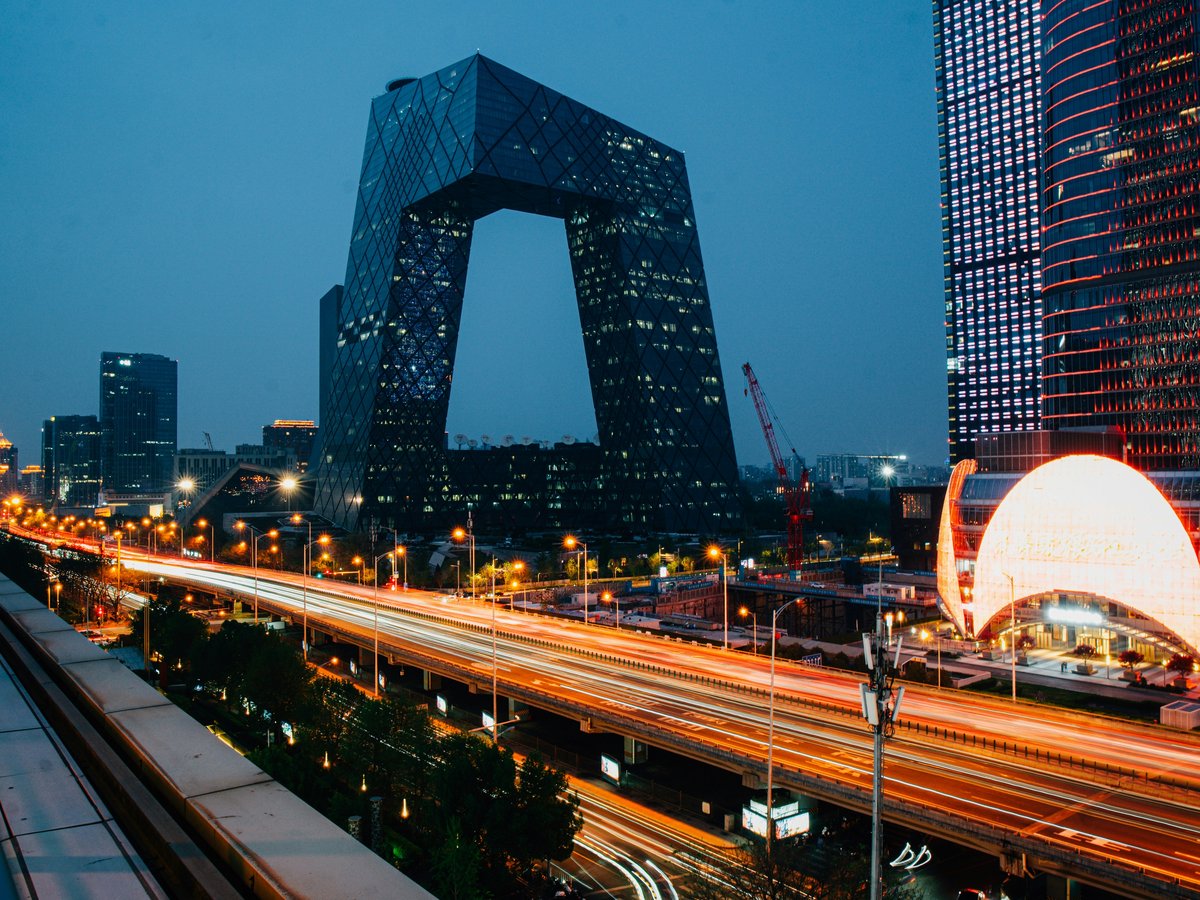
Beijing is built in concentric ring roads that radiate outward from the Forbidden City like ripples in a pond. The 2nd Ring Road traces the old city wall, the 3rd Ring cuts through established residential neighborhoods, and by the time you hit the 5th or 6th Ring you're in a different city entirely. Most of what visitors care about sits inside the 3rd Ring, roughly a 20-kilometer circle. The subway system, which now has over 25 lines covering more than 800 kilometers, connects nearly everything worth seeing, though transfers at stations like Xizhimen or Dongzhimen can involve 10-minute underground walks. The north-south axis running through Tiananmen Square still organizes the city's mental geography. East of that axis tends to feel newer, wealthier, more international. West tends to feel more governmental, more residential, a bit quieter. The old hutong neighborhoods cluster around the Drum Tower and the lakes in the center, while the business districts push east toward Guomao and Sanlitun. Understanding this basic geometry, rings plus axis, saves you from accidentally booking a hotel an hour from anything you want to see.
Neighborhoods
-
Dongcheng (Gulou & Nanluoguxiang)
This is the Beijing of narrow gray-walled hutongs, where elderly residents still sit on stools outside their doorways on summer evenings and the smell of jianbing drifts from corner carts at 7 a.m. The area around the Drum Tower and Nanluoguxiang has changed considerably since the 2000s, with craft cocktail bars and indie boutiques filling old courtyard homes, but step one alley east or west of the main drag and you're back in the old city. The architecture is still mostly single-story siheyuan courtyard houses, though some have been converted into guesthouses or cafes. Foot traffic on Nanluoguxiang itself can be dense on weekends, easily 50,000 visitors on a Saturday, but the parallel lanes like Banchang Hutong stay calm.
- Best for
- First-time visitors who want to walk to the Forbidden City and still have good nightlife within stumbling distance. Couples and solo travelers tend to do well here.
- Key streets
- Nanluoguxiang runs 786 meters north-south and connects to the Drum Tower area at its north end. Wudaoying Hutong, about 600 meters east of the Lama Temple station, has a quieter and slightly more curated stretch of cafes and shops. Gulou East Street (Gulou Dongdajie) is where locals go for late-night food, with lamb skewer spots and Xinjiang restaurants open past midnight. Baochao Hutong connects Gulou to the Back Lakes area.
-
Houhai & Shichahai (Back Lakes)
Three connected lakes, Qianhai, Houhai, and Xihai, sit in the middle of old Beijing and have been a gathering spot for centuries. The south shore of Houhai has become a wall-to-wall bar strip, and on summer nights the noise from competing sound systems carries across the water. That said, the north and west shores of Xihai are still genuinely peaceful. Willow trees trail into the water, old men fish from the banks, and the pace drops to something almost rural. The contrast within a 10-minute walk is stark. The area sits at roughly the same elevation as the rest of central Beijing, around 40 meters above sea level, but the water and the mature trees make it feel cooler by 2 or 3 degrees in July.
- Best for
- Travelers who want a central location with water views and don't mind some bar noise at night. Families with older kids who want to rent pedal boats on the lake. Budget travelers will find hutong guesthouses in the 200 to 400 yuan per night range tucked into the surrounding alleys.
- Key streets
- Yandai Xiejie, a short diagonal street connecting the Drum Tower area to the lake, is one of Beijing's oldest commercial lanes, about 230 meters long. Lotus Lane (Hehua Shichang) runs along the east bank of Qianhai. For quieter walking, try the path along the north shore of Xihai, past the old Deshengmen arrow tower.
-
Sanlitun
Beijing's most international district sits about 3 kilometers east of the Forbidden City. The anchor is Taikoo Li, an open-air shopping complex where a single cup of coffee might run 45 yuan and the foot traffic skews heavily toward people under 35. The surrounding blocks hold most of the city's foreign restaurants, from proper Neapolitan pizza at places like Bottega to Korean barbecue spots along the east side of Workers' Stadium. The old Sanlitun Bar Street (Sanlitun Jiuba Jie) has been partly demolished and redeveloped, but the drinking scene has scattered into the side streets and into the Topwin Center area. Architecturally it is all glass, steel, and LED, a different planet from the hutongs 15 minutes west.
- Best for
- Younger travelers and expats who want international food options, nightlife that runs until 4 or 5 a.m., and proximity to embassies if you need consular services. Business travelers often stay here for the hotel density, with the Intercontinental, Opposite House, and several others within a 5-minute walk.
- Key streets
- Sanlitun Road (Sanlitun Lu) is the main north-south spine. Workers' Stadium North Road (Gongti Bei Lu) runs east-west and has been a nightlife corridor since the 1990s. Nali Patio, a small courtyard complex on Sanlitun Road, holds a rotating cast of restaurants and bars across its 3 floors. The back alleys south of the Taikoo Li complex, around Sanlitun Houjie, have cheaper local restaurants.
-
Wangfujing & Dongdan
Wangfujing is Beijing's most famous shopping street, about 810 meters long, and it has been a commercial center since the Ming Dynasty. The pedestrianized section can feel like a theme park version of China on weekends, with the night market's scorpion-on-a-stick stalls drawing crowds of tourists photographing food they have no intention of eating. Mind you, behind the main drag, Wangfujing has genuine depth. The old Catholic church, St. Joseph's (Wangfujing Cathedral, built 1655), sits at the street's north end and holds services in Mandarin every Sunday morning. Dongdan, a few blocks south, is more local in feel, anchored by Dongdan Sports Center, where you can still play pickup basketball on outdoor courts for free.
- Best for
- Travelers who want to be within walking distance of Tiananmen Square and the Forbidden City, around 1 kilometer, and who prefer large international hotels. The Peninsula Beijing and the NUO Hotel sit on or near this street. Families with young children might appreciate the flat, car-free walking.
- Key streets
- Wangfujing Dajie itself, plus Jinyu Hutong running east, which has a string of high-end hotels. Dongdan North Street connects south to the more local shopping along Chongwenmen. The small alleys east of Wangfujing, like Shuaifuyuan Hutong, still have old residential life and a few hole-in-the-wall noodle shops.
-
Qianmen & Dashilar
South of Tiananmen Square, Qianmen Dajie was rebuilt in 2008 for the Olympics into a sanitized replica of its early-20th-century self. The main street feels constructed, almost a film set, with old brand-name shops like Quanjude (Peking duck since 1864) and Ruifuxiang (silk since 1893) anchoring a pedestrian boulevard. But turn west into Dashilar (pronounced da-shi-lan-er by locals) and the texture changes fast. The old commercial alleys still hold traditional medicine shops, tea houses, and a couple of Peking opera costume stores that have been in the same families for generations. The area south of here, toward Zhushikou, is still mid-renovation, with some blocks half-demolished and others recently restored.
- Best for
- History-focused travelers who want to be close to Tiananmen Square and the Temple of Heaven, roughly 2 kilometers south. Budget-conscious visitors will find more affordable hotels here compared to Wangfujing, with decent options in the 300 to 500 yuan range.
- Key streets
- Dashilar Xijie for the old shops. Yangmeizhu Xiejie has been converted into a design-and-culture alley with independent bookshops and small galleries, though it tends to be quiet on weekdays. Meishi Jie (Coal Market Street) runs parallel and has a rougher, more lived-in feel with traditional breakfast spots.
-
CBD (Guomao & Jianwai)
The Central Business District clusters around the intersection of the 3rd Ring Road and Jianguomenwai Dajie, anchored by the twin leaning towers of the CCTV Headquarters, a Rem Koolhaas building that opened in 2012 and still looks like it is defying gravity. The streets here are wide, the buildings are tall, and everything moves at corporate pace. Lunch spots cater to office workers, so the food is decent and fast. Restaurants in the China World Mall basement, connected to Guomao Station, serve everything from Sichuan hot pot to Japanese ramen, and most meals run 40 to 80 yuan. After 7 p.m. the neighborhood empties out except around the malls and the Kerry Hotel area.
- Best for
- Business travelers and anyone with meetings in Beijing's financial district. The China World Summit Wing, Beijing's tallest hotel at 330 meters, sits on floors 64 through 77 and has views that extend to the Western Hills on clear days. Leisure tourists will find it efficient but a bit sterile.
- Key streets
- Jianguomenwai Dajie is the main east-west artery. Jintong West Road runs behind the CCTV building and has a few galleries. Guanghua Road connects to the embassy district and has some of the area's better restaurants. The skybridge between the CCTV towers is occasionally open for public tours, though availability seems to shift year by year.
-
Haidian (Wudaokou & University District)
Northwest Beijing is university territory. Peking University and Tsinghua sit side by side near the Old Summer Palace, and the streets around Wudaokou station have the energy of a college town, cheap food, late-night study cafes, Korean restaurants along the main drag (the area has a large Korean student population). The architecture is mixed, some Soviet-influenced campus buildings from the 1950s, some modern glass labs, and a lot of functional residential blocks. The air quality tends to be marginally better up here, possibly because of the proximity to the western hills and the Summer Palace's 2.9 square kilometers of lake and parkland.
- Best for
- Students, academic travelers, and anyone visiting the Summer Palace who wants to stay nearby rather than commute from central Beijing, which can take 45 minutes or more by subway. Budget accommodation runs cheaper here, with clean guesthouses around 150 to 250 yuan per night.
- Key streets
- Chengfu Road between Wudaokou and Peking University's east gate. The area around Zhongguancun, about 3 kilometers south, is Beijing's tech hub, sometimes called China's Silicon Valley, though it has less street-level interest for visitors. Yiheyuan Road leads directly to the Summer Palace's east gate.
-
798 Art District (Dashanzi)
A decommissioned military electronics factory complex in northeast Beijing, 798 was taken over by artists in the early 2000s when rents were almost nothing. The Bauhaus-influenced factory buildings, designed with East German assistance in the 1950s, have sawtooth roofline skylights that flood the galleries with natural light. The complex covers about 600,000 square meters. Some of the original tenants have been priced out as commercial galleries and cafes moved in, but UCCA Center for Contemporary Art, one of China's most respected contemporary art institutions, remains the anchor. On weekdays the district is quiet enough to hear your own footsteps on the concrete. Weekends bring photography enthusiasts and wedding photo shoots.
- Best for
- Art enthusiasts and photographers. It is not a great place to base yourself, the surrounding Jiuxianqiao area is mostly residential towers and tech offices with limited dining, but it is worth a half-day trip. The nearest subway is Wangjing South on Line 14 or 15, still a 15-minute walk or short taxi from the complex entrance.
- Key streets
- The main internal road runs roughly east-west through the complex and is unnamed but well-signed. The alley between UCCA and the 798 Photo Gallery has the densest cluster of smaller exhibition spaces. Jiuxianqiao Road, on the east edge, has a few Yunnan and Sichuan restaurants that cater to gallery staff rather than tourists.
-
Xicheng (Financial Street & Xidan)
West of the Forbidden City, Xicheng is government and finance territory. Financial Street (Jinrong Jie) is a 1.18-kilometer corridor that houses the headquarters of China's major banks, the securities regulator, and several state-owned enterprises. The neighborhood is orderly, well-maintained, and not particularly exciting for visitors, though it has some of Beijing's best infrastructure. Xidan, a few blocks south, is a shopping district that caters to younger Chinese consumers rather than tourists, with malls like Joy City drawing local crowds. The area around Beihai Park's west gate offers a pocket of calm, with the White Pagoda visible above the trees.
- Best for
- Business travelers with meetings in the financial sector, or anyone who wants a quieter, less touristy base with easy subway access to the sights. Hotels here, like the Ritz-Carlton Financial Street, tend to offer lower weekend rates than their Sanlitun or Wangfujing counterparts because the business traffic drops.
- Key streets
- Jinrong Dajie (Financial Street) for the corporate towers. Xidan North Street for shopping. Fuchengmennei Dajie, running east-west, passes several historic temples and the old Lidai Diwang Miao (Temple of Successive Emperors), which receives a fraction of the foot traffic that the Forbidden City gets despite being a genuinely interesting Ming-dynasty site.
-
Yonghe & Beixinqiao
The area around the Lama Temple (Yonghegong) and Beixinqiao sits at the northeast edge of old Beijing's hutong belt. The Lama Temple itself is the city's largest Tibetan Buddhist temple, with a 26-meter sandalwood Buddha statue that has been standing since 1694. Outside, Yonghegong Dajie has a strip of incense and Buddhist supply shops that smell of sandalwood and camphor. Beixinqiao, one subway stop south, has a grittier, more local feel, with old apartment blocks and a few ghost-kitchen streets that do enormous delivery business. The Confucius Temple and the Imperial Academy sit about 200 meters west of the Lama Temple and see maybe one-tenth the foot traffic.
- Best for
- Travelers interested in religious history and traditional architecture who still want hutong character but with fewer tourists than Nanluoguxiang. The area is well-connected by subway, with Lines 2 and 5 intersecting at Yonghegong Station.
- Key streets
- Yonghegong Dajie for the temple approach and incense shops. Guozijian Jie, the tree-lined street connecting the Confucius Temple to the Imperial Academy, still has traditional paifang archways and is one of the few streets in Beijing that feels genuinely preserved rather than rebuilt. Dongzhimennei Dajie, the main east-west road, has a cluster of Gui Street-adjacent restaurants.
FAQ
What is the best neighborhood to stay in for a first visit to Beijing?
Dongcheng, particularly the area between the Drum Tower and Nanluoguxiang, puts you within walking distance of the Forbidden City, about 2 kilometers south, while keeping you in the hutong atmosphere that defines old Beijing. Subway Lines 6 and 8 both serve the area, and Line 8 now extends to the Olympic Park if you want to see the Bird's Nest. Hotels and guesthouses here range from 200 yuan courtyard stays to the Aman at Summer Palace's prices north of 4,000 yuan, though the Aman is technically in Haidian. For a first trip of 3 to 5 days, being central saves you an hour of transit per day.
How do I get between neighborhoods in Beijing without taxis?
Beijing's subway is the fastest option for most trips. A single ride costs 3 to 9 yuan depending on distance, and trains run from roughly 5:30 a.m. to 11 p.m., though last trains vary by line. The Yikatong transit card or the Beijing Subway app (which generates QR codes) both work at turnstiles and save you from buying single tickets each time. For shorter hops between nearby hutong areas, shared bikes from Meituan or Hello are parked on nearly every block and cost about 1.5 yuan per 15 minutes. Buses cover routes the subway misses, but signage is in Chinese only and routes can be confusing for newcomers.
Is it worth staying near the Great Wall instead of central Beijing?
Probably not for most visitors. The Mutianyu section, the most popular with international tourists, is about 70 kilometers northeast of central Beijing, roughly a 90-minute drive without traffic. Badaling is closer at 60 kilometers but more crowded. A few guesthouses near Mutianyu, like the Brickyard Retreat, let you hike the wall early before the tour buses arrive, which is a genuine advantage. But you would likely spend only one night there and return to the city, so booking your main stay near the wall trades convenience for every other day of your trip.
When does Beijing's air quality tend to be worst, and does it affect where to stay?
Winter months, particularly December through February, tend to have the worst air quality days, with PM2.5 readings sometimes exceeding 200 micrograms per cubic meter. Summer is generally better, though sandstorms from the Gobi can hit in March and April. Neighborhood choice does not meaningfully affect your exposure, the pollution blankets the entire city uniformly within the 5th Ring Road. If air quality is a major concern, Haidian near the Summer Palace offers marginally better readings on some days due to tree cover, but the difference is small. Checking the US Embassy's air quality monitor on Twitter or the AirVisual app each morning is more useful than any location strategy.
Are Beijing's hutong neighborhoods safe to walk around at night?
Beijing is one of the safer large cities in the world for walking at night. The hutong areas around Houhai, Nanluoguxiang, and the Drum Tower have foot traffic well past midnight, with restaurants and bars open late. Petty theft is the main concern, particularly in crowded tourist areas during the day, so keep your phone and wallet in front pockets. The neighborhoods mentioned in this guide are all well-lit and regularly patrolled. The only practical caution is that hutong alleys can look similar after dark, so having your hotel's address saved in Chinese on your phone helps if you get turned around.
What is the best area in Beijing for food, specifically Peking duck?
For Peking duck, the two names you will hear most are Quanjude (established 1864, multiple locations) and Da Dong, which has a branch near the CBD on Dongsi Shitiao. Quanjude's Qianmen branch is the original and tends to feel like a tourist obligation, often a 30-minute wait for a table at peak times. Da Dong's preparation tends to render more fat from the skin, producing a crispier result. To be fair, locals often prefer smaller neighborhood spots. Siji Minfu near Nanluoguxiang consistently draws long lines for its duck at around 168 yuan for a whole bird, compared to 300 or more at Da Dong. Likun Roast Duck on Banchang Hutong is another local preference, less polished but with a loyal following.
Last verified by automated review (v1.7.2) on . What is automated review?