Beijing might seem like a city built around ticketed landmarks. The Forbidden City, Temple of Heaven, Summer Palace. All worth the price, all the images you see on postcards. But the bulk of daily life in Beijing happens outside those gates, in neighborhoods and public spaces that have been open to everyone for decades. The National Museum of China, one of the largest museums on earth, has been free since 2011. Ritan Park, where retired residents practice sword forms at 6 AM, has never charged a yuan. The hutong alleyways around Nanluoguxiang still smell like charcoal-grilled lamb skewers and sesame flatbread at dusk. You could spend a solid week here without buying a single ticket and still walk away feeling like you understood something real about the city. That said, 'free' in Beijing currently means 'free with a reservation' for most museums. You'll want to book slots on WeChat or the venue's official app a day or two ahead. Worth noting that this reservation system tends to fill up faster on weekends and national holidays, so weekday mornings are your friend.
Free attractions
-
National Museum of China (中国国家博物馆)
Sits on the east side of Tian'anmen Square in a building stretching nearly 200,000 square meters. The permanent collection covers Chinese history from Paleolithic tools through the Qing dynasty, with rotating exhibitions on the upper floors. Free entry year-round with advance reservation through WeChat or the museum's app. Arrive before 9 AM on weekdays and you'll have the bronze galleries nearly to yourself.
DongchengMuseum -
Capital Museum (首都博物馆)
The Capital Museum opened in its current Fuxingmen location in 2006 and focuses on Beijing-specific history. Five floors of porcelain, Buddhist sculpture, and a full-scale hutong courtyard reconstruction. Free with reservation. The jade collection on the 4th floor tends to get overlooked, which is a shame because it includes pieces from the Liangzhu culture dating back 5,000 years.
XichengMuseum -
National Art Museum of China (中国美术馆)
NAMOC sits on Wusi Dajie in Dongcheng and has been free since 2011. The building itself, designed by Dai Nianci in 1963, mixes traditional Chinese roof lines with Soviet-era proportions. Exhibitions rotate every few weeks and lean toward contemporary Chinese painting and calligraphy. Expect 6 to 8 shows running at any given time. Reservation required.
DongchengMuseum -
Military Museum of the Chinese People's Revolution (中国人民革命军事博物馆)
Located on Fuxing Road near the Military Museum metro stop on Line 1. Reopened in 2017 after extensive renovation. Four floors of military history spanning from the Nanchang Uprising of 1927 to modern defense technology, including decommissioned aircraft and tanks on the ground floor. Free with reservation and valid ID.
HaidianMuseum -
Tian'anmen Square (天安门广场)
The square covers about 440,000 square meters at the geographic center of the city. Security screening has been required since 2013, but entry remains free. You'll need to bring your passport. The granite paving stones hold residual heat well into September evenings, and the scale of the space still catches people off guard even after seeing photographs. The Monument to the People's Heroes stands at the center, 37.94 meters tall.
DongchengLandmark -
Ritan Park (日坛公园)
One of Beijing's 4 historic altar parks, originally built in 1530 for imperial sun-worship rituals during the Ming dynasty. Free entry since the 2006 park reforms. Located in the Jianguomen embassy district, the park fills with residents practicing tai chi and erhu players before 7 AM most mornings. The stone altar platform at the center still sits in its original position. In autumn the ginkgo trees along the south path turn a thick yellow that catches the light around 4 PM.
ChaoyangPark -
Zizhuyuan Park (紫竹院公园)
Known in English as Purple Bamboo Park. Sits in Haidian near the National Library of China metro station. About 48 hectares with a lake system that connects to the old imperial canal network. Free year-round. The bamboo groves in the eastern section feel noticeably cooler in July and August, sometimes 3 to 4 degrees below the surrounding streets. Paddle boats on the lake cost extra, but the shoreline path is one of the better running loops in northwest Beijing.
HaidianPark -
Olympic Forest Park (奥林匹克森林公园)
The park opened in 2008 and covers 680 hectares north of the Bird's Nest stadium. The south section is the more developed half, with a 10-kilometer running loop around the central lake and a wetland boardwalk. The north section feels wilder, with taller grass and fewer people, especially on weekday afternoons. Free entry to both sections. The hilltop at the south end offers a clear view of the National Stadium and the central axis of Beijing on low-pollution days.
ChaoyangPark -
798 Art District (798艺术区)
A converted electronics factory complex in the Dashanzi area of Chaoyang, about 2 kilometers east of the Olympic Village. The Bauhaus-influenced factory buildings date to the 1950s, built with East German technical assistance. Walking the main lanes is free, and many galleries charge nothing for entry. UCCA Center for Contemporary Art, the anchor gallery, does charge for its main exhibitions, typically around 60 to 100 yuan, but the outdoor sculpture installations and smaller project spaces remain open. The district gets quiet on Monday when most galleries close.
ChaoyangArt District
Free activities
-
Nanluoguxiang and Drum Tower Hutong Walk
Start at the Nanluoguxiang metro station on Line 6 or 8 and walk the 786-meter lane north toward the Drum Tower. The main alley gets crowded, but turn into any of the 8 branching hutongs on either side and you'll find courtyard entrances with carved stone door guardians, laundry hung between gray brick walls, and the smell of someone making jianbing on a griddle. The Bell Tower (钟楼) and Drum Tower (鼓楼) sit at the north end. Climbing them costs 20 yuan each, but the view of their rooflines from the surrounding alleys is free and arguably more interesting at street level.
DongchengWalking Route -
Qianmen Pedestrian Street and Dashilar
Qianmen Dajie runs south from the Zhengyangmen gate tower for about 840 meters. The street was rebuilt before the 2008 Olympics to resemble its 1920s appearance, with restored shopfronts and vintage streetcar tracks. Free to walk. The real find is Dashilar (大栅栏), the warren of older commercial lanes branching west from the main drag. Ruifuxiang silk shop has been at the same address since 1893. The narrow Yangmeizhu Xiejie alley, about 500 meters long, has been converted into a design corridor with small bookshops and independent studios.
DongchengWalking Route -
Panjiayuan Antique Market (潘家园旧货市场)
Beijing's largest flea market, covering about 48,500 square meters in southeast Chaoyang. Browsing is free. The market runs Saturday and Sunday from roughly 4:30 AM, though the predawn hours are mainly for dealers. By 8 AM the stalls are fully set up with Mao-era posters, calligraphy brushes, jade carvings, Tibetan jewelry, and old ceramics. Whether anything is genuinely antique is a fair question, mind you, but the atmosphere at sunrise, with vendors unpacking crates under fluorescent tubes and haggling over tea, is worth the early alarm. Weekday sections open later and carry mostly new goods.
ChaoyangMarket -
Houhai and Shichahai Lakeside Walk
The 3 connected lakes of Shichahai (前海, 后海, 西海) form a free waterfront circuit of about 5 kilometers through Xicheng District. Houhai's north shore has been a bar street since the early 2000s, noisy on summer evenings with live music spilling from open doors. The west side of Xihai is quieter, with a wetland boardwalk that opened in 2018. In winter, parts of the lake freeze thick enough for skating, and temporary rinks appear, though those charge a small rental fee for skates. The willow-lined path on Houhai's south shore still has the weathered stone benches where older residents play xiangqi in the afternoons.
XichengWalking Route -
Central Axis Architectural Walk
Beijing's historic central axis runs 7.8 kilometers from Yongdingmen in the south to the Drum Tower in the north. UNESCO inscribed it as a World Heritage Site in 2024. You can walk the full length in about 2.5 hours, passing Qianmen, Tian'anmen Square, the outer walls of the Forbidden City, Jingshan Park (the park charges 2 yuan, but the axis view from the street is still striking), and the Bell and Drum Towers. The walk itself costs nothing and gives you the clearest sense of how the city was designed around this single north-south line since the Yuan dynasty in the 1200s.
Dongcheng / XichengWalking Route
Free events
-
Tian'anmen Square Flag Raising Ceremony
Daily at sunrise and sunsetA military honor guard marches from the Forbidden City's Duanmen gate to the flagpole at the north end of Tian'anmen Square every morning at sunrise. The ceremony lasts about 5 minutes, with the flag reaching the top of the 32.6-meter pole as the national anthem plays over loudspeakers. Arrival time changes daily with the sunrise. In June the ceremony happens before 5 AM. In December it might not start until 7:15 AM. Free to watch, though you'll want to arrive 30 to 45 minutes early for a front-row position. The lowering ceremony at sunset draws a smaller crowd and can feel more intimate.
Tian'anmen Square, Dongcheng -
Morning Tai Chi and Exercise Groups in Ritan Park
Daily, 5:30 AM to 7:30 AMInformal groups gather at Ritan Park from roughly 5:30 to 7:30 AM for tai chi, fan dancing, sword practice, and ballroom dancing. No sign-up, no fee. The tai chi circles near the south gate tend to be the most welcoming to newcomers. You'll hear erhu strings mixing with the scratch of shoes on packed earth. Some groups have been meeting at the same spots for over 20 years.
Ritan Park, Chaoyang -
798 Art District Gallery Openings
Saturdays, typically every 4 to 8 weeks per galleryIndividual galleries in 798 host opening receptions for new exhibitions, typically on Saturday afternoons. These events are free, often with drinks, and tend to run from 3 PM to 6 PM. Pace Gallery Beijing, Galleria Continua, and Long March Space are among the larger venues with regular exhibition rotations every 6 to 8 weeks. Check gallery WeChat accounts for specific dates. The district sees a noticeable uptick in openings during March and September, coinciding with the beginning of the spring and autumn art seasons.
798 Art District, Chaoyang -
Beijing International Music Festival Free Concerts
Annually, approximately 3 weeks in OctoberThe Beijing Music Festival, held annually across about 3 weeks in October, has been running since 1998. While the main performances at the National Centre for the Performing Arts and other concert halls are ticketed, the festival programs a series of free community concerts and open rehearsals at parks and public venues. Past editions have featured chamber groups performing in Zhongshan Park and outdoor screenings of opera recordings. Schedules appear on the festival's official site in early September.
Various venues across Beijing -
Chinese New Year Temple Fairs (Free Portions)
Annually during Spring Festival, late January or FebruaryDuring Spring Festival, usually late January or February, several parks and temple grounds host temple fairs (庙会). Ditan Park and Longtan Park have historically held 2 of the largest. The fairs themselves have charged entry in recent years, typically 10 yuan, but the surrounding streets fill with free-to-watch dragon dances, stilt walkers, and yangge folk dancers. The smell of tanghulu (candied hawthorn sticks) and roasted chestnuts carries several blocks. Street performances along the access roads to the fairs remain free and can be more fun than the ticketed sections.
Streets surrounding Ditan Park, Longtan Park, and others
Free Architecture Worth Seeking Out
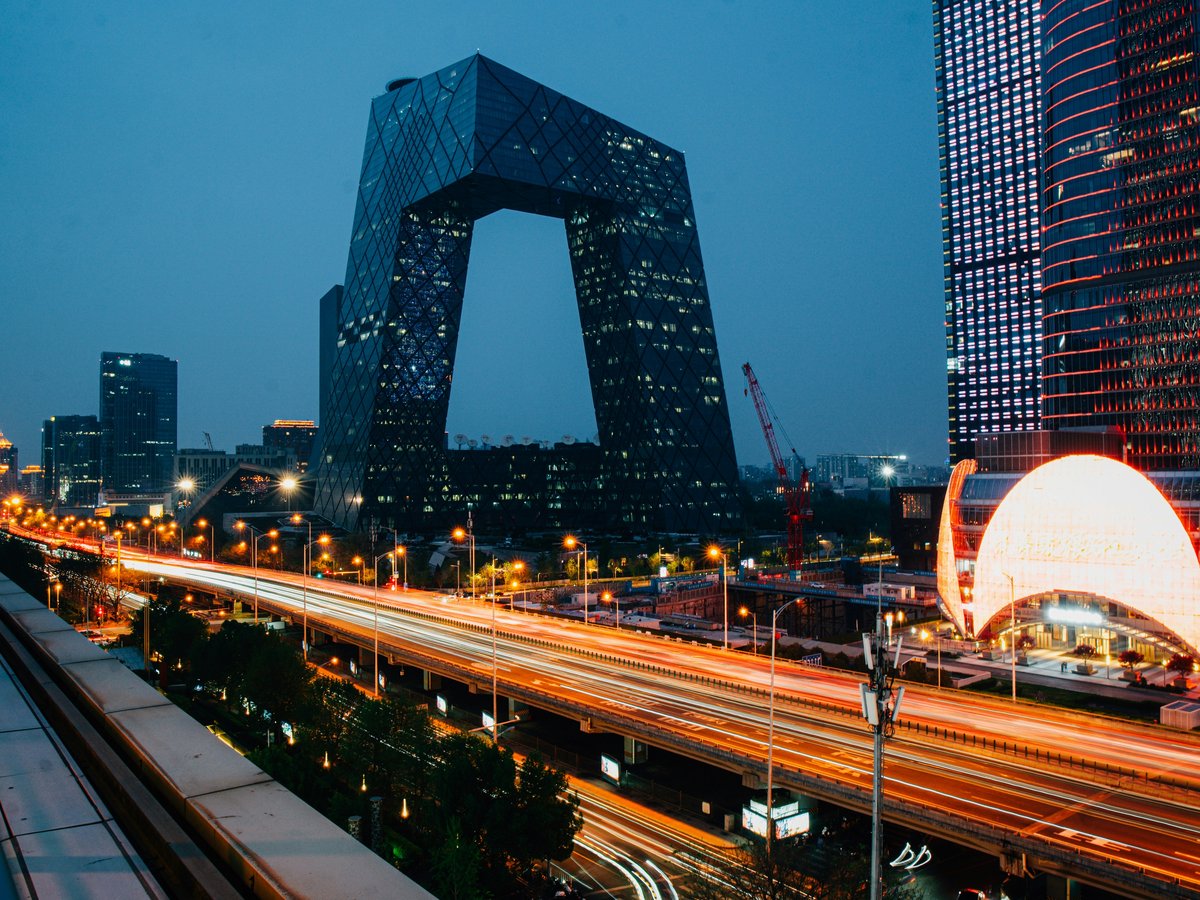
Beijing's modern architectural landmarks are visible from public streets and sidewalks at no cost. The National Centre for the Performing Arts (国家大剧院), designed by Paul Andreu and completed in 2007, sits in an artificial lake west of Tian'anmen. The titanium-and-glass dome is best viewed from the surrounding path at dusk, when interior lighting makes the structure glow. The CCTV Headquarters (中央电视台总部大楼), Rem Koolhaas's 234-meter cantilevered loop, is visible from multiple points along East 3rd Ring Road. Galaxy SOHO, Zaha Hadid's flowing aluminum complex near Chaoyangmen, opened in 2012 and is free to enter and walk through the interior courtyards on all 4 levels. The Wangjing SOHO towers, also by Hadid's firm, are about 7 kilometers northeast and visible from Line 15's Wangjing station. None of these buildings charge for exterior viewing or, in Galaxy SOHO's case, interior exploration.
Navigating Beijing's Reservation Systems
Most free museums in Beijing shifted to reservation-only entry between 2019 and 2021. The National Museum of China typically opens reservations 7 days ahead, and weekend slots for popular exhibitions can fill within hours. The Capital Museum allows booking 5 days in advance. Both use WeChat mini-programs for booking, which currently requires a Chinese phone number for verification. If you don't have a Chinese number, some museums still accept walk-up visitors with a foreign passport when capacity allows, but this is not guaranteed and tends to work better on weekday mornings. Bring your passport to every museum visit. ID checks happen at the door, and the name on the reservation must match the document. The Military Museum on Fuxing Road follows a similar system. Plan your museum days early in the trip so you have time to rebook if your first-choice slot fills up.
When Free Costs a Little
A few places sit in a gray area. Jingshan Park (景山公园), directly behind the Forbidden City, charges 2 yuan. Beihai Park (北海公园) costs 10 yuan in summer and 5 in winter. These are not free, but at current exchange rates 2 yuan is roughly 0.28 USD. The Temple of Heaven park grounds (天坛公园) charge 15 yuan without the interior halls. Some visitors treat these as effectively free, but this guide does not list them in the free attractions section because they do charge. Also worth knowing that many hutong courtyards marked on tourist maps as 'free to visit' are private residences. Peering through gates is generally tolerated, but walking into an occupied siheyuan courtyard without invitation is not appropriate. The distinction between public and private space in hutong neighborhoods can feel ambiguous to newcomers. When in doubt, a quick 'keyi jinqu ma?' (可以进去吗, may I come in?) goes a long way.
FAQ
Do I need to make reservations to visit free museums in Beijing?
Yes, nearly all of Beijing's free museums currently require advance reservations. The National Museum of China, Capital Museum, and National Art Museum of China all use WeChat-based booking systems. Slots typically open 5 to 7 days in advance. Weekend and holiday slots fill fastest. Bring your passport, as ID checks happen at entry. If you don't have a Chinese phone number for WeChat verification, try arriving at the museum early on a weekday morning and asking at the ticket window whether walk-up entry with a foreign passport is possible. It sometimes works, but it is not guaranteed.
Is Tian'anmen Square really free to visit?
Tian'anmen Square is free to enter but requires security screening and a valid ID. Foreign visitors need their passport. The screening process can take 10 to 20 minutes during busy periods, especially on national holidays like October 1. The square is open daily but may close for state events without much advance notice. The flag raising ceremony at sunrise and flag lowering at sunset are also free to watch.
Are Beijing's parks free?
Some are, some are not. Ritan Park, Zizhuyuan Park (Purple Bamboo Park), and Olympic Forest Park are fully free year-round. Other well-known parks charge entry. Beihai Park costs 10 yuan in summer and 5 in winter. Jingshan Park charges 2 yuan. The Temple of Heaven park grounds charge 15 yuan. The pricing distinction tends to follow historical significance. The 2006 park reforms made many neighborhood-level parks free, but the larger imperial-era parks kept their fees.
What is the best time of year to visit Beijing for free activities?
Autumn, specifically late September through mid-November, is likely the best window. The air tends to be clearer than summer, temperatures hover around 10 to 20 degrees Celsius, and the ginkgo trees along roads like Ditan Park's east wall turn a deep gold. The Beijing Music Festival runs through October. Spring in April and May is also pleasant, though sandstorms still hit occasionally, usually 2 to 3 times per season. Summer brings temperatures above 35 Celsius and heavy rain in July and August, which can make long outdoor walks uncomfortable. Winter is cold, often below minus 5 Celsius in January, but the city is quieter and museum reservation slots are easier to get.
Is 798 Art District free to visit?
Walking through the district is free, and many smaller galleries charge no entry fee. The main anchor gallery, UCCA Center for Contemporary Art, charges for its primary exhibitions, currently around 60 to 100 yuan depending on the show. But dozens of smaller galleries, the outdoor sculpture installations, and the Bauhaus-era factory architecture are all accessible without paying. Most galleries close on Mondays. Saturday afternoons tend to have the most energy, especially when multiple galleries host opening receptions on the same day.
Can I see the Great Wall for free?
The major restored sections of the Great Wall all charge admission. Badaling costs 40 yuan in peak season (April through October) and 35 yuan in off-season. Mutianyu charges 40 yuan year-round. Some unrestored 'wild wall' sections like Jiankou do not have formal ticket booths, but reaching them requires significant hiking, the trails are unmarked and sometimes dangerous, and local authorities have been increasing enforcement against unauthorized access in recent years. This guide does not recommend wild wall sections as a free alternative because conditions are unpredictable and rescue services are limited.
Last verified by automated review (v1.7.2) on . What is automated review?