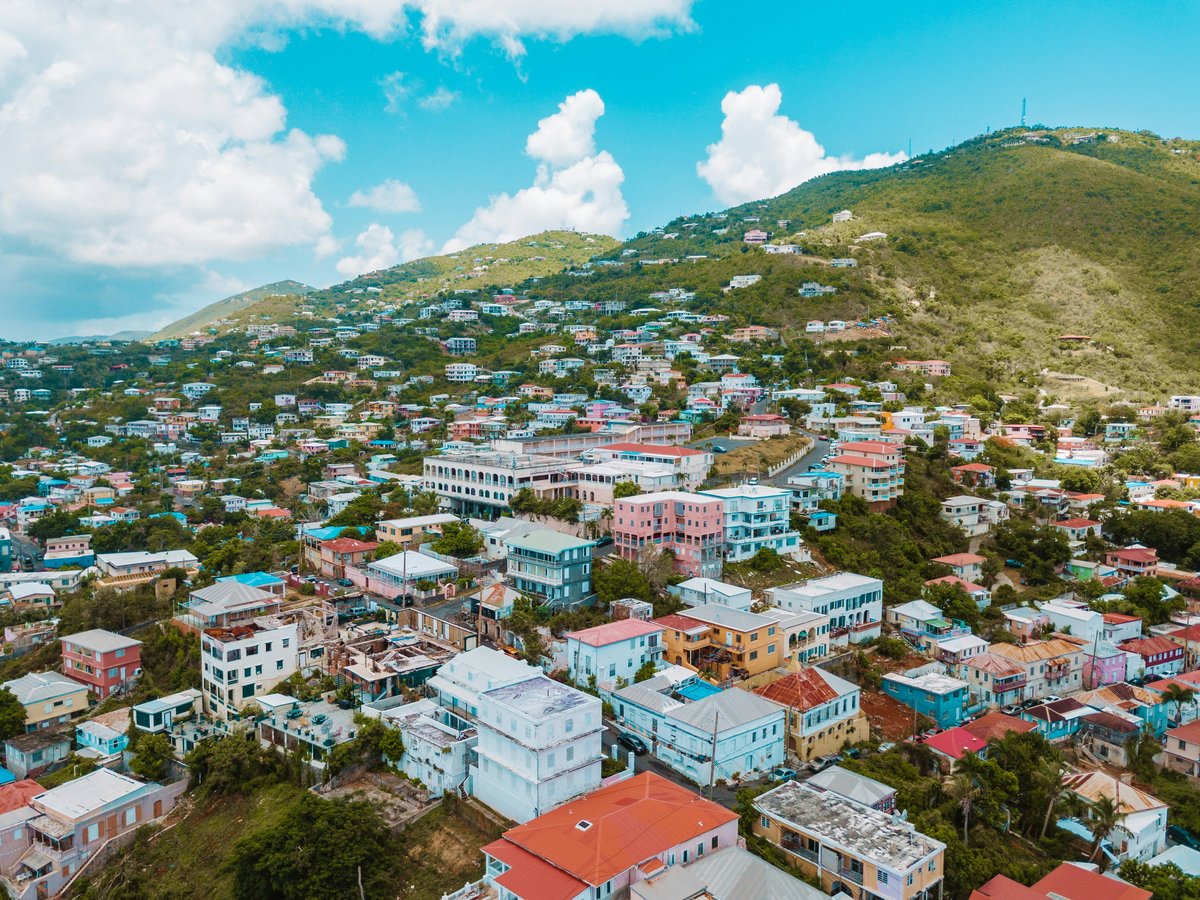
Best Time to Visit St. Thomas, by Season
St. Thomas's average highs range from 25.6°C in February to 28.8°C in September. A 3.2°C annual swing means weather alone never rules out a month. The real variables are hurricane risk, cruise-ship traffic at Havensight and Crown Bay, and what you pay for a room.
Published
1 The 3-Degree Island: Why St. Thomas's Temperature Curve Changes the When-to-Visit Equation
Stand on the waterfront in Charlotte Amalie in February and the thermometer reads an average high of 25.6°C. Come back in September and that number has reached 28.8°C. The full annual range on St. Thomas is 3.2°C. You could visit in any of the twelve months and find air that feels like the same island.
The month-by-month data confirms a flat line. January and April share an identical average high of 26.0°C, three months apart on the calendar. The cool season, December through April, stays inside a band of 25.6°C to 26.9°C for daytime highs. The warm season, June through October, holds between 28.0°C and 28.8°C. May at 27.2°C and November at 27.8°C sit between the two plateaus, the calendar's only real transition months.
So what drives the when-to-visit decision? Three forces that have nothing to do with temperature. First, cruise-ship density. Havensight dock and Crown Bay dock together make St. Thomas one of the Caribbean's busiest cruise ports. A peak-season morning in January or February can bring several large ships to harbor at once. Thousands of day-trippers fill Charlotte Amalie's duty-free jewelry stores along Main Street and Back Street. By June, those sidewalks thin to a fraction of winter foot traffic.
Second, hotel pricing. Properties from the Ritz-Carlton on the east end to mid-range spots like Bolongo Bay Beach Resort on the south coast run their highest rates from mid-December through mid-April. Shoulder months like May and November tend to sit well below peak. Third, the Atlantic hurricane season runs June 1 through November 30, with the statistical peak in August and September. Hurricane Irma struck St. Thomas as a Category 5 storm on September 6, 2017, a date the island still measures time against. A February afternoon at 25.6°C and a July afternoon at 28.2°C both feel warm beside the Caribbean. The difference is whether Magens Bay's parking lot fills by 10 a.m. or sits half-empty at noon.
A 3.2°C swing across twelve months means St. Thomas barely has seasons. The real variables are cruise-ship traffic, hurricane risk, and price.
2 December Through February: St. Thomas at Its Coolest, from 25.6°C to 26.9°C
Step outside on a January morning in St. Thomas and the air sits at an average low of 24.5°C. It is warm, but it is the kind of warm that lets you walk the 99 Steps up Government Hill without dripping by the third landing. By afternoon the high reaches 26.0°C. February drops to an average high of 25.6°C, the coolest reading the island posts all year. December runs marginally warmer at 26.9°C for the high and 25.2°C overnight.
This is precisely why high season exists. The December-through-February window brings peak North American demand, and St. Thomas's two cruise docks feel it. Havensight, a 10-minute walk from Charlotte Amalie's Main Street shopping corridor, handles the larger vessels. Crown Bay sits closer to the Frenchtown neighborhood, where a row of waterfront restaurants fills with cruise-day lunch traffic. On a busy February morning, the combined dock capacity can put more visitors onshore than the island's resident population of roughly 51,000.
Magens Bay, the north-shore beach that consistently ranks among the Caribbean's best, charges a $5 entrance fee and fills early on ship days. The sand is fine-grained, the U-shaped bay blocks open-ocean swell, and the water at Magens stays calm enough for small children. If you want that beach without the crowd pressure, Brewers Bay on the west end sits near the University of the Virgin Islands campus. The sand is coarser, the snorkeling is better, and the parking lot rarely fills even in peak February.
Hotel rates between mid-December and late February hit the annual ceiling across the island. Properties book months ahead for the Christmas-through-New Year's window. Mind you, the weather case for choosing January over February is nonexistent. January at 26.0°C versus February at 25.6°C is a gap of 0.4°C. The final week of February tends to carry lighter cruise traffic after the Presidents' Day surge clears.
3 March and April Hold Near 26°C While the Shoulder-Season Discount Arrives
A trade-wind breeze picks up off the harbor in late March and the air still feels indistinguishable from January. The numbers confirm it. March posts an average high of 25.7°C. April matches January exactly at 26.0°C for the high and 24.5°C overnight. You would need decimal precision to tell a March thermometer from a January one on St. Thomas.
This is where timing gets interesting. March sits at the tail of official high season. April falls into shoulder territory. Fewer cruise ships anchor in the harbor during April than during January or February. The Red Hook ferry terminal on the east end, where boats depart for St. John's Cruz Bay every hour, runs lighter traffic. A day trip to St. John's beaches and trails becomes a calmer experience without the peak-season ferry crowds.
Worth noting, April's average low of 24.5°C matches January's 24.5°C to the decimal on St. Thomas. The nights and days feel identical to January's readings. Room rates drop as the perceived season ends, even though the climate data shows zero meaningful change from peak-season temperatures. For travelers who can shift into early April, this gap between market perception and the thermometer creates one of St. Thomas's better value windows.
March might suit families with spring-break calendars. Magens Bay's $5 entrance fee still applies, and the north-shore water temperature hovers near 26°C in March, warm enough for long sessions. Coral World Ocean Park at Coki Point on the northeast coast runs its marine encounters and undersea observatory on full schedule. Spring-break weeks carry near-peak traffic in Charlotte Amalie, but the crowds thin noticeably between the Friday departures and Tuesday arrivals of the weekly cruise rotation.
4 May's Jump to 27.2°C Is the Sharpest Monthly Shift on St. Thomas
You feel the shift in the pavement underfoot by mid-morning in May. The air has taken on weight. The average high reaches 27.2°C, a jump of 1.2°C from April's 26.0°C. In a climate where the entire annual range is 3.2°C, that single-month change is the largest step the thermometer takes in any direction. The overnight low climbs to 25.6°C, up 1.1°C from April's 24.5°C.
May is the hinge month on St. Thomas. Behind it lies the cooler plateau of December through April, where highs stayed between 25.6°C and 26.9°C. Ahead lies the warm season, where June's 28.0°C high climbs toward September's 28.8°C peak. St. Thomas Carnival typically falls in late April, and its energy carries into early May. The main events center on Charlotte Amalie's parade route. J'ouvert starts before dawn. The Grand Parade fills the waterfront with steel-pan bands, moko jumbies on stilts, and food vendors who sell pate, the island's deep-fried meat turnover.
The Atlantic hurricane season begins June 1, and the statistical risk in May stays low. Hotel pricing already reflects the off-season calendar. A room at Bolongo Bay Beach Resort on the south coast or Point Pleasant Resort above Red Hook tends to run well below winter rates. The beaches belong to residents and the handful of visitors who know the rhythm. Hull Bay on the north shore, where a reef break draws the island's small surf community, sits empty most May afternoons.
The 1.1°C gap between May's overnight low of 25.6°C and April's 24.5°C matters more than it sounds. April nights still carry a slight edge of cool air on St. Thomas. May nights are uniformly warm. If sleeping temperature matters and your room relies on cross-ventilation rather than air conditioning, that gap separates the two months more clearly than the daytime readings. May's 25.6°C nighttime low sits above every month from December through April.
5 June Through August Stay Within 28.0°C to 28.6°C, Barely 3°C Above the Winter Floor
Moisture hangs in the air as you step into a June morning on St. Thomas. The thermometer has settled into a new band. June averages 28.0°C for the daily high and 26.3°C at night. July reads 28.2°C and 26.4°C. August reaches 28.6°C and 26.7°C. Across these three months, the high moves 0.6°C total. This is the summer plateau.
The distance between this plateau and peak season is narrower than most visitors assume. August's 28.6°C sits 3.0°C above February's 25.6°C. Along a Caribbean waterfront, that gap separates comfortable from slightly warm, not comfortable from oppressive. Coki Beach, on the northeast point near Coral World Ocean Park, tends to run warmer water in summer, near 28°C to 29°C. The snorkeling visibility can reach 15 meters on calm days. The reef fish seem to school thicker without the churn from cruise-excursion snorkel groups.
That said, all three months sit inside the Atlantic hurricane season. June carries lower statistical risk than August. August and September mark the historical peak for Caribbean storm formation. The 0.6°C spread between June's 28.0°C and August's 28.6°C is small, but humidity tends to make that gap feel wider in practice.
For budget travelers, this is St. Thomas's value window. Frenchtown, the old fishing quarter west of Charlotte Amalie, keeps its waterfront restaurant row open year-round. You can hear the harbor water lapping at the seawall between conversations on a quiet July evening. Red Hook's bar scene stays lively through summer, fed by the sailing community and St. John ferry commuters. Room rates across the island sit near their annual floor. June's 26.3°C overnight and August's 26.7°C mean the air on St. Thomas never fully cools after dark, which matters if your accommodation relies on trade winds rather than air conditioning.
August's 28.6°C sits 3.0°C above February's 25.6°C. Along a Caribbean waterfront, that gap separates comfortable from slightly warm, not comfortable from oppressive.
6 September Peaks at 28.8°C and October Holds at 28.7°C, and Few Visitors See Either Month
The water in the harbor shifts to a deeper green by late September. The air is dense with stored moisture, and the thermometer confirms what your body already registers. September posts the highest average high of 28.8°C and the highest overnight low of 26.8°C on the island's calendar. This is St. Thomas's thermal ceiling. October follows at 28.7°C for the high and 26.7°C at night, different by 0.1°C on both readings.
Few visitors experience either month on St. Thomas. Peak hurricane risk keeps tourist traffic near its annual floor. September 6, 2017, remains the reference date. Hurricane Irma crossed St. Thomas that morning as a Category 5 storm with sustained winds above 280 km/h. Two weeks later, Hurricane Maria followed. The rebuilding stretched over years. Every September, the anniversary sharpens awareness of what the season can deliver. The National Hurricane Center can track potential threats 5 to 7 days ahead, but the insurance and operational costs of the season keep much of the tourism infrastructure on reduced schedules.
Restaurant hours shorten across the island. Some tour operators pause entirely between September and mid-October. Coral World Ocean Park trims its daily programming. The Charlotte Amalie waterfront feels closer to a working Caribbean town than a cruise destination. Locals eat at bakeries in Sub Base and near Tutu Park Mall. The pace slows to something the island's roughly 51,000 residents recognize as their own.
To be fair, temperature alone does not justify the avoidance. September's 28.8°C high is 1.9°C above December's 26.9°C. But highs above 28°C have run continuously since June on St. Thomas. The buildings and pavement retain that heat. The warm season takes on a cumulative density that daily averages understate. October at 28.7°C begins the slow turn. November drops to 27.8°C, a 0.9°C step that starts the descent toward December's 26.9°C.
7 November Drops to 27.8°C and Becomes the Best Single Month to Visit St. Thomas
The heaviness lifts in early November on St. Thomas. You notice it first at daybreak on the hillside above Charlotte Amalie, where the air has lost the thick stillness of September and October. The average high has dropped to 27.8°C, a full degree below September's 28.8°C peak. The overnight low sits at 26.0°C, down 0.8°C from September's 26.8°C.
Here is the timing case. The Atlantic hurricane season runs through November 30, but late-season storms carry lower statistical probability than the August-through-October peak. Pricing tends to stay in the off-season bracket on St. Thomas, not yet carrying the premium that December's holiday demand brings. Cruise traffic remains light. Magens Bay, which can see tour buses lining its access road in February, runs at a fraction of winter capacity. The beach bar serves the same rum punches to a smaller crowd.
Sapphire Beach on the east end, sheltered by a reef that holds the water calm on windless November days, tends to clear out by mid-afternoon. The sand catches late sun until past 5 p.m. Red Hook, a 5-minute drive from Sapphire, keeps its ferry schedule to St. John's Cruz Bay at full frequency. The crossing takes about 20 minutes. November is arguably the best month for a day trip to Virgin Islands National Park on St. John, with lighter trail traffic on the Reef Bay Trail and water warm enough to snorkel Waterlemon Cay without a rashguard.
You get air at 27.8°C instead of August's 28.6°C. You avoid the crowd density that arrives with December's 26.9°C. For most travelers weighing a single month, November sits 2.2°C above February's 25.6°C floor and 1.0°C below September's 28.8°C ceiling on St. Thomas. The overnight low of 26.0°C has dropped 0.7°C from October's 26.7°C and points toward December's 25.2°C.
November at 27.8°C sits 2.2°C above February's 25.6°C floor and 1.0°C below September's 28.8°C ceiling. For most travelers, it threads the needle between heat, crowds, and cost.
8 The Verdict: Which Month Wins for Budget Travelers, Families, and Everyone Else
The air at 25.6°C in February sits light against your skin as you walk past Fort Christian, the 17th-century Danish fortification at the foot of Charlotte Amalie's Main Street. That same walk in September, at 28.8°C, moves slower, the pavement warm underfoot. Both months deliver the Caribbean. The question is which slice of that 3.2°C range fits your trip.
If comfort is the priority, February's 25.6°C high and 24.0°C low mark the coolest air St. Thomas produces all year. Pair it with January at 26.0°C and December at 26.9°C, and you get a three-month window of mild highs and cool nights. The trade-off is crowd density at every beach and the annual pricing peak at every hotel. Book Magens Bay mornings before 9 a.m. on ship days, or try Lindquist Beach at Smith Bay Park on the east end, where a $5 entry fee and no cruise-excursion routes keep the sand quieter.
For budget travelers, the June-through-August plateau holds highs between 28.0°C and 28.6°C at off-season rates. June at 28.0°C tends to feel the most manageable of the three months. August at 28.6°C sits at the warmer edge and coincides with peak Atlantic storm risk. Properties from the Ritz-Carlton to Marriott's Frenchman's Cove run summer promotions, and smaller spots like Bolongo Bay and Secret Harbour Beach Resort price competitively.
For families on school calendars, March's 25.7°C average high matches February within 0.1°C during spring-break timing on St. Thomas. April at 26.0°C moves into shoulder pricing. Coral World Ocean Park at Coki Point runs marine encounters year-round.
For the single best all-around month, November at 27.8°C sits 2.2°C above February's floor and 1.0°C below September's ceiling. The overnight low of 26.0°C has pulled back from October's 26.7°C. The hurricane season winds down through late November. Peak pricing has not started. May at 27.2°C earns a mention as the pivot month, 1.2°C above April and 0.8°C below June, with Carnival energy on the Charlotte Amalie waterfront and near-empty beaches at Hull Bay and Brewers Bay.
Last verified by automated review (v1.7.2_onboard-st-thomas-flagship-2026-09-11) on . What is automated review?