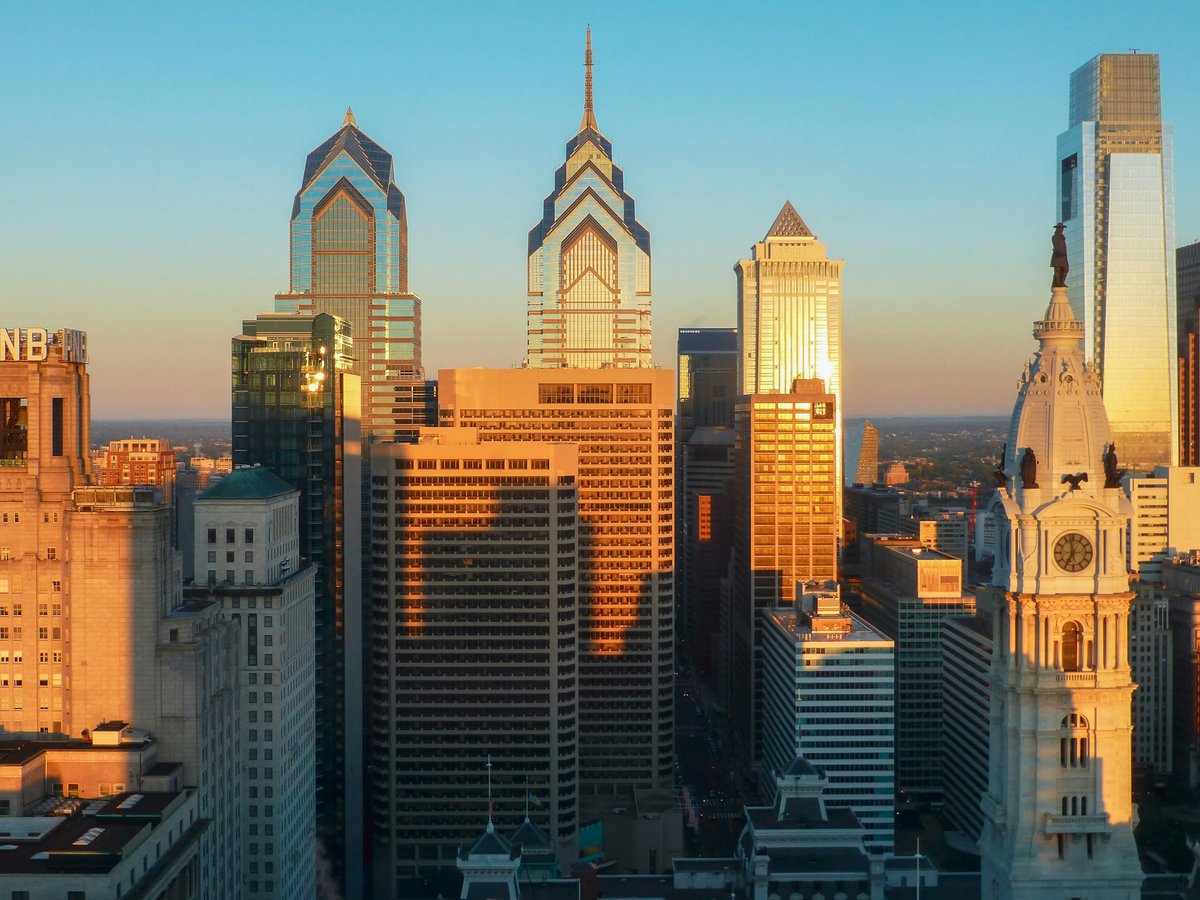
Best Time to Visit Philadelphia, by Season
Philadelphia's temperature swings 34 degrees between January's -2.6°C and July's 31.3°C. This month-by-month guide, built from 5-year daily-observation averages, names the single best travel window for budget visitors, families, photographers, and everyone in between.
Published · Updated
1 Philadelphia Swings 34 Degrees Between January and July: That Gap Decides Everything
Step off the train at Philadelphia's 30th Street Station on a July afternoon and the heat presses against your skin before you clear the platform. The avg high that month reaches 31.3°C. Overnight lows rarely drop below 21.4°C. Philadelphia's concrete and brick hold the warmth deep into the night, and the Delaware River offers no relief. Now picture the same platform in January, when the avg high sits at 5.2°C and the avg low falls to -2.6°C. Your breath hangs visible over the Schuylkill.
That 34-degree gap between January's overnight floor and July's afternoon ceiling is the single most useful fact for planning a Philadelphia trip. It splits the calendar into 4 temperature bands across 12 months, and picking the wrong band means picking the wrong city.
February's avg high of 7.3°C feels almost identical to December's 7.5°C. Both define Philadelphia's deep winter. But March's avg high climbs to 13.1°C, and April reaches 18.2°C. That 11-degree rise in about 8 weeks is the fastest seasonal shift on Philadelphia's calendar. Philadelphia's fall mirrors that speed. September's avg high of 25.9°C drops to October's 20.2°C, then November's 13.2°C, a loss of roughly 6°C per month through autumn.
The visitor who books a July trip at 31.3°C and the one who targets late September at 25.9°C are visiting different Philadelphias. The July traveller gets peak-season rates, longer waits, and 21.4°C nighttime lows that keep Center City sticky after dark. The September traveller gets 16.5°C evenings, thinner crowds, and the same access to Independence Hall and the museum district along the Benjamin Franklin Parkway. Each section below breaks a seasonal window by its temperature range and names the single best month for 5 types of traveller. December averages 7.5°C for highs and -0.2°C for lows.
2 December Through February: Below-Freezing Nights and the Off-Season Advantage
The smell of roasted chestnuts on a December evening near Rittenhouse Square might feel romantic for about 15 minutes. Then the -0.2°C overnight avg starts to register through your gloves. December's avg high of 7.5°C is survivable for daytime walking. You can cross Center City in a good coat without suffering. But once the sun sets behind City Hall, Philadelphia's winter announces itself.
January hits the lowest point on Philadelphia's temperature curve. The coldest month on the calendar averages 5.2°C for highs and -2.6°C for lows. That -2.6°C floor means ice on the sidewalks of South Street and a wind off the Delaware that finds every gap in your layers. February offers almost no improvement. Its avg high of 7.3°C and avg low of -1.9°C land within 0.3°C of December's numbers. All 3 months live in the same narrow temperature band, between 5.2°C and 7.5°C for highs, between -2.6°C and -0.2°C for lows.
To be fair, Philadelphia's winter has a clear upside for the right visitor. Hotel rates in Center City and Old City tend to reach their annual low between January and February. The crowds that pack the Liberty Bell pavilion in July thin to a trickle. If your Philadelphia trip is built around indoor destinations, the Reading Terminal Market on 12th Street, the galleries in Old City, the theaters on the Avenue of the Arts, then the temperature outside matters less than the price of the room.
The budget traveller who can tolerate January's 5.2°C highs and -2.6°C lows should target late February, when rates are still depressed but the calendar is moving toward March's 13.1°C. Mind you, February's avg low of -1.9°C still means layering up after dark. Philadelphia in winter is a trade. You swap comfort for cost, and February's 7.3°C high is what you're buying into.
3 March Climbs to 13.1°C and April Reaches 18.2°C: The Fastest Warm-Up on the Calendar
There's a morning in late March when you step outside in Philadelphia and the air no longer bites. It still carries an edge, maybe a damp chill off the Schuylkill at the 2.3°C overnight low, but February's sting is gone. March's avg high of 13.1°C does not sound like much on paper. In practice, it feels like a different city from the 7.3°C you were getting 4 weeks earlier. The trees along Broad Street are still bare, but the sidewalk cafes in Rittenhouse Square start setting up outdoor tables.
April accelerates the shift. The avg high reaches 18.2°C and the avg low rises to 7.2°C. That is a 5.1-degree jump in 1 month at the top end, and a 4.9-degree rise on the bottom. By mid-April, Philadelphia's outdoor life starts to function again. The Schuylkill River Trail fills with runners. Fairmount Park draws families after school.
The spring shoulder season, roughly March 15 through April 30, tends to hit a useful sweet spot for price and weather. Temperatures sit between 13.1°C and 18.2°C for highs. Hotel prices in Center City haven't yet climbed to summer levels. The school-group crowds that descend on Independence National Historical Park in June haven't arrived. You'll find some of Philadelphia's quieter weekends in this window, between the winter lull and the summer rush.
April is the better of the 2 months for most visitors. Its 18.2°C highs allow a full day outdoors without cold-weather gear, and its 7.2°C lows make evenings on a restaurant patio in Old City manageable with a light jacket. March's 2.3°C lows still mean cold nights. The visitor who targets the last 2 weeks of April, when highs approach 18.2°C and the calendar points toward May's 23.1°C, gets spring rates with nearly summer weather. April's avg low of 7.2°C is the trade-off, and for most travellers it is a mild one.
4 May Averages 23.1°C and June Hits 28.7°C: The Best Walking Weather Before the Sweat
The first genuinely warm evening in Philadelphia tends to land in early May. You feel it on the walk from Suburban Station toward Washington Square, when the air at 12.4°C overnight no longer calls for a jacket. May's avg high of 23.1°C is the first month that sits comfortably in the warm range without tipping into heat. T-shirt weather during the day, light-layer weather at night, and the most balanced temperature window on the Philadelphia calendar.
June changes the equation. The avg high reaches 28.7°C and the avg low rises to 17.7°C. Philadelphia in June feels properly hot by midday, especially in the dense blocks around Market East and Chinatown where the buildings trap warmth. The 5.6-degree jump from May's 23.1°C to June's 28.7°C is enough to shift the city from pleasant to sweaty on an afternoon walk.
For the outdoor traveller, the choice between these 2 months is straightforward. May offers 23.1°C without the intensity. June offers 28.7°C with it. If your Philadelphia trip involves long days on foot through the grid from South Philadelphia to Northern Liberties, or afternoons in Fairmount Park, May is the better month. Worth noting, June's 17.7°C overnight lows do make for warmer evenings, which suits anyone whose trip centers on dining outdoors on East Passyunk or along the Delaware waterfront near Penn's Landing.
The late-May window, roughly May 15 through May 31, likely offers Philadelphia's best price-to-weather ratio. Summer rates haven't fully kicked in across Center City hotels, but the temperature already sits at 23.1°C for highs and 12.4°C for lows. June is summer pricing at summer temperatures. The budget-conscious visitor who needs warm weather but not necessarily 28.7°C should book the second half of May. June's avg low of 17.7°C means comfortable nights, but you'll pay summer rates for them. May's 12.4°C evenings come at shoulder-season prices.
5 July Peaks at 31.3°C and August Holds at 29.7°C: An Honest Look at Peak Summer
Stand at the corner of Broad and Walnut on a July afternoon and the heat radiates off the pavement in waves you can almost see. The avg high that month hits 31.3°C, but the felt temperature in Center City's concrete corridors runs higher. July also brings Philadelphia's warmest nights, with an avg low of 21.4°C. Philadelphia barely cools down between sunset and sunrise. A late walk along the Delaware waterfront near Race Street Pier offers moving air, but the temperature at 10pm still sits above 21°C.
August provides a small step down. The avg high drops to 29.7°C and the avg low to 19.8°C. That 1.6-degree decrease at the top and 1.6-degree drop at the bottom amounts to a slight softening rather than real relief. July and August belong to the same heat tier. Philadelphia at 29.7°C is a marginally cooler version of Philadelphia at 31.3°C, not a different experience.
This is the season that most domestic tourists choose for Philadelphia, and it is the wrong choice for most of them. Families visit in July and August because school is out, which means peak pricing at Center City hotels, long lines at the Liberty Bell, and crowded sidewalks through Old City on Saturday afternoons. The visitor who wants Independence National Historical Park or Elfreth's Alley will share every one of those spots with the largest crowds of the year.
The honest recommendation is to avoid July and August unless your schedule allows no alternative. If summer is your only window, early June at 28.7°C is cooler by 2.6 degrees and precedes the peak-season rush. September at 25.9°C is 5.4 degrees cooler than July and carries lower prices. The traveller locked into July should plan indoor time between 11am and 3pm, when the 31.3°C high peaks, and shift outdoor activities to after 6pm. July's overnight low of 21.4°C is the warmest Philadelphia gets at night.
The honest recommendation is to avoid July and August unless your schedule allows no alternative.
6 September Holds at 25.9°C and October Drops to 20.2°C: Philadelphia's Overlooked Best Season
Walk through Rittenhouse Square on a late September morning and the light arrives at a lower angle than summer allowed. The air carries a crispness that July's 31.3°C never permitted. September's avg high of 25.9°C sits in the range that outdoor cities were designed for, warm enough for short sleeves, cool enough for a full day of walking without the exhaustion that 31.3°C produces. The avg low drops to 16.5°C, which means evenings along South Street or at the outdoor tables on East Passyunk Avenue feel comfortable in a light jacket.
October continues the cooling. The avg high falls to 20.2°C and the avg low to 10.5°C. That 5.7-degree drop from September's high to October's is noticeable. By late October, Philadelphia is in jacket weather during the day and approaching cold at night. The leaves across Fairmount Park turn, and 10.5°C overnight lows mean dinner outdoors in Old City requires real planning.
November completes the fall descent. The avg high of 13.2°C and avg low of 4.2°C place it closer to December's 7.5°C than to October's 20.2°C. November in Philadelphia is functionally early winter, not late fall, and the drop from October's 20.2°C takes only about 4 weeks.
For most travellers, September is Philadelphia's single best month. The 25.9°C high is 2.8 degrees below June's 28.7°C and 2.8 degrees above May's 23.1°C. It sits at the center of the comfortable range. The 16.5°C overnight low means you'll want a layer after dark but won't need a coat. Summer crowds have largely cleared by Labor Day weekend. That said, hotel rates in Center City tend to drop from their July peaks. The visitor who can travel in late September, roughly September 15 through September 30, hits Philadelphia at its most livable temperature. October's 20.2°C is the fallback for anyone who prefers cooler weather and can handle 10.5°C evenings.
For most travellers, September is Philadelphia's single best month.
7 The Verdict: Late September for Most, Early May for Budget Travellers, Skip July
Philadelphia's best travel window depends on 2 variables, how you handle heat and how sensitive you are to price. The temperature data narrows the realistic options to 3 windows for most visitors, with the 34-degree swing between January's -2.6°C and July's 31.3°C eliminating the extremes on both ends.
For the general visitor who wants warm weather, manageable crowds, and moderate prices, late September is the answer. The 25.9°C avg high and 16.5°C avg low deliver the most comfortable outdoor conditions on Philadelphia's calendar. September sits 2.8 degrees below June's 28.7°C and 2.8 degrees above May's 23.1°C. Most Philadelphians would agree.
For the budget traveller, early May is the window. The avg high of 23.1°C is warm enough for outdoor days, and the 12.4°C overnight low needs only a light layer. May precedes the summer pricing that kicks in around Memorial Day weekend. You get 23.1°C weather at shoulder-season rates.
For the cold-tolerant bargain hunter, late February offers the lowest room rates in Philadelphia at 7.3°C highs and -1.9°C lows, with March's 13.1°C already in sight.
For families with school-age children locked into summer, the best compromise is the first 2 weeks of June. The avg high of 28.7°C is 2.6 degrees below July's 31.3°C, and school-break crowds haven't fully formed. June's 17.7°C overnight lows keep evenings warm enough for outdoor dining in Old City or walks along the Schuylkill Banks.
For photographers and architecture visitors, October at 20.2°C brings the best light and 10.5°C evenings that clear the haze July's 31.3°C carries. Skip July and August unless you have no choice. July at 31.3°C and August at 29.7°C are Philadelphia's hottest, most crowded, and most expensive months. September's 25.9°C is 5.4 degrees cooler and only weeks away. September's avg low of 16.5°C means you can eat dinner outdoors at Rittenhouse Square after dark.
Last verified by automated review (v1.7.0_onboard-philadelphia-flagship-2026-06-18) on . What is automated review?