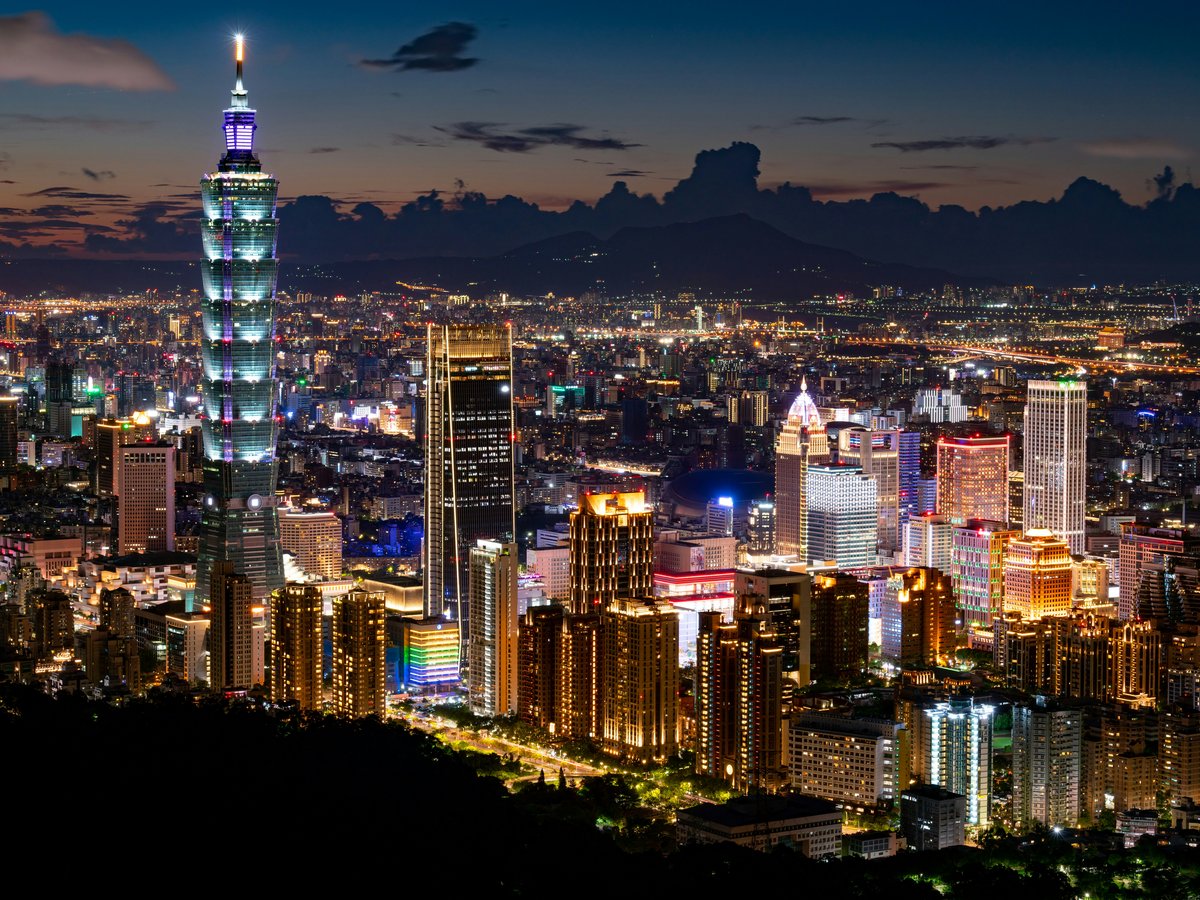
Taipei sits in a basin ringed by mountains on three sides, with the Tamsui River curving along its western edge and the Keelung River cutting through the center. The MRT system, with 6 lines and 131 stations as of 2024, connects most neighborhoods in under 40 minutes. The city tends to cluster its energy around specific MRT stops rather than spreading evenly across districts. North of Taipei Main Station, the older commercial districts feel denser and louder. South of it, the streets widen and the Japanese colonial-era grid becomes more apparent, especially around Da'an and Zhongzheng. East Taipei, anchored by Taipei 101 and the Xinyi development zone, is where the corporate towers and department stores landed in the 1990s and 2000s. West Taipei holds the oldest temples, the original trading ports along Dadaocheng, and the kind of narrow lanes where you'll still find 80-year-old noodle shops next to incense-filled shrines. Most first-time visitors end up near Zhongxiao Dunhua or Taipei Main Station, but the city rewards spreading out. A single MRT ride from Dongmen to Beitou covers roughly 14 kilometers and crosses at least 4 distinct neighborhood personalities.
Neighborhoods
-
Da'an
Da'an feels like Taipei's default setting for comfortable daily life. Tree-lined streets, particularly along Dunhua South Road and Xinyi Road, are shaded by banyans planted in the 1960s. The architecture is a mix of 5-story walk-ups from the 1970s and newer 12-story towers with ground-floor bakeries and tea shops. Foot traffic stays steady but rarely overwhelming, except around the Yongkang Street area on weekends. The pace here is slower than Ximending or Xinyi, with more stroller-pushing parents and university students from nearby National Taiwan University than tourist groups.
- Best for
- First-time visitors who want a residential feel with strong food options within walking distance. Couples and solo travelers who prefer quiet evenings over nightlife.
- Key streets
- Yongkang Street for the original Din Tai Fung (at No. 194, Xinyi Road Section 2) and the mango shaved ice at Smoothie House. Dunhua South Road's cafe strip between Zhongxiao and Ren'ai runs about 1.5 kilometers. Wenzhou Street near NTU has secondhand bookshops and cheap lunch sets under NT$120.
-
Ximending
Ximending operates at a higher volume than the rest of Taipei. The pedestrian zone around Kunming Street and Wuchang Street stays packed from noon until well after midnight, with speakers competing from storefronts selling bubble tea, fried chicken, and Japanese-import cosmetics. The architecture is a jumble of postwar commercial buildings, some still showing art deco details from the Japanese era, especially along Chengdu Road near the old Taipei Zhongshan Hall. Graffiti and street art cover most of the alleys south of Xining South Road. The smell shifts block by block, from deep-fried sweet potato balls to incense drifting out of Longshan Temple a 10-minute walk south.
- Best for
- Younger travelers, teenagers, anyone who feeds on street energy and late-night eating. Budget travelers will find hostels here starting around NT$500 per night.
- Key streets
- The pedestrian zone centered on Hanzhong Street and Kunming Street is the main draw, roughly 6 blocks. Emei Street has the historic Red House, built in 1908, now surrounded by outdoor bars and craft stalls on weekend nights. Chengdu Road Section 2 connects Ximending to Longshan Temple in about a 15-minute walk.
-
Zhongshan
Zhongshan sits north of Taipei Main Station and currently feels like it is mid-transition. Zhongshan North Road was once the diplomatic corridor, lined with embassies and formal restaurants. That old-money quality still shows in the wider sidewalks and the occasional marble-lobbied hotel. But the side streets, especially the lanes between Nanjing West Road and Minsheng West Road, have filled with independent coffee roasters, small galleries, and clothing boutiques over the past 10 years. The underground book street beneath Zhongshan MRT, a 270-meter corridor of bookshops, smells like old paper and fluorescent lighting. At street level, the Japanese-built Taipei Fine Arts Museum sits in a park that fills with families on Saturdays.
- Best for
- Design-minded travelers, gallery hoppers, and anyone who wants walkable streets without the tourist density of Ximending or Xinyi.
- Key streets
- The lanes between Zhongshan North Road Section 2 and Xinsheng North Road, particularly Lane 25 and Lane 53, hold most of the independent shops. Chifeng Street, running parallel about 2 blocks west, has become a concentrated stretch of small studios and cafes over the past 5 years. Nanjing West Road links Zhongshan to the Dadaocheng area on foot in about 20 minutes.
-
Xinyi
Xinyi is where Taipei puts on its corporate face. The district was largely farmland until the 1980s, then developed rapidly around the World Trade Center and, from 2004, Taipei 101. The streets here are wide and grid-planned, the buildings mostly glass and steel from the past 30 years. Songshan Cultural and Creative Park, a repurposed tobacco factory from 1937, adds some texture at the district's northern edge. The area around the Taipei City Hall MRT stop has 7 department stores within a 500-meter radius, including Breeze Center and the ATT 4 Fun building. After dark, the clubs on Songren Road draw a younger crowd, and the noise level rises considerably. Daytime Xinyi feels corporate. Night Xinyi feels like it is trying to be Roppongi.
- Best for
- Business travelers, luxury shoppers, and visitors who want proximity to Taipei 101 and nightlife without needing to transfer on the MRT.
- Key streets
- Songgao Road and Songren Road form the main retail and nightlife spine between Taipei City Hall MRT and Taipei 101. Songzhi Road connects to Songshan Cultural Park. The elevated walkway between Eslite Spectrum (which replaced the old Eslite Xinyi in 2023) and the Humble House hotel gives a wide view of the 101 tower, particularly after 6 PM when the lighting kicks in.
-
Songshan (around Raohe)
Songshan district covers a wide area, but the part most visitors encounter is the stretch around Raohe Street Night Market and Ciyou Temple. Raohe runs about 600 meters along the south bank of the Keelung River, and the market has operated here since 1987. The smell of black pepper buns from the stall at the market entrance, which typically has a 15-to-20-minute line after 6 PM, reaches you before you see the crowd. The temple at the market's west end, Ciyou Temple, dates to 1753 and still hosts active worship. Away from the market, Songshan is residential and calm, with 8-story apartment blocks and small breakfast shops.
- Best for
- Food-focused travelers and anyone who wants a night market experience that is slightly less chaotic than Shilin. Families might find it easier here since the single-street layout keeps navigation simple.
- Key streets
- Raohe Street is the main attraction. Bade Road Section 4, a block south, has several traditional breakfast spots serving dan bing and soy milk for under NT$60. The Five Fingers Mountain hiking trailhead is accessible from the Houshanpi MRT stop, about a 10-minute walk east of the market area.
-
Dadaocheng (Datong District)
Dadaocheng is the oldest commercial district in Taipei, with roots going back to the 1850s when it served as the main tea and camphor trading port. Dihua Street, the neighborhood's spine, is lined with baroque and southern Fujian-style shophouses, many dating to the 1920s. The buildings have been gradually restored since a preservation push in the mid-1990s. Some now hold fabric shops that have operated here for 3 generations. Others have become tea rooms or dried goods stores selling mullet roe and Chinese herbs. The air on Dihua Street tends to smell like dried mushrooms and herbal medicine, especially near the intersection with Minsheng West Road. The pace is noticeably slower than the areas south of Taipei Main Station.
- Best for
- Architecture enthusiasts, photographers, and travelers who prefer historical neighborhoods over commercial districts. Couples looking for a quieter base with walkable food options.
- Key streets
- Dihua Street Section 1 runs about 800 meters and holds most of the restored shophouses, fabric merchants, and specialty food stores. Yanping North Road, running parallel one block east, has less foot traffic and more functional neighborhood shops. Minsheng West Road connects Dadaocheng to the Zhongshan area in a 15-minute walk. The Dadaocheng Wharf along the Tamsui River has a bike path that runs 8 kilometers north to Guandu.
-
Beitou
Beitou sits at the end of the Red Line MRT, about 35 minutes north of Taipei Main Station, where the foothills begin and natural hot springs surface along the Beitou Creek. The sulfur smell hits you as soon as you exit Xinbeitou MRT. The neighborhood splits into two zones. The lower commercial area around Guangming Road has hotels, convenience stores, and the free public foot-soaking pools along the creek. The upper hillside, accessed by walking past the Beitou Hot Spring Museum (a 1913 Japanese bathhouse, free entry, closed Mondays), gets progressively quieter, with traditional ryokan-style inns and the sounds of running water and cicadas replacing traffic noise. The thermal valley, or Hell Valley, at the top of the path produces water at roughly 80 to 100 degrees Celsius and is visually striking, with green-gray sulfuric pools steaming against the hillside.
- Best for
- Travelers who want a hot spring retreat without leaving the city. Anyone looking for a half-day escape that does not require a car or a train ticket beyond the regular MRT fare of NT$30 to NT$40 from central Taipei.
- Key streets
- Zhongshan Road in Beitou leads uphill from Xinbeitou MRT past the hot spring museum and the Ketagalan Culture Center to the thermal valley, about a 20-minute walk. Guangming Road near the station has restaurants and the public foot bath. Qinianlu Road, a side lane off Zhongshan, has a few smaller, less crowded hot spring hotels with private rooms starting around NT$300 per person for a 90-minute soak.
-
Wanhua (Longshan Temple area)
Wanhua is the oldest settled part of Taipei, centered on Longshan Temple, which was first built in 1738. The neighborhood still carries a rougher, more lived-in quality than the polished districts east of it. Guangzhou Street, which runs south from the temple, hosts a night market that is smaller and less touristy than Shilin or Raohe. The daytime street life includes older residents playing Chinese chess on folding tables and vendors selling herbal teas from metal carts. The temple itself is intensely sensory, with thick coils of incense hanging from the ceiling, the clatter of divination blocks against stone floors, and red and gold woodwork darkened by decades of smoke. Huaxi Street, formerly known for snake restaurants, has shifted toward more conventional seafood stalls, though a couple of the original snake-blood shops reportedly still operate.
- Best for
- Travelers interested in traditional Taiwanese temple culture, local street food, and neighborhoods that have not been redeveloped for tourism. Budget travelers will find accommodation around Longshan Temple MRT starting near NT$800 per night for basic hotels.
- Key streets
- Guangzhou Street runs the night market from the temple south for about 400 meters. Xiyuan Road, one block east, has traditional shops selling Buddhist supplies, paper offerings, and temple goods. Bangka (the old name for Wanhua, from the indigenous Ketagalan word) Park, across from the MRT exit, fills with older men in the early mornings and has been a neighborhood gathering point for decades.
-
Tianmu
Tianmu developed as an expatriate neighborhood during the 1950s and 1960s when American military advisors and their families were stationed nearby. That legacy still shows in the wider-than-average streets, the Western-style grocery stores, and the restaurants offering cuisines uncommon elsewhere in Taipei, from German sausages to American-style brunch. Tianmu East Road and Tianmu West Road form the main commercial strip, with a mix of international schools, pet shops, bakeries, and the kind of cafes that serve eggs Benedict. The residential lanes behind the main roads are quiet, lined with low-rise apartment buildings and small gardens. Yangmingshan National Park is accessible by bus from Tianmu, a 20-minute ride up into the volcanic hills.
- Best for
- Families with children, especially those attending Taipei American School or Taipei European School. Travelers who want an English-friendly neighborhood base for exploring Yangmingshan.
- Key streets
- Tianmu East Road and Tianmu West Road are the twin main streets, running about 800 meters each. Zhongshan North Road Section 6 connects Tianmu to central Taipei. The bus stop for Yangmingshan (Route S15 or 260) is at the Tianmu roundabout. Jason's Supermarket on Tianmu East Road stocks imported goods from about 15 countries.
FAQ
Which Taipei neighborhood is best for first-time visitors?
Da'an tends to work well for first visits. The Zhongxiao Dunhua and Dongmen MRT stations put you within 2 to 3 stops of most major attractions. Yongkang Street gives you immediate access to well-regarded restaurants without needing to plan. Hotels in the area range from about NT$2,500 to NT$6,000 per night for mid-range options, and the area feels safe for walking at any hour.
Is it worth staying near Taipei Main Station?
Taipei Main Station offers the most MRT connectivity (Red, Blue, and Green lines all intersect here, plus the airport MRT and HSR), but the immediate surroundings are commercial and not particularly interesting after business hours. The underground mall beneath the station, stretching nearly 1 kilometer, is useful but sterile. If convenience of transit is your priority and you plan to spend most time in other neighborhoods, it works. But for a more textured daily experience, staying one or two stops away in Zhongshan or Da'an is generally a better trade-off.
How safe is it to walk around Taipei's neighborhoods at night?
Taipei consistently ranks among the safest large cities in Asia. Night markets operate past 11 PM in most neighborhoods, and convenience stores stay open 24 hours on nearly every major block. The MRT runs until midnight (until 1 AM on Fridays and Saturdays since 2023). Wanhua around Longshan Temple has a slightly grittier feel after dark, but serious safety incidents affecting visitors are quite rare. Common sense still applies, but walking alone at midnight in Da'an or Zhongshan is normal behavior for residents.
What is the best neighborhood for street food in Taipei?
Wanhua around Guangzhou Street and Songshan around Raohe Street both offer concentrated night market eating. Raohe is more famous and slightly more orderly, with its single 600-meter lane. Guangzhou Street has rougher edges and fewer tourists. For daytime street food, the lanes around Yongkang Street in Da'an and the traditional market in Shuanglian (one MRT stop north of Zhongshan) both deliver well. Budget for about NT$200 to NT$400 per person for a full night market meal with drinks.
How long does it take to get between neighborhoods on the MRT?
Most neighborhood-to-neighborhood trips within central Taipei take between 10 and 25 minutes on the MRT. Da'an to Xinyi is about 8 minutes. Taipei Main Station to Beitou is roughly 30 minutes. Ximending to Songshan (Raohe area) takes about 20 minutes with one transfer at Taipei Main Station. The MRT runs from 6 AM to midnight, with trains every 3 to 7 minutes depending on the line and time of day. A single ride ranges from NT$20 to NT$65 depending on distance.
Should I stay in Beitou or visit as a day trip?
Both work, depending on what you want. An overnight in Beitou, particularly at one of the hillside ryokan-style inns along Qinianlu Road, lets you soak at off-peak hours when the baths are quietest, typically early morning or late evening. Rooms at mid-range hot spring hotels start around NT$3,000 per night and usually include private in-room baths. As a day trip, the MRT gets you there in 35 minutes from Taipei Main Station, and 3 to 4 hours is enough to visit the thermal valley, the hot spring museum, and take a public soak. The Millennium Hot Spring at NT$40 makes it an affordable half-day outing.
Last verified by automated review (v1.7.2) on . What is automated review?