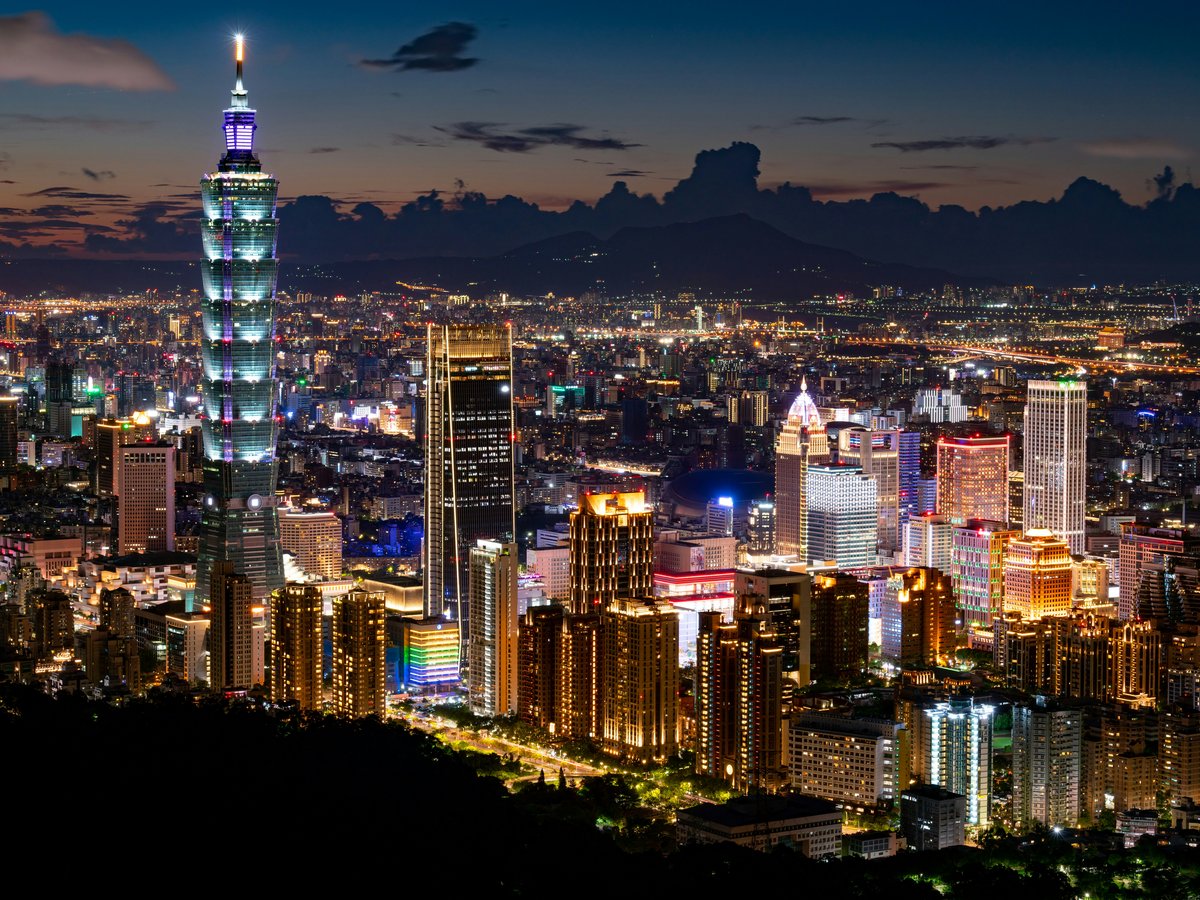
Best Time to Visit Taipei, by Season
Taipei's temperatures swing from January's 13.1°C nights to July's 33.4°C afternoons, a 20-degree range that separates a great trip from an endurance test. This month-by-month projection, built from 5-year daily-observation averages, names the single best window for every kind of traveller.
Published · Updated
1 Taipei's 20-Degree Annual Swing Means the Calendar Decides Your Trip
Steam curls off the pavement outside Taipei Main Station on a July afternoon, the air so thick you can taste the exhaust and tropical moisture on your tongue. The thermometer reads 33.4°C, the average high for both July and August in Taipei. Come back in January and the same sidewalk feels like a different city, 19.0°C and grey, the cold damp pushing through every layer you packed. That 20-degree range between Taipei's coldest January nights at 13.1°C and its hottest July afternoons at 33.4°C shapes every planning decision.
Taipei's overnight lows sharpen the contrast. January nights drop to 13.1°C. July nights barely dip to 25.7°C, providing little relief from the daytime heat. August mirrors July almost exactly, with a 33.4°C high and a 25.6°C low. Those 2 months form a heat plateau that defines Taipei's summer and tests every visitor who arrives unprepared.
The warming curve across Taipei's basin is not symmetrical, and that matters for planning. Spring heats fast. March reaches a 23.3°C average high, April pushes to 26.2°C, and by May the city sits at 28.8°C. That is nearly 10 degrees of warming in 3 months. The autumn cooldown is gentler. September still holds at 32.0°C in Taipei, October eases to 28.2°C, and November settles at 24.8°C. Taipei's spring comfort window runs roughly 2 months. The autumn shoulder stretches closer to 3.
Temperature is one of 3 variables that shape a Taipei trip. Crowds follow their own calendar. Chinese New Year fills the city in late January or February regardless of the 20.2°C highs. Summer vacation packs hotels through July and August despite the 33.4°C punishment. Hotel prices tend to track demand, not comfort. December's average high of 20.3°C is pleasant by global standards, yet hotel rates in Taipei tend to drop because the tourist calendar has moved on.
That 20-degree range between Taipei's coldest January nights at 13.1°C and its hottest July afternoons at 33.4°C shapes every planning decision.
2 December Through February Brings 13°C Nights and the City to Yourself
Ginger, sesame oil, and slow-cooked pork bone broth roll out of hot pot restaurants across Taipei's Datong district on a December evening. When the average high sits at 20.3°C and the overnight low drops to 15.1°C, the city turns inward and the steamboat restaurants fill up.
January is Taipei's coldest month. Average highs reach only 19.0°C, with lows of 13.1°C. That might sound mild to visitors from Oslo or Montreal, but Taipei's older buildings were designed for subtropical heat, not insulation. Central heating is rare in Taiwan's residential buildings. The damp northeast monsoon air makes 13.1°C in Taipei feel noticeably colder on exposed skin. Layers work better than a single heavy coat in Taipei's winter.
February warms marginally to 20.2°C average highs and 14.1°C lows. The variable that decides February for most visitors isn't temperature. It's Chinese New Year. When the holiday falls in February, hotel rates spike across Taipei, domestic travellers fill every High Speed Rail train south to Tainan and Kaohsiung, and some family-run restaurants close for a full week. Outside that holiday window, February tends to be one of Taipei's quietest months.
Hotel rates in Taipei from December through February, excluding the New Year spike, tend to be the year's lowest. Night market queues at Shilin and Raohe shrink. Temple courtyards in Wanhua empty out enough to study the carved stonework without a crowd at your shoulder. The cost is persistent grey sky, drizzle from the northeast monsoon, and short December daylight.
This window fits budget travellers who run warm and prefer eating to hiking, visitors who want Beitou's sulfur springs at their peak season, and anyone who values thin crowds over blue sky. Skip December through February if outdoor sightseeing is the point. January's 19.0°C highs and 13.1°C lows keep most visitors indoors by late afternoon.
3 March and April Land Between 23°C and 26°C, the Two Easiest Months to Walk
March mornings in Taipei have a softness the other months don't match. The air sits at 15.5°C at dawn, cool enough for a light jacket, and warms to a 23.3°C average high by early afternoon. You can walk the riverside paths from Dadaocheng Wharf toward Guandu without drowning in sweat, and that alone makes March one of Taipei's most comfortable months.
April pushes the average high to 26.2°C with lows of 18.8°C. Still comfortable for most visitors, though the humidity builds noticeably across Taipei's basin. The 26.2°C reads as moderate on paper, but the moisture that pools in the Taipei Basin between Yangmingshan to the north and the hills to the south makes it feel warmer on your skin than the number suggests. By late April, the air thickens.
These 2 months sit in a narrow window between winter's grey drizzle and the plum rain season that arrives in May at 28.8°C. March and April tend to get more clear days than the December-through-February stretch in Taipei, and the temperatures allow full days of walking without the heat management that June through September demand. Yangmingshan National Park's trails above Taipei are at their best in March, when the mountain air sits cooler than the 23.3°C basin below.
The crowd picture in Taipei is mixed across these months. March is moderate. April sees a bump around the Qingming Festival, a public holiday that falls around April 4 or 5 each year. Domestic travel across Taiwan rises for several days, and some temple areas in Taipei get busier. Hotel prices tend to sit in a middle range, below summer's peak but above the December-January lows.
For travellers who want to walk Taipei's temples, parks, and mountain trails, March's 23.3°C highs and 15.5°C lows are the year's most balanced conditions. April's 26.2°C highs still work, but late April starts the humidity that defines the next 5 months in Taipei.
4 May Hits 28.8°C and Then June's 31.7°C Brings the Plum Rains
The first thing you notice about Taipei in May isn't the heat. It's the sound of rain hitting corrugated metal awnings over night market stalls, a metallic drumming that follows you block after block through Shilin and Raohe. May marks the start of Taipei's plum rain season, and the average high reaches 28.8°C with lows of 21.7°C.
June pushes the average in Taipei to 31.7°C highs and 24.5°C lows. The plum rains, called méiyǔ in Mandarin, typically dominate May and June across northern Taiwan. The difference between May and June is roughly 3 degrees on paper, but that jump from 28.8°C to 31.7°C crosses a threshold most visitors feel. At 28.8°C with rain, you're damp and warm. At 31.7°C with rain, you're reconsidering the afternoon plan.
These 2 months are Taipei's least popular tourist window for good reason. The combination of heat, humidity, and rain makes sustained outdoor walking difficult. Taipei's MRT system and covered night markets become essential infrastructure. Indoor draws like the National Palace Museum in Shilin district make more practical sense in May and June than in any other month.
Hotel rates in Taipei during May and June tend to sit below the summer-holiday peaks of July and August but above the winter floor of December and January. You won't find January's low rates, but you won't compete with August crowds either. If you handle 31.7°C highs and afternoon downpours without complaint, June offers a version of Taipei with shorter queues at the night markets and somewhat lower hotel rates than peak summer.
May's 28.8°C is the on-ramp to Taipei's hot season. June's 31.7°C with 24.5°C overnight lows is the full commitment. Neither month tends to make the short list for a first Taipei trip, and June's 31.7°C highs are the main reason.
5 July and August Plateau at 33.4°C with No Relief Until October
Woks flame at chest height inside a Taipei night market stall on a July evening. Deep fryers bubble at your elbow. Steam rises from dumpling baskets stacked 4 high. The ambient air already reads 33.4°C before you factor in the body heat of the crowd pressing through the lane. July and August share Taipei's highest average high at 33.4°C, with nearly identical lows of 25.7°C and 25.6°C respectively. The city does not cool down after dark in these 2 months.
September in Taipei teases relief but doesn't deliver. The average high drops to 32.0°C, only 1.4 degrees below the July-August plateau. September lows land at 24.7°C. You might notice the difference when checking the forecast, but on a Taipei sidewalk at 2 PM, 32.0°C with tropical humidity still registers as full summer.
These 3 months overlap with Taipei's busiest tourism window. July and August bring summer vacationers from Japan, South Korea, and Hong Kong. Taiwan's own summer break fills domestic routes. Hotel rates in Taipei typically reach their annual highs between mid-July and late August.
Typhoon season adds a variable that temperature data alone doesn't capture. Taiwan sits in the northwestern Pacific typhoon corridor, and July through September is the core window. Taipei is somewhat shielded by Taiwan's Central Mountain Range when storms approach from the southeast, but direct hits happen. A typhoon warning can cancel flights, shut the MRT, and confine visitors to their hotel for 1 to 2 days.
That said, this window has its pull for certain visitors. Taipei runs at full energy through summer, with long evenings that stay light past 7 PM along the Tamsui riverside. But every outdoor hour at 33.4°C requires deliberate planning around shade, water, and air conditioning. August's 25.6°C overnight low means the hotel room's air conditioning earns its keep through the night.
6 October and November Drop to 24.8°C and Deliver Taipei's Best Weather Window
October in Taipei has a quality of light the other months don't match. The late-afternoon sun cuts lower through the Xinyi district skyline, the air has lost its summer thickness, and the temperature sits at a 28.2°C average high, down from September's 32.0°C. That 3.8-degree drop between September and October is the single biggest monthly decline on Taipei's annual curve. You feel it the moment you step outside.
October lows of 22.7°C mean evenings along Taipei's riverside cycling paths feel comfortable for the first time since April's 18.8°C nights. The 28.2°C daytime high is warm but walkable, a different experience from July's 33.4°C. Crowds in Taipei thin after the National Day holiday on October 10, Taiwan's most prominent public celebration. After that first week, October tends to be one of the least crowded months with some of the year's best weather.
November continues the descent across Taipei. Average highs reach 24.8°C, with lows of 19.4°C. These figures sit close to March's numbers at 23.3°C and 15.5°C, but November tends to bring drier conditions than March and carries residual warmth from the summer months. The 24.8°C high allows short sleeves during the day and comfortable sleep without air conditioning at night. Yangmingshan's trails above Taipei are less crowded in November than in spring, and the autumn foliage on the mountain adds a visual dimension the March-April transition doesn't offer.
Hotel prices in Taipei during October and November typically sit in a moderate range, below the July-August peak but above January's floor. You get walkable temperatures, manageable crowds, and reasonable rates without the grey skies that weigh down winter. October's 28.2°C suits visitors who run warm. November's 24.8°C fits those who prefer cooler air. Both tend to be more weather-reliable than the rain-prone March-April transition across northern Taiwan.
That 3.8-degree drop between September and October is the single biggest monthly decline on Taipei's annual curve.
7 The Verdict: March for Walkers, October for Everyone, January for Savings
A breeze carries the scent of grilled squid and stinky tofu across Ningxia Night Market on an October evening, and the thermometer reads a comfortable 28.2°C. This is what the numbers point toward. There is no universally perfect month to visit Taipei, because the 20-degree range from January's 13.1°C nights to July's 33.4°C afternoons means every window involves a trade-off. But some windows match certain travellers better, and the 12-month data reveals clear favorites.
Walkers, hikers, and temple visitors should target March in Taipei. The 23.3°C average high and 15.5°C low create the year's most comfortable outdoor conditions. April's 26.2°C is the runner-up, but humidity builds across the Taipei Basin by late April. If your trip centers on Yangmingshan trails, riverside cycling, or full days in Wanhua's older neighborhoods, March's temperatures reward effort without punishing the body.
The general-purpose visitor who wants both outdoor and indoor Taipei should book October. The 28.2°C high is warm but manageable, the 22.7°C low makes evenings along the Tamsui River pleasant, and the post-holiday crowd thinning after October 10 opens the city up. November at 24.8°C is the cooler alternative for visitors who prefer jacket weather to short sleeves.
Budget travellers should look at January in Taipei. The 19.0°C highs and 13.1°C lows drive tourist numbers down and hotel rates with them. December at 20.3°C and February at 20.2°C offer similar savings, with the critical exception of the Chinese New Year spike. Mid-January is likely the cheapest week of the year for Taipei hotels.
Heat lovers get July and August in Taipei. The matching 33.4°C highs and respective 25.7°C and 25.6°C lows deliver the city at peak intensity. The nights are loud, warm, and long along Taipei's Tamsui waterfront. The single best all-round month for a first visit to Taipei is October, at 28.2°C and 22.7°C.
The single best all-round month for a first visit to Taipei is October, at 28.2°C and 22.7°C.
Last verified by automated review (v1.7.0_onboard-taipei-flagship-2026-06-07) on . What is automated review?