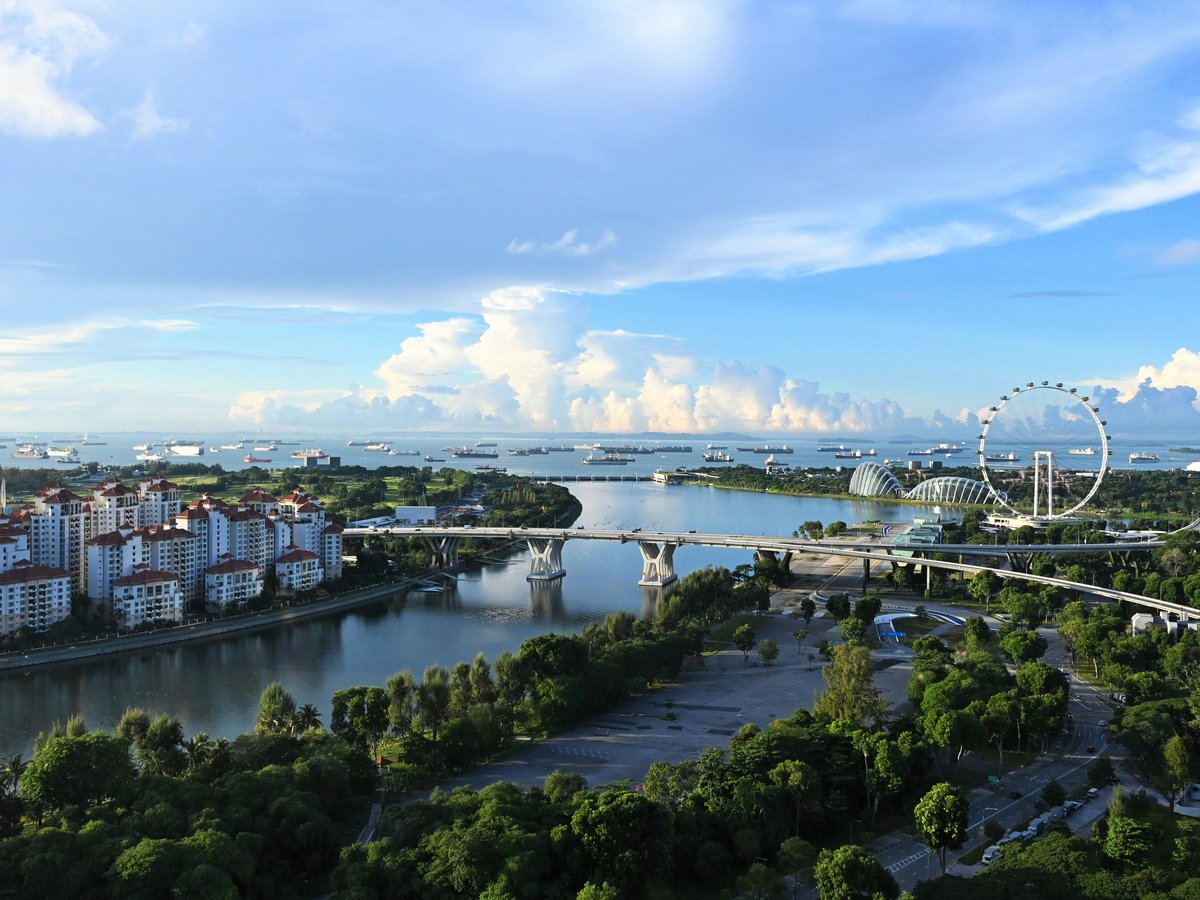
Best Time to Visit Singapore, by Season
Singapore's average high swings just 1.7 degrees across the entire year: from January's 29.0°C to April's 30.7°C. The real variables are rain, crowds, and your wallet. Here is the month-by-month verdict, with a single best window named for each kind of traveller.
Published · Updated
1 Singapore's Temperature Swings Less Than Two Degrees All Year: The Real Question Is Rain and Price
The air hits you the moment you step off the jet bridge at Changi. Thick, warm, heavy with moisture, and it feels basically the same whether you land in January or July. That is the single most important thing to understand about timing a Singapore trip: the temperature barely moves. January's average high sits at 29.0°C, April and May peak at 30.7°C, and August dips to 29.6°C. The entire annual range from coolest to warmest high is 1.7 degrees. You will sweat in February at 30.3°C. You will sweat in December at 29.8°C. The overnight lows tell a similar story: January's 23.1°C is the coolest, May's 24.9°C the warmest, and the difference between the two is barely enough to notice without a thermometer.
So if the heat is a constant, what varies? Two things: how often it rains and how much everyone else is willing to pay. Singapore's northeast monsoon runs roughly November through January, pulling moisture across the South China Sea and dumping it in long afternoon downpours. The southwest monsoon from June through September is drier on paper but brings the regional haze from agricultural burning in Sumatra and Borneo. The inter-monsoon windows (March to April and October to early November) deliver the most unpredictable weather, with sudden thunderstorms that can flood Orchard Road and vanish within the hour.
Hotel rates and crowd density follow their own calendar, driven more by school holidays and regional festivals than by anything a thermometer shows. March's 30.5°C average high and October's nearly identical 30.5°C feel the same on your skin, but March commands a premium and October often does not. That gap (same weather, different price) is the thread running through every section below.
Mind you, none of this means timing does not matter. It means you are optimizing for rain patterns and value, not for a comfortable temperature that does not exist in an equatorial city one degree north of the equator.
The entire annual range from coolest to warmest high is 1.7 degrees. You will sweat in February. You will sweat in December.
2 February and March Are the Conventional Best Months: Expect to Pay for It
You can smell the difference in February. The pavement dries faster after the brief showers, the puddles along Boat Quay shrink by mid-morning, and the hawker centres keep their outdoor tables wiped rather than surrendering them to standing water. February averages a high of 30.3°C with overnight lows around 23.3°C: fractionally cooler than what follows. March nudges the high to 30.5°C and the low to 23.7°C, adding just enough warmth that you notice it on the back of your neck at midday but not enough to change your plans.
This two-month window sits between the tail end of the northeast monsoon and the arrival of the inter-monsoon storms, which tends to make it the driest stretch of the year. To be fair, "driest" in Singapore still means you will get rained on: the question is whether it lasts twenty minutes or two hours. In February and March, the answer tends to be the former.
The problem is that everyone knows this. February coincides with Chinese New Year travel across Southeast Asia, and March lines up with European spring-break bookings. Hotels in the Marina Bay corridor routinely charge peak-season rates through both months. Compare February's 30.3°C high against October's 30.5°C and the weather difference is negligible: two-tenths of a degree on the high, about half a degree separating March's 23.7°C low from October's 23.9°C low. The price difference, though, is not negligible at all.
That said, if you are a first-time visitor who wants the safest weather bet and does not mind paying the premium, February and March remain the textbook recommendation. The extra cost buys marginally drier days and the psychological comfort of visiting during what every guidebook calls the best season. Just know what you are paying for: a fraction of a degree and slightly shorter rain showers, not a fundamentally different climate experience from what September at 29.9°C or October at 30.5°C would deliver.
Compare February's 30.3°C against October's 30.5°C and the weather difference is negligible. The price difference is not.
3 The November-to-January Monsoon Is Wetter and Cheaper, and January Is the Coolest Month Singapore Gets
The rain arrives with a sound you learn to recognize after a few days: a low static hiss building from the direction of the Straits, swelling to a drumroll on the metal roofs above the food stalls, and then the full downpour that sends everyone under the nearest covered walkway. This is northeast monsoon Singapore, running roughly November through January, and it is the stretch most travel advice tells you to avoid.
November averages a high of 30.2°C with a low of 23.6°C. December drops to 29.8°C and 23.4°C. January is the coolest month on the calendar at 29.0°C for a high and 23.1°C for a low: the only month where the average high dips below 29.5°C. That January figure sounds dramatic until you remember 29.0°C is still warmer than a peak summer day in Berlin or London.
The monsoon does not mean constant rain. It means a higher probability of extended afternoon showers, sometimes lasting into the evening. Mornings tend to be clear. Singapore's covered walkways, MRT stations, and the underground networks connecting malls across the central area mean you can navigate large swathes of the city without ever opening an umbrella. The rain is a logistical detail, not a dealbreaker.
The real upside is economic. November through January, excluding the two-week Christmas-to-New-Year spike, tends to be the most affordable window for flights and hotels from most origin markets. December's 29.8°C high and January's 29.0°C deliver what passes for cool air in this city: you might want long sleeves in a heavily air-conditioned MRT car. Worth noting: the lower overnight temperatures, particularly January's 23.1°C, make evening walks along the Singapore River or through the Botanic Gardens noticeably more pleasant than the same walk in May at a sticky 24.9°C low, or July at 24.8°C. The monsoon is not bad weather. It is cheaper weather with a slightly longer umbrella commute.
January's 29.0°C is still warmer than a peak summer day in Berlin or London. The monsoon is not bad weather: it is cheaper weather.
4 April and May Peak at 30.7°C With the Stickiest Nights of the Year: Plan Accordingly
The heat at four in the afternoon in late April has a texture to it. It sits on the skin like a damp cloth draped across your shoulders, and the shade of a shophouse five-foot way barely helps because the humidity is the problem, not the sun. April and May share the year's highest average high at 30.7°C. That number alone does not sound threatening: it is only two-tenths of a degree above March's 30.5°C, but the overnight lows tell the real story. April's average low of 24.1°C and May's 24.9°C are the warmest nights of the year. May's 24.9°C means the air barely cools after sunset, and your hotel room's air conditioning earns its keep from about three in the afternoon until well past midnight.
This is the inter-monsoon transition, the gap between the retreating northeast monsoon and the arriving southwest monsoon. It brings the year's most violent thunderstorms: short, intense, loud enough to halt conversation under a hawker-centre roof. The storms usually break by evening, but the humidity they leave behind can feel worse than the rain itself.
April and May occupy a strange middle ground for visitors. The heat is at its most aggressive, which keeps rates slightly below the February-March peak. But those overnight lows of 24.1°C to 24.9°C make outdoor dining genuinely less comfortable than January at 23.1°C or December at 23.4°C, where the difference of a degree or more on the low end translates to noticeably less adhesive evenings.
To be fair, Singapore is engineered for this. The city has been air-conditioning itself since the 1960s. You can spend an entire April day moving between temperature-controlled spaces: museums, underground malls, hawker centres with their industrial fans. The people who do well in April and May are the ones who lean into the indoor city and treat the outdoor heat as something to cross quickly between air-conditioned destinations.
May's overnight low of 24.9°C means the air barely cools after sunset. Your hotel room's air conditioning earns its keep until past midnight.
5 June Through August Is Tourist High Season Despite the Haze: Skip It If You Have Any Flexibility
Step onto the viewing platform at Marina Bay Sands on a July afternoon and you might see the skyline clearly, or you might see a pale yellow-grey wash where the financial district should be. That is the haze: smoke from agricultural burning across Sumatra and Borneo carried by the southwest monsoon, and it turns the June-through-August window into Singapore's most unpredictable stretch for visibility.
The temperatures tell a subtler story than you might expect. June averages 30.0°C for a high, July rises to 30.1°C, and August dips to the year's second-lowest high at 29.6°C. The overnight lows sit warm: June at 24.6°C, July at 24.8°C, August at 24.1°C, though not as oppressive as May's 24.9°C ceiling. August in particular, with its 29.6°C high and 24.1°C low, is technically one of the cooler months. Compare it to January's 29.0°C and 23.1°C and the gap is modest.
The problem is that June through August is peak tourist season driven by Northern Hemisphere summer holidays. Families, gap-year backpackers, and regional tour groups converge on the major attractions simultaneously. You pay more, you queue longer, and every hawker centre feels a degree warmer from the body heat alone.
Mind you, August's relatively gentle 29.6°C average high can feel oppressive if the air quality drops: heat combined with particulates produces a different kind of discomfort than heat alone. The haze varies wildly from year to year. Some Augusts barely register; others blanket the island for weeks.
If you are locked into a Northern Hemisphere school calendar, August is the least-bad option of the three: its 29.6°C high is the lowest, its 24.1°C low matches April exactly, and the worst haze tends to arrive in September rather than August. But if you have any flexibility at all (even a few weeks) September and October deliver similar or better temperatures with far thinner crowds. June at 30.0°C and July at 30.1°C are the hardest sell: warmer than August, more crowded than October, and priced at the top.
August's 29.6°C average high is technically one of the cooler months. The problem is everyone else had the same idea.
6 September and October Quietly Deliver February's Weather at Shoulder-Season Prices
The light shifts in late September. Still equatorial (the sun is overhead and relentless) but the quality of the afternoon sky starts to change, the grey thinning out as the southwest monsoon weakens. September averages a high of 29.9°C with a low of 24.3°C. October warms to 30.5°C and cools to 23.9°C overnight. Now compare those to the conventional favourites: February's 30.3°C high and 23.3°C low, March's 30.5°C and 23.7°C. October and March are, by the thermometer, functionally the same city: 30.5°C to 30.5°C, lows within two-tenths of a degree.
The difference is foot traffic. October sits after the summer-holiday surge and before the Christmas buildup, which makes it one of the thinnest months for crowds at the major attractions. The September-to-October corridor also avoids the northeast monsoon's sustained afternoon showers. You will get thunderstorms (this is the inter-monsoon, and they hit fast) but they tend to be the short, violent kind that drains away in forty minutes rather than the monsoon's slower all-afternoon soak.
September's 29.9°C high and 24.3°C low feel close to gentle by Singapore standards. The nights are still warm: 24.3°C is not anyone's idea of crisp, but compared to May's 24.9°C or July's 24.8°C, the relief registers when you are walking the Southern Ridges trail at dusk or eating outdoors along a Tiong Bahru side street.
October's 30.5°C matches March exactly, and at 23.9°C the overnight low is just two-tenths warmer than March's 23.7°C. If you were dropped into Singapore blindfolded on a random day in either month, you could not tell which one by the weather. Pricing, though, tends to favour October by a comfortable margin.
Worth noting: the Formula 1 Singapore Grand Prix typically falls in late September or early October. If motorsport is your thing, that is a bonus. If not, hotel rates spike for that specific weekend: book around it and you keep the shoulder-season advantage intact.
October's 30.5°C matches March degree for degree. The pricing tends to favour October by a comfortable margin.
7 One Calendar, Seven Travellers: The Final Verdict on When to Book Singapore
Pour a kopi-o at a kopitiam, spread the calendar flat, and here is the honest answer for each kind of visitor: stripped of the hedging that makes most timing advice useless.
The budget traveller picks November or early January. January's 29.0°C high, the year's lowest, and its 23.1°C overnight low make it the most physically comfortable month on the calendar. November's 30.2°C and 23.6°C are close behind. Both sit in the monsoon window, which means afternoon rain but also off-peak pricing from most origin markets.
The first-time visitor who wants the safest bet picks late February. At 30.3°C for a high and 23.3°C overnight, it is the driest window with the most predictable weather. Pay the premium, pack light, accept that you are sharing the city with everyone who read the same guidebook.
The repeat visitor who knows Singapore picks October. Its 30.5°C high matches March degree for degree, its 23.9°C low is practically interchangeable with March's 23.7°C, and the crowds are noticeably thinner. The thermometer reads peak season; the bill reads shoulder.
The family locked into summer holidays picks August. At 29.6°C for a high and 24.1°C for a low, it is the coolest of the June-July-August trio: June runs 30.0°C and 24.6°C, July hits 30.1°C and 24.8°C. August is the best of a constrained situation.
The heat-averse traveller should know there is no cool month. January's 29.0°C high and 23.1°C low are as mild as it gets. The gap between January and the peak of April and May at 30.7°C is just 1.7 degrees. If 29°C feels too warm, Singapore might not be your city regardless of the month.
The photographer picks February for clean skies and harsh equatorial light, or September at 29.9°C and 24.3°C for the golden-hour quality that arrives when the haze lifts.
The honest summary, and the thing no one seems willing to say plainly: Singapore's annual temperature range is smaller than the margin of error on a five-day forecast. Pick your month by price tolerance and crowd sensitivity. The weather will be warm. It is always warm.
Singapore's annual temperature range is smaller than the margin of error on a five-day forecast. Pick your month by price and crowd tolerance.
Last verified by automated review (v1.7.0_onboard-singapore-flagship-2026-06-02) on . What is automated review?