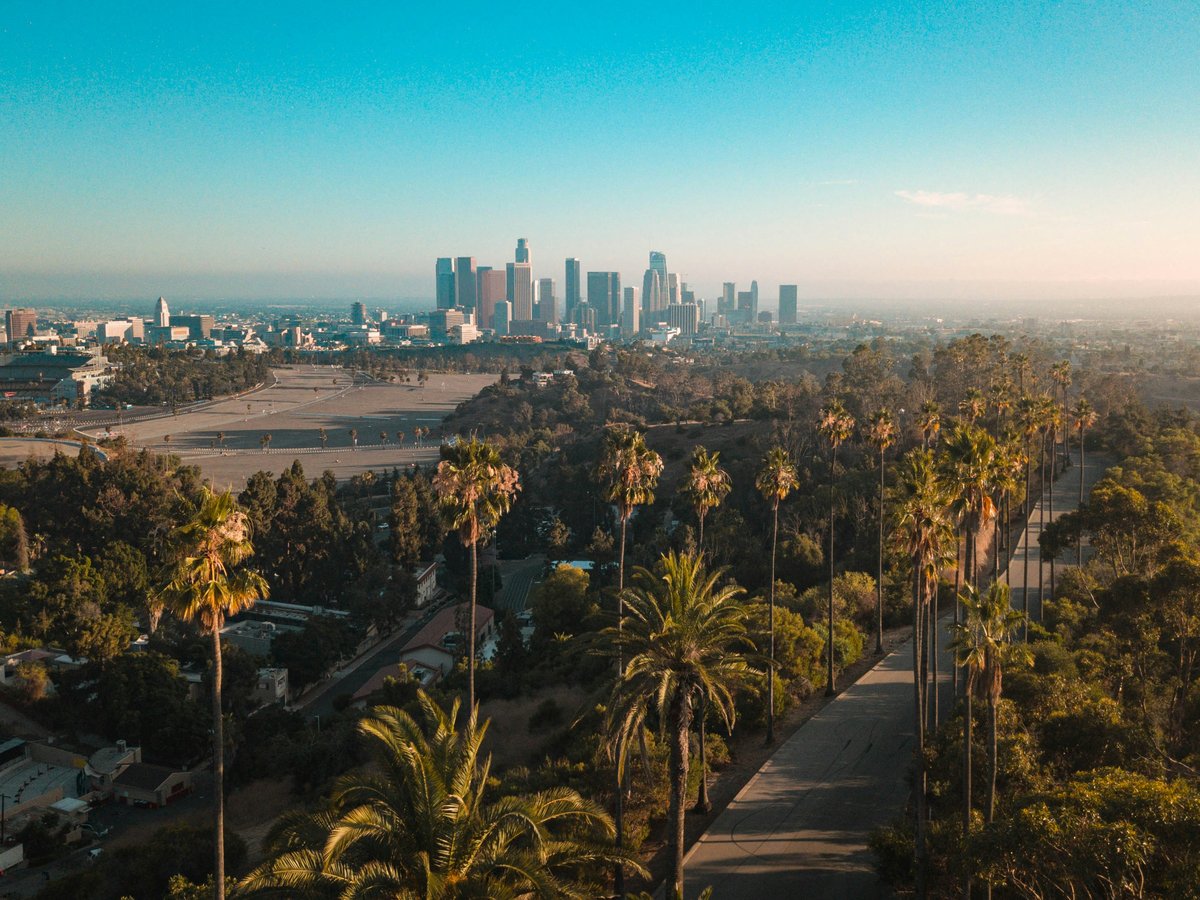
Los Angeles sprawls across a coastal basin framed by the Santa Monica Mountains to the north and the Pacific Ocean to the west, a city whose four million residents occupy roughly five hundred square miles of land that never really ends so much as it fades into the next municipality. The geography defines the experience: you can stand on the sand at Venice Beach in the morning, drive thirty minutes north into the chaparral canyons above Malibu, and by afternoon find yourself eating hand-pulled noodles in the San Gabriel Valley, which is where many Angelenos will quietly tell you the best food in the city actually lives. Unlike most American cities, LA never had a single downtown moment: it grew outward from dozens of independent towns that merged and overlapped, which is why Silver Lake feels nothing like Koreatown, which feels nothing like Leimert Park, which feels nothing like the old money grid of Hancock Park. The freeway system stitched these places together starting in the 1940s and the car remains the dominant fact of daily life here, though the Metro rail network has been expanding steadily and now connects Hollywood to Long Beach and Santa Monica to East LA. First-time visitors tend to underestimate the distances and overestimate the importance of the Walk of Fame, which most locals treat as an obstacle on their way to somewhere better. The more rewarding version of the city reveals itself in its specific textures: the smell of jasmine on a warm night in Echo Park, the particular quality of winter light that pulled the film industry here in the first place, the weekend crowds at Grand Central Market where the stalls have been trading since 1917. LA runs on Pacific time and the weather is so consistently mild that restaurants operate without walls for most of the year, which over time stops feeling novel and starts feeling like the point.
Los Angeles in photos


Los Angeles right now
Answers about Los Angeles
-
Airport to city
From LAX, take the FlyAway bus to Union Station for $9.75, about 50 minutes, if you're heading to Downtown or Hollywood. For Santa Monica or the Westside, an Uber or Lyft runs $30-45 from the airport pickup area. Taxis use flat-rate city fares. $50 to Downtown, $35 to Santa Monica. Skip the rental car counter on day one.
Read the full answer → -
Best time to visit
The best window for Los Angeles is October or early November, with March and April running a close second. October afternoons are warm without August's heat, the coastal fog of May and June has burned off, summer crowds have cleared out of Santa Monica Pier, and hotel rates fall from their July peak. The one catch is Santa Ana wind days, which can close hiking trails.
Read the full answer → -
Cost per day
Budget $75 per day covers a hostel dorm, taco trucks, and Metro rides. Midrange lands around $200 with a hotel room and sit-down meals. Luxury starts at $500 in Beverly Hills. California sales tax, mandatory tipping, and parking fees inflate every posted price by 25-40%, so pad any budget you set by that margin.
Read the full answer → -
Cultural etiquette
Los Angeles runs on casual friendliness but rigid unwritten rules about cars, tipping, and personal space. Tip 18-20% at restaurants without exception. Never honk in residential neighborhoods. Arrive 10-15 minutes late to house parties (on time is early here). The dress code is relaxed everywhere except upscale spots on Melrose and in Beverly Hills.
Read the full answer → -
Best day trips
Santa Barbara by Amtrak Pacific Surfliner (2h45 from Los Angeles Union Station, $64 round trip) is the best single-day couple's trip. Catalina Island works with the early ferry from Long Beach ($82, 1 hour crossing). Ojai suits spa-and-wine couples. Skip Palm Springs June through September unless you want 40°C heat.
Read the full answer → -
Digital nomads
Los Angeles scores 6.2/10 for digital nomads (sourced from TTDI's editorial rubric). Fiber speeds of 200-500 Mbps are standard in newer apartments across Silver Lake, Koreatown, and Santa Monica. The 6.2 reflects real friction. No US digital nomad visa, so most visitors cap out at 90 days. Monthly burn hits $4,000-4,500, and car dependency adds 2 hours a day to your routine.
Read the full answer → -
Family-friendly
Los Angeles scores 7.8/10 for family friendliness (see the TTDI Family-Friendliness Index). The car-dependent layout works in your favor. You park close, roll a stroller on flat sidewalks between air-conditioned stops, and skip the broken Metro elevators entirely. The California Science Center and Getty Center both charge $0 admission. Coastal July temperatures sit near 24°C while the San Fernando Valley bakes past 35°C.
Read the full answer → -
Food culture
Los Angeles eats by neighborhood, not by restaurant list. The San Gabriel Valley holds some of the best Chinese food outside Asia. Koreatown's BBQ joints serve past midnight. East LA's taco trucks sell shrimp tacos dorados for $3.50. Thai Town sits on Hollywood Boulevard. The city's food runs on immigration patterns, and you need a car to reach all of it.
Read the full answer → -
Getting around
Uber and Lyft are the real transit system in Los Angeles. Metro Rail's 6 lines connect Downtown to Hollywood, Santa Monica, and Long Beach, but gaps between stations mean ridehail fills most trips. A TAP card costs $1.75 per ride. Rent a car only if you're heading to Malibu or the San Gabriel Valley.
Read the full answer → -
How to get there
Los Angeles International Airport (LAX), 27 km southwest of downtown, handles over 88 million passengers a year with nonstop flights from 80+ international cities. Hollywood Burbank Airport (BUR) serves domestic routes 20 km closer to the Valley. From New York, nonstop flights run 5.5 hours at $200-450 round-trip. From London, 11 hours at £400-800.
Read the full answer → -
Is it safe?
Los Angeles scores 5.8 out of 10 for solo-traveler safety (see the TTDI Solo-Safety Index). Violent crime near Santa Monica Pier or Hollywood is low. The real risks are car dependence, property crime, and sprawl that strands you without a vehicle. Stick to walkable clusters like Silver Lake, Koreatown, and the Westside. Call 911 for emergencies.
Read the full answer → -
Layover guide
Yes, but only on layovers of 7 hours or more. LAX immigration runs 30 to 75 minutes, and the People Mover plus Metro K Line reaches Santa Monica or Venice in about 35 minutes. Budget 90 minutes to clear security on return. That leaves roughly 2 to 3 hours for the coast, enough for one neighborhood and a meal.
Read the full answer → -
LGBTQ-friendly
Los Angeles scores 9.5/10 for LGBTQ+ friendliness (sourced from TTDI's editorial rubric). California offers among the strongest legal protections for queer residents and visitors in the United States. West Hollywood operates as a self-governing queer district at the center of the metro's scene. Year-round nightlife runs along WeHo's Santa Monica Boulevard, with quieter options in Silver Lake. Same-sex couples face no friction anywhere in LA.
Read the full answer → -
Where locals go
Locals skip Hollywood Boulevard. On weekday mornings they work from the Sunset Junction cafes in Silver Lake and eat lunch at Grand Central Market in Downtown, while chefs shop the Santa Monica Wednesday Farmers Market on Arizona Avenue. At night the crowd moves to Koreatown, where Sixth Street and Wilshire stay busy past 1am. Weekends fill out with Boyle Heights, Sawtelle, and Fern Dell.
Read the full answer → -
Must-see
The Getty Center in Brentwood. J. Paul Getty's $1.3 billion hilltop campus opened in 1997 and charges nothing to enter. A driverless tram carries you from the parking structure up to Richard Meier's travertine buildings, where the permanent collection spans medieval manuscripts to Van Gogh's Irises. On clear days you can see Catalina Island 40 km to the southwest.
Read the full answer → -
Solo travel
Los Angeles rates a 6 out of 10 for solo travel. Counter-service dining culture means nobody blinks at a single plate, and the weather keeps outdoor socializing comfortable year-round. The real barrier is transit. Metro covers limited corridors, so budget $35/day for a rental car or $25-40 in daily rideshare to move between Silver Lake, Venice, and Santa Monica.
Read the full answer → -
This week
Los Angeles runs on a weekly market-and-museum rhythm rather than a single event calendar. The Hollywood Farmers' Market fills Ivar Avenue every Sunday morning, the Getty Center is free daily, and most major museums close Mondays. Summer runs hot, so outdoor plans work best before 10am.
Read the full answer → -
3-day itinerary
Day 1 covers Hollywood and Griffith Park, from the Walk of Fame to the observatory for sunset. Day 2 heads west to Santa Monica, Venice Beach, and the Getty Center. Day 3 is Downtown Los Angeles, with Grand Central Market, The Broad, and LACMA. About 85 km total across three days, mostly by rideshare between neighborhood clusters.
Read the full answer → -
What to avoid
A long visit to the Hollywood Walk of Fame, the costumed characters outside the TCL Chinese Theatre, and the celebrity-home van tours sold on Hollywood Boulevard will eat your time without giving much back. Don't try to cover Santa Monica, Hollywood, and Downtown in one day, don't drive the 405 at rush hour, and don't hunt for a rideshare at the LAX terminal curb. See the Hollywood Sign from Griffith Observatory instead.
Read the full answer → -
What to pack
Pack layers for Los Angeles's 10-15°C temperature swing between the coast and inland valleys. A light hoodie handles June's marine layer mornings at Santa Monica, while afternoons in Downtown hit 30°C+. Bring SPF 50. The UV index reaches 9-10 in June at 34°N latitude. Broken-in walking shoes for the Getty Center's hillside campus and Griffith Park trails. Skip the umbrella.
Read the full answer → -
Where to stay
Santa Monica for your first LA trip. The E Line connects to downtown in 48 minutes, the beach is a 10-minute walk from most hotels, and Third Street Promenade handles first-night dinner without a car. Budget $180-300 per night mid-range. West Hollywood is the alternative if nightlife and central location matter more than ocean air.
Read the full answer →
Deep guides for Los Angeles
-
Best Time to Visit Los Angeles, by Season
Los Angeles averages 18.6°C in January and 31.9°C in August. That 13°C range creates four distinct travel windows, each with its own trade-off between weather, crowds, and cost. Here is the month-by-month verdict, with one best month named for five kinds of visitor.
Read the guide → -
Los Angeles Restaurants: What's Worth It
From Homeboy Diner's 07:00 griddle at City Hall to Redbird LA's rectory dining room behind Saint Vibiana's, every meal on this fifteen-block grid earns its tier. Two tiers, six verdicts, one ZIP code.
Read the guide →
Curated lists for Los Angeles
accommodation
-
Best boutique hotels
Los Angeles spreads across a basin so wide that choosing a neighborhood matters more than choosing a hotel. The freeway grid connects everything on paper; in practice, rush-hour traffic can turn a short drive into an hour of brake lights, so the block you sleep on sets the tone for the entire trip. The airport fringe along Century Boulevard serves early departures and nothing else. Bunker Hill stacks cultural anchors, concert halls, and elevated walkways above the older downtown grid, where the Jewelry District and the Broadway corridor trade in grit and rooftop bars. Koreatown runs on a schedule most of the city ignores: late-night barbecue joints and spa houses that stay open long past midnight, while Hollywood sells the tourist version of the industry that long ago moved to Burbank sound stages. Glendale sits north of the 134, quieter and cheaper, with its own downtown that most visitors never hear about. Little Armenia, wedged between Hollywood and Los Feliz, holds a stretch of Sunset Boulevard where the signage switches scripts and the cafes serve Armenian coffee before the influencer brunch crowd wakes up. Nightly rates range from around $108 in Glendale to $199 near the airport terminals, and the mid-range tier across all ten neighborhoods scores between 8.4 and 9.3 on Trip.com. The neighborhood descriptions below ground each area in what you can reach on foot and which traveler it suits.
See the picks → -
Best hostels
Los Angeles sprawls across dozens of neighborhoods with distinct overnight characters, and budget beds scatter unevenly across them. Hostel and motel inventory clusters in five pockets: Hollywood for transit and nightlife access, Lennox for the airport corridor, Lincoln Heights for eastside quiet, Ocean Park for the Santa Monica beachfront, and Venice Beach for boardwalk proximity. Nightly rates run from $39 to $79, a narrow spread that makes neighborhood fit matter more than price. The Metro system has redrawn the budget traveler's map; the B Line puts Hollywood within reach of Downtown and North Hollywood without a car, while the E Line connects Ocean Park to the broader Westside. Lennox sits under the LAX flight path, a functional choice for layovers rather than exploration. Lincoln Heights and Venice Beach sit off the rail grid, where buses and bikes fill the gap. The five areas share little beyond price tier: Hollywood is loud and vertical, Ocean Park is salt air and bike lanes, Venice Beach is boardwalk grit, Lincoln Heights is residential and unhurried, Lennox is motel-strip practical. Choosing between them is choosing what kind of Los Angeles morning you want: coffee on the boardwalk, a taco truck on Broadway, or a shuttle to your terminal.
See the picks → -
Best luxury hotels
Los Angeles sprawls across enough geography that its luxury hotels serve different trips entirely. A high-rise suite downtown and a poolside room along the Sunset Strip share a metro area but almost nothing else: not the commute, not the light, not the reason you booked. The 12 properties below cover downtown's convention corridor, Hollywood's entertainment blocks, the Beverly Hills border, West Hollywood, and one address in Glendale that sits outside city limits but well inside the booking radius. What separates one from another is the specific room, the specific pool, the specific block. This list is organized by those editorial differences, not by brand prestige. If you need a rooftop bar on the Sunset Strip, a downtown executive lounge will not serve the same trip; the entry for each property tells you what earns its rate and where the rate is coasting on address alone.
See the picks → -
Where to stay
Los Angeles spreads across a basin so wide that where you sleep determines which version of the city you get. The beach towns, the downtown towers, the valley suburbs, and the airport strip share a name but not a commute; picking the wrong neighborhood can burn most of a morning just reaching the thing you came for. The areas below match a traveler's priorities to the hotel inventory clustered in each zone. Santa Monica and Beverly Hills stack luxury rooms along the Westside, where ocean air and boutique sidewalks justify the rate. Hollywood and the blocks around Mickey Rooney Memorial Square put budget and mid-range beds within walking distance of the Metro B Line, the best transit spine the city has. Bunker Hill anchors downtown with convention-friendly towers and rooftop bars. Koreatown and Carthay sit in the mid-city belt, quieter and cheaper than the name-brand strips but still on the Metro. Glendale offers a suburban fallback north of the freeway, and the two LAX clusters serve anyone whose trip begins or ends at the terminal. Rates swing from $41 a night in a Hollywood dorm to $1295 at the Regent Santa Monica Beach. The gap between those numbers is real, and the notes below help you decide which part of it is worth paying for.
See the picks →
attractions
-
Best free attractions
Los Angeles keeps a lot of its best ground open to anyone who turns up, and this list leans on that public land. Twelve picks, most of them parks rather than ticketed attractions. Some of the big municipal ones go back to the 1800s: Exposition Park dates from 1872, Lincoln Park from 1881, and Griffith Park from 1896. Check their official pages for current entry terms before you set off. This list is for visitors who would rather walk a hillside than queue at a ticket desk, and who want to see how the city uses its open ground, not how it sells it.
See the picks → -

Best museums
Los Angeles spreads its museums the way it spreads everything else, across freeways and postal codes, so this list is for the visitor who would rather choose well than tick boxes. The range is wide: a natural history museum dating from 1913, a library and art museum in San Marino dating from 1919, a contemporary art museum in Downtown that dates only from 2015, a music museum, and a car museum on Wilshire Boulevard. Wilshire alone carries three of these picks, and Pasadena and San Marino deserve an afternoon of their own. Plan around the hours: several of these institutions close on one weekday, and that day is not always the same one, and the late evenings are spread across the week as well, so read each entry before you set out. The list suits people who would rather spend a long morning in one great building than sprint through five.
See the picks → -
Must-see attractions
Los Angeles keeps its famous sights in plain view: set into the sidewalk, standing on a hillside, lit up on a theatre marquee. Many of these 12 picks are things to walk past and take in, and the rest are rooms where you need a ticket and a reason to sit down. The list starts with the oldest, the Hollywood Bowl, which dates from 1922, and the Hollywood Sign followed in 1923. The newest is the Cathedral of Our Lady of the Angels, from 2002, and in between come a cemetery, a film studio, an opera house and a skyscraper. These are not obscure finds. They are the famous names, chosen with judgement and approached the way a local would: going to a show rather than just photographing the building, reading the quieter stars on the sidewalk, and seeing the sign from a distance. If this is your first time in the city and you want the landmarks without the tour-bus version of them, start here.
See the picks →
food
-
Best cafes
Downtown Los Angeles is a coffee city that never quite decided what kind of coffee city it wanted to be, and that is the whole appeal. Inside a roughly two-mile radius bounded by Union Station, Little Tokyo, the Arts District, and the Financial Core, you can drink a matcha in a shopping arcade, a French press in a bakery run by pastry-school graduates, an Ethiopian pour-over in a converted warehouse, and a $6 drip that a Wall Street analyst would recognize on sight. The list below is arranged for a walking day, not a ranking of taste: each of these twelve rooms opens onto a different piece of downtown, and each earns its place by doing one thing with unusual conviction. Skip the Highland Park pilgrimage; on a first visit downtown holds enough range to fill a notebook. Bring cash for the counter-service places, patience for the ones that only accept mobile orders, and a light jacket for the ones that keep the door open all afternoon.
See the picks → -

Best restaurants
Downtown Los Angeles reads as a stack of neighbourhoods rather than a single dining district, and the twelve rooms on this list argue for the 90012 postal code as one of the more honest places to eat in the city. The addresses cluster tight: North Spring Street at the Civic Center edge, East 1st and East 2nd through Little Tokyo, South Central Avenue past the Japanese Village Plaza. What links them is not cuisine but working discipline. American diners run against Japanese kissa counters, Korean grill houses sit two blocks from a Mediterranean rotisserie, a ramen shop shares a plaza with conveyor sushi. Hours run from breakfast-only civic canteens to bars that pour until 01:40 on Fridays. This is a list for a reader who wants to eat at a real address, from a real kitchen, with a phone number that answers and a website that resolves. Every claim below traces back to a mapped node and a working URL, so a visitor can plan a lunch, a late dinner, and a nightcap along a walkable slice of downtown without a guidebook's guesswork.
See the picks →
Browse by traveler type
- For foodies
Los Angeles for foodies
- For families with kids
Los Angeles for families
- For digital nomads
Los Angeles for digital nomads
- For solo travelers
Los Angeles for solo travelers
- For couples
Los Angeles for couples
- For budget travelers
Los Angeles on a budget
- For luxury travelers
Los Angeles for luxury travelers
- For first-timers
Los Angeles for first-time visitors
Book experiences in Los Angeles
 Free cancellation
Full-Day Iconic Sights of LA, Hollywood, Beverly Hills, Beaches and More
Day trip: 7.5 hours, free cancellation.
via Viator Free cancellation
Hollywood, Beverly Hills & Celebrity Homes Tour by Open Air Bus
City tour: 2 hours, free cancellation.
via Viator Free cancellation
Full-Day LA Tour: Santa Monica, Hollywood and Beverly Hills
Day trip: 7 hours, free cancellation.
via Viator Free cancellation
Hollywood and Celebrity Homes Bus Tour
City tour: 2 hours, free cancellation.
via Viator Free cancellation
Best of Los Angeles Guided City Tour with 4 Stops and Free Time
Day trip: 5.5 hours, free cancellation.
via Viator Free cancellation
Los Angeles 3-Hour City Tour with 3 Stops
City tour: 3 hours, free cancellation.
via Viator Free cancellation
Hollywood Open Bus Tours
City tour: 2 hours, free cancellation.
via Viator Free cancellation
Best of LA: Hollywood, Griffith, Santa Monica, Venice, and Rodeo
Day trip: free cancellation.
via Viator Free cancellation
Hollywood, Beverly Hills and Celebrity Homes Tour by Open-Air Bus
City tour: 2 hours, free cancellation.
via Viator Free cancellation
Celebrity Homes & Lifestyle Tour of Hollywood and Beverly Hills
City tour: 2 hours, free cancellation.
via Viator Free cancellation
Hollywood, Beverly Hills and Celebrity Homes Open Air Van Tour
City tour: 2 hours, free cancellation.
via Viator Free cancellation
Catalina Island Private Guided Golf Cart Tour of Avalon
Day trip: 2 hours, free cancellation.
via ViatorBrowse by interest
Compare Los Angeles with
Find a flight to Los Angeles
Live fares to Los Angeles appear here once cookies are accepted.
Last verified by automated review (v1.7.2) on . What is automated review?