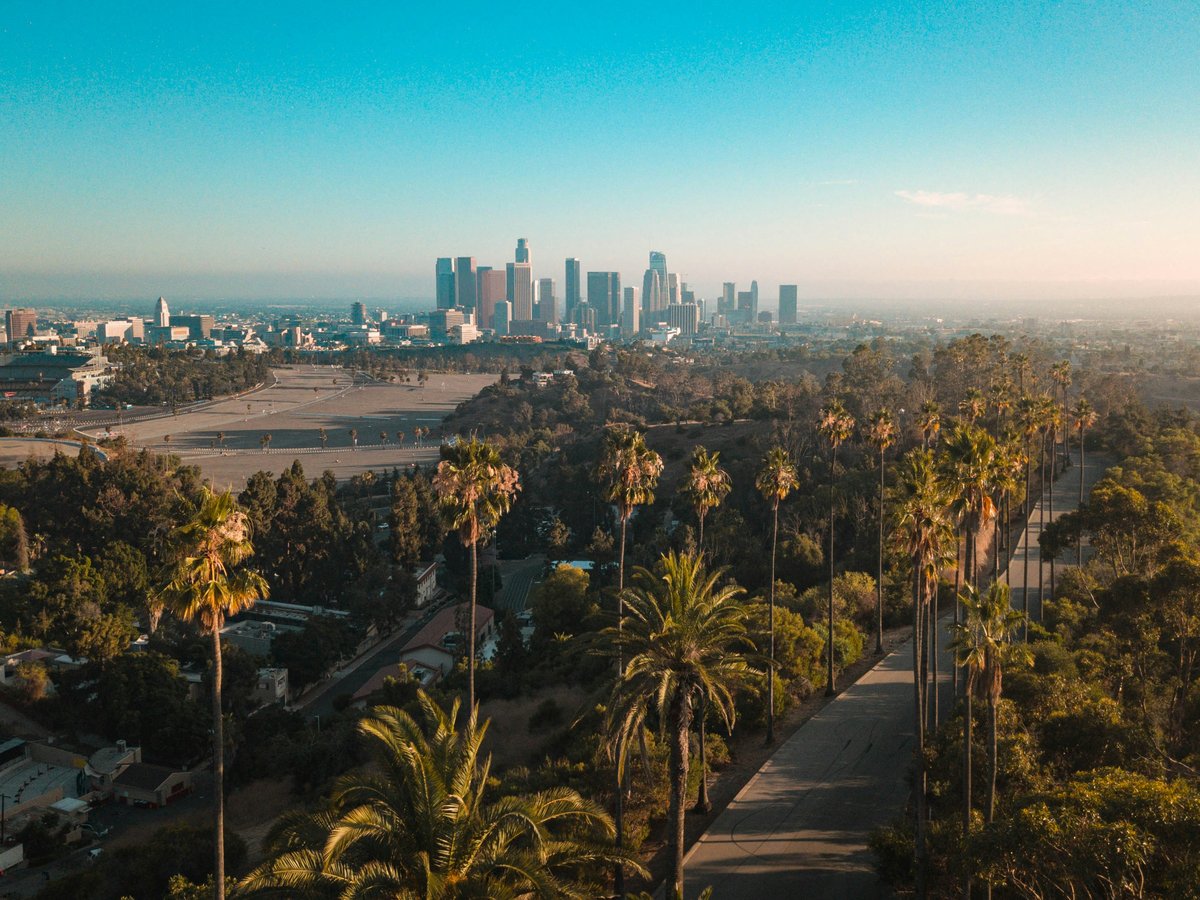
Los Angeles sits in a coastal basin pinched between the Pacific Ocean and the San Gabriel Mountains, which rise to over 10,000 feet less than 50 miles from the beach. That geographic compression tends to surprise first-time visitors. You can surf at Manhattan Beach at 7 a.m. and be standing in snow on Mount Baldy by noon, at least between November and March. The Santa Monica Mountains cut through the city's west side, threading chaparral-covered ridges between neighborhoods like Brentwood and Malibu. Griffith Park alone covers more than 4,300 acres, making it one of the largest urban parks in North America. The climate is Mediterranean, which means warm, dry summers from May through October and mild, occasionally rainy winters. Summer temperatures in the valleys regularly hit 95°F or higher, while coastal areas might sit at a comfortable 75°F on the same afternoon. That marine layer, the June Gloom that locals grumble about, keeps mornings cool enough for comfortable hiking well into July. The upshot is that LA functions as a year-round outdoor city, though the specifics shift with the seasons. Spring wildflower blooms in the Santa Monica Mountains typically peak around late March. Fall, from September through November, tends to be the sweet spot for longer hikes. The air cools, the summer crowds thin out, and the light turns golden around 4 p.m.
Outdoor activities
-
Road Cycling on the Marvin Braude Bike Trail
The Marvin Braude Bike Trail, which most people call The Strand, runs roughly 22 miles along the coast from Will Rogers State Beach in Pacific Palisades south to Torrance Beach. The path is paved and flat, passing through Santa Monica, Venice, Marina del Rey, Manhattan Beach, Hermosa Beach, and Redondo Beach. Weekend mornings get crowded near the Venice Boardwalk section, so starting before 8 a.m. helps. Perry's Cafe at Santa Monica rents bikes for around $10-15 per hour. The stretch between El Segundo and Hermosa is typically the least congested. You'll smell sunscreen and saltwater the whole way, with the ocean within a few hundred feet for most of the ride.
- Difficulty
- Easy to moderate
- Duration
- 2-4 hours for the full out-and-back
- Best season
- Year-round, though May and June mornings can be foggy
-
Rock Climbing at Stoney Point Park
Stoney Point in Chatsworth, at the northwest edge of the San Fernando Valley, is LA's most accessible outdoor bouldering area. The sandstone formations reach about 50 feet in places, with routes ranging from beginner-friendly slabs to tricky overhangs. The rock is coarse and grippy when dry but dangerously slick when wet, so skip it after rain. Topanga Canyon Boulevard runs right past the park, and parking is free on the residential streets nearby. The boulders heat up fast in summer. By 10 a.m. on a July morning, the south-facing walls will burn your hands. Worth noting, this spot has been a climbing destination since the 1930s, and Royal Robbins trained here before his Yosemite ascents.
- Difficulty
- Beginner to advanced depending on the problem
- Duration
- 2-5 hours
- Best season
- October through April, when temperatures in the Valley drop below 80°F
-
Mountain Biking in the Santa Monica Mountains
Sullivan Canyon in Brentwood offers a mellow, mostly fire-road ride of about 10 miles round trip through a shaded canyon with sycamore trees. For something more technical, Backbone Trail segments near Encinal Canyon Road in Malibu have rocky singletrack with 1,500-plus feet of climbing. Dirt Mulholland, the unpaved section of Mulholland Drive between the 405 and Topanga Canyon, is another popular option. It runs about 7 miles with moderate climbs and decent views of both the Valley and the ocean on clear days. Mountain bike rentals are available at shops in Santa Monica, typically $50-80 for a full day.
- Difficulty
- Moderate to strenuous depending on the trail
- Duration
- 2-4 hours
- Best season
- October through May, avoiding the fire-risk closures common in late summer
-
Trail Running in Griffith Park
Griffith Park has over 50 miles of trails, and the trail-running community here is active. A popular loop starts at the Fern Dell entrance on Western Canyon Road, climbs to the observatory on the West Trail, then drops down to the Boy Scout Trail before looping back via the Riverside Trail. That circuit covers roughly 5 miles with about 800 feet of elevation gain. The dirt is firm and well-packed most of the year, though it gets muddy after December and January storms. You'll hear red-tailed hawks overhead and the distant hum of the 5 freeway below. Tuesday and Thursday evenings, you'll see organized group runs starting from the Trails Cafe parking area around 6 p.m.
- Difficulty
- Moderate
- Duration
- 45 minutes to 2 hours depending on the loop
- Best season
- Year-round, but early mornings in summer to avoid heat above 90°F
-
Surfing at El Porto Beach
El Porto, the northern section of Manhattan Beach, is probably the most consistent surf break in the South Bay. It picks up west and northwest swells well, and the sandy bottom means fewer hazards for beginners. Waves typically run 2-4 feet in summer, with larger swells arriving between October and March. The water temperature drops to about 56°F in January and climbs to around 68°F by August. A 3/2mm wetsuit handles most of the year. Parking fills the lot at 45th Street by 9 a.m. on weekends. Rental boards and wetsuits are available at ET Surf on Highland Avenue in Manhattan Beach for around $25-35 for a half day.
- Difficulty
- Beginner to intermediate depending on swell size
- Duration
- 2-3 hours per session
- Best season
- Year-round, with best swells September through March
-
Hang Gliding and Paragliding at Dockweiler Beach
The bluffs above Dockweiler State Beach in Playa del Rey are one of the few legal urban launch sites for hang gliders and paragliders in the US. The coastal thermals and steady onshore winds create consistent lift conditions. Tandem flights with Windsports, the school that has operated there since the 1970s, run about $175-250 per flight. Solo pilots need a USHPA rating. The launch site sits at maybe 80 feet above sea level, so these are ridge-soaring flights rather than high-altitude thermal rides. Planes from LAX pass overhead on approach, which adds a surreal quality to the experience. That said, the airspace restrictions are real and tightly enforced.
- Difficulty
- Beginner-friendly for tandem flights
- Duration
- 15-30 minutes of flight time, plus ground instruction
- Best season
- March through October, when onshore winds are most reliable
Day hikes
-
Mount Hollywood via the Charlie Turner Trail from Griffith Observatory
This 5-mile round trip hike starts behind Griffith Observatory and climbs about 500 feet to the summit of Mount Hollywood at 1,625 feet. The trail is wide, well-maintained, and mostly exposed to sun. You'll pass through coastal sage scrub with the smell of black sage strong in the morning. The summit gives a 360-degree view that includes downtown, the Hollywood Sign, and the San Gabriels. To be fair, you'll share the top with plenty of other hikers, but the views earn it. The trail is dog-friendly.
- Difficulty
- Easy
- Duration
- 1.5 to 2.5 hours
- Best season
- Year-round, but most pleasant October through May
-
Temescal Gateway Park to Skull Rock
Starting from the Temescal Gateway Park entrance on Sunset Boulevard in Pacific Palisades, this loop covers roughly 4 miles with about 850 feet of elevation gain. The first mile climbs steadily through a shaded canyon with coast live oaks. Skull Rock, a sandstone formation near the ridge, is the halfway landmark. The trail connects to a ridge with views of the Pacific and Santa Monica. Parking at the trailhead costs $12. The canyon section stays cool in the morning, but the ridge is fully exposed. Watch your footing on the descent. The loose sandstone crumbles underfoot.
- Difficulty
- Moderate
- Duration
- 2 to 3 hours
- Best season
- October through May, before the canyon dries out
-
Escondido Falls Trail in Malibu
The hike to Escondido Falls starts from Winding Way off Pacific Coast Highway, about 30 miles west of Santa Monica. The lower falls, a 50-foot limestone cascade, is reachable via a mostly flat 4-mile round trip along a paved road and then a short dirt trail. The upper falls, at roughly 150 feet, require scrambling over slippery boulders and a short rock climb that's genuinely exposed. Stick to the lower falls unless you're comfortable with Class 3 scrambling. The falls flow strongest between January and April after winter rains. By August, they typically slow to a trickle. Limited roadside parking fills early on weekends.
- Difficulty
- Easy to lower falls, strenuous to upper falls
- Duration
- 1.5 hours to lower falls, 3-4 hours to upper falls
- Best season
- January through April for water flow
-
Mount Baldy via the Ski Hut Trail
Mount San Antonio, which everyone calls Mount Baldy, is the highest peak in the San Gabriel Mountains at 10,069 feet. The Ski Hut Trail starts from Manker Flats at around 6,160 feet and climbs roughly 3,900 feet over about 5.5 miles one way. The lower section passes through big-cone Douglas fir forest. Above the Sierra Club Ski Hut at 8,200 feet, the trail steepens through loose scree and talus. Snow and ice cover the upper trail from November through April, and crampons and an ice axe are strongly recommended during those months. The air thins noticeably above 9,000 feet. This is a serious day hike. Start by 6 a.m. to avoid afternoon thunderstorms in summer. An Adventure Pass ($5 daily, $30 annual) is required for parking at Manker Flats.
- Difficulty
- Strenuous
- Duration
- 7 to 10 hours round trip
- Best season
- June through October for snow-free conditions
-
Solstice Canyon Loop in Malibu
Solstice Canyon, managed by the National Park Service as part of the Santa Monica Mountains National Recreation Area, offers a gentle 3-mile loop with about 300 feet of elevation gain. The trail follows Solstice Creek through a lush canyon shaded by sycamores and bay laurels. You'll smell the bay leaves before you see the trees. The ruins of the Roberts Ranch house, destroyed in a 1982 wildfire, sit at the turnaround point, with the remains of a stone fireplace and a seasonal waterfall behind it. The trail is well-marked and mostly flat, making it a good choice for families. Parking is free.
- Difficulty
- Easy
- Duration
- 1 to 1.5 hours
- Best season
- Year-round, best in winter and spring when the creek runs
-
Bridge to Nowhere in the San Gabriel Mountains
This roughly 10-mile round trip hike follows the East Fork of the San Gabriel River from the Heaton Flats trailhead. The trail crosses the river multiple times, and water levels can be knee-deep after winter storms. The destination is a 120-foot concrete bridge, built in 1936 for a road that was never completed after a flood washed out the approaches. Bungee jumping operates off the bridge on weekends during warmer months. The canyon walls are tight and the rocky riverbed requires careful footing, especially on wet granite. A day-use Adventure Pass is required. Mind you, this hike takes longer than people expect because of the stream crossings.
- Difficulty
- Moderate to strenuous
- Duration
- 5 to 7 hours
- Best season
- Late spring through early fall, when water levels are manageable
Water activities
-
Kayaking in Marina del Rey
Marina del Rey is the largest man-made small-craft harbor in North America, with about 5,300 boat slips. The protected waters inside the marina are flat and calm, making it a solid starting point for beginners. UCLA Marina Aquatic Center rents single kayaks for around $15-25 per hour. You can paddle out past the breakwater into Santa Monica Bay if conditions are mild, though the chop picks up noticeably outside the harbor. Harbor seals haul out on the rocks near the channel entrance, and great blue herons stalk the riprap along the main channel. Weekday mornings are quieter, with fewer powerboats creating wake.
- Difficulty
- Easy inside the harbor, moderate in open water
- Duration
- 1 to 3 hours
- Best season
- Year-round, calmest conditions May through October
-
Ocean Swimming at Santa Monica Beach and Zuma Beach
Santa Monica Beach has lifeguard towers staffed year-round, with swimming areas marked by flags between towers 26 and 28 near the pier. Water temperature ranges from about 56°F in winter to 68°F in summer. Zuma Beach in Malibu, about 30 miles up PCH, has cleaner water and fewer crowds during the week. The bottom is sandy at both spots, with minimal riptide risk on calm days. That said, rip currents do occur, especially near jetties and after storms. Check the LA County lifeguard surf report before heading out. Zuma parking costs $8-15 depending on the lot.
- Difficulty
- Easy in calm conditions
- Duration
- As long as you like
- Best season
- June through October for warmest water, though locals swim year-round
-
Stand-Up Paddleboarding at Mother's Beach
Mother's Beach, inside the Marina del Rey harbor on the south side, has no surf and minimal current. The protected cove stays glassy most mornings. Several rental shops along Admiralty Way offer SUP boards for about $25-35 per hour. The shallow, sandy bottom means you can wade back if you fall off. Pelicans perch on the nearby docks and mostly ignore paddlers. Morning sessions before 10 a.m. tend to have the flattest water, as afternoon wind from the west picks up around noon.
- Difficulty
- Easy
- Duration
- 1 to 2 hours
- Best season
- Year-round, best on calm mornings
-
Kayaking and Canoeing on the LA River at Sepulveda Basin
The LA River's soft-bottom section through the Sepulveda Basin in Encino is one of the few stretches where the river looks like a river rather than a concrete channel. LA River Kayak Safari has run guided trips on a seasonal basis during the summer months, typically between Memorial Day and the end of September, pending annual permits from the Army Corps of Engineers. The 2.5-mile paddle passes through riparian habitat with willows and cattails. Great egrets and green herons are common along this stretch. The water is shallow, maybe 2-3 feet deep in most spots, and the current is gentle.
- Difficulty
- Easy
- Duration
- About 2 hours for the guided trip
- Best season
- Summer only, roughly June through September when permitted
-
Snorkeling and Diving at Leo Carrillo State Beach
Leo Carrillo, about 28 miles north of Santa Monica on PCH, has tide pools and underwater kelp forests along its rocky western shore. The water visibility varies from 5 to 20 feet depending on recent surf and runoff. Sea urchins, garibaldi fish, and small leopard sharks are common in the kelp beds. The best snorkeling area is in the cove west of the main beach, accessible through the sea cave at low tide. Bring your own gear. Water temperature drops to the mid-50s in winter, so a full wetsuit is recommended year-round. Camping is available at the adjacent state park for $45-65 per night.
- Difficulty
- Easy to moderate depending on surf conditions
- Duration
- 1 to 3 hours
- Best season
- July through October for best visibility and calmest surf
Parks & gardens
-
Griffith Park
FreeAt 4,310 acres, Griffith Park dwarfs most urban parks in the country. Central Park in New York would fit inside it more than 5 times. The terrain runs from flat, grassy picnic areas near Los Feliz Boulevard to scrubby chaparral ridges above 1,600 feet. The east side of the park, around the Mineral Wells area, tends to be quieter than the observatory side. Old zoo ruins from the original Griffith Park Zoo, which closed in 1966, sit along a shaded trail near the merry-go-round parking lot. Coyotes are common at dawn and dusk, and you'll likely spot mule deer along the fire roads if you're out early enough.
Highlights: Griffith Observatory (free admission), the abandoned old zoo, Fern Dell with its spring-fed stream and fern grotto, the recently restored Bronson Caves used in the 1960s Batman TV series
-
The Huntington Library, Art Museum, and Botanical Gardens
The Huntington in San Marino spreads across 120 acres of themed gardens. The Desert Garden alone contains one of the world's largest collections of mature cacti and succulents, with over 2,000 species planted across 10 acres. The Japanese Garden is built around a restored 19th-century house and a koi pond that smells faintly of wet moss. The Chinese Garden, Liu Fang Yuan, opened in phases between 2008 and 2020 and covers about 12 acres. Weekday mornings are significantly less crowded than weekends. Timed-entry tickets run $25 for adults and $29 on weekends.
Highlights: Desert Garden's massive Cereus cacti, the Chinese Garden's lake pavilion, Jungle Garden with its tropical canopy walk, Shakespeare Garden with heritage roses blooming April through June
-
Kenneth Hahn State Recreation Area
FreeKenneth Hahn sits on a ridge in Baldwin Hills, about 10 minutes south of Mid-City. The park covers 401 acres of grassland and scrub with a network of short trails. On clear days, particularly after winter rain, you can see from the San Gabriel Mountains to Catalina Island from the hilltop viewpoints. The park was built on a former oil field, and you'll still spot a few pumpjacks working along the perimeter. The Olympic Forest, planted with trees from every country that competed in the 1984 Summer Games, has grown into a dense, shaded grove.
Highlights: Janice's Green Valley loop trail (1.2 miles), Olympic Forest, the lotus pond near the main parking lot that blooms in July and August
-
South Coast Botanic Garden
This 87-acre garden in Palos Verdes Peninsula was built on a former landfill, which seems unlikely until you notice the methane vents disguised as fake rocks along some paths. It opened in 1961 and now holds over 2,500 plant species. The Mediterranean Garden does well in LA's dry climate and smells of rosemary and lavender in the spring. The Rose Garden peaks in April and May. Admission is $15 for adults. The garden is rarely crowded on weekday afternoons.
Highlights: The Rose Hills Foundation Conservatory for tropical plants, the Children's Garden with edible plantings, the dahlia collection blooming from August through November
-
Runyon Canyon Park
FreeRunyon Canyon covers 160 acres between Hollywood Boulevard and Mulholland Drive. It's probably the most social hiking spot in the city. Dogs are allowed off-leash on the main trails, so expect a parade of retrievers and French bulldogs on weekend mornings. The east ridge trail climbs steeply to about 1,320 feet with loose dirt switchbacks that get slippery after rain. The views take in the Hollywood Sign, downtown LA, and the ocean on clear days. The park gets full sun, so summer afternoons can be punishing.
Highlights: Sunrise hikes from the Fuller Avenue entrance, the Indian Rock viewpoint at the top of the east ridge, the ruins of a 1930s estate pool near the south entrance
-
Descanso Gardens
Descanso Gardens in La Cañada Flintridge covers 150 acres at the base of the San Gabriel Mountains. The Camellia Forest, planted in the 1940s, contains one of the largest collections of camellias in North America, with over 600 varieties blooming from January through March. The California Native Plant Garden shows what the local landscape looked like before development. The oak woodland sections stay cool even in summer, with temperatures under the canopy running 10-15 degrees below the surrounding neighborhood. Admission is $15 for adults.
Highlights: Camellia Forest peaking in February, the Japanese Tea Garden, the lilac collection flowering in April, the bird observation station where you might spot Cooper's hawks nesting
Practical tips
- Sun Protection
- LA's UV index reaches 10-11 during summer, which is extreme. Wear SPF 50 sunscreen and reapply every 90 minutes, especially on exposed ridgeline hikes like Runyon Canyon or Mount Hollywood. A wide-brimmed hat makes a real difference. Sunglasses with UV protection are not optional. The marine layer can fool you. Overcast mornings still deliver significant UV exposure, and sunburns through clouds are common among visitors who let their guard down in June.
- Water and Hydration
- Carry at least 1 liter of water per hour of hiking in temperatures above 80°F. On longer hikes like Mount Baldy or Bridge to Nowhere, bring 3-4 liters minimum. There are no reliable water sources on most LA-area trails. Electrolyte tablets or powder help on hot days, especially in the San Fernando Valley or the San Gabriel canyons where temperatures regularly exceed 95°F. Dehydration sneaks up fast in the dry air. If you feel thirsty, you're already behind.
- Trail Conditions and Fire Closures
- The National Forest and Santa Monica Mountains trails close during red flag fire weather warnings, which occur most often between September and December. Check the Angeles National Forest or NPS Santa Monica Mountains websites before driving out. After winter rains, trails in the San Gabriels can wash out or become impassable. The AllTrails app is widely used locally and has reasonably current condition reports, though nothing replaces checking the official agency sites the morning of your hike.
- Parking and Trailhead Access
- An Adventure Pass ($5 daily, $30 annual) is required for most parking areas in the Angeles National Forest, including Chantry Flats, Manker Flats, and Heaton Flats. Santa Monica Mountains trailheads vary. Some are free, others charge $8-12. Arrive before 8 a.m. on weekends at popular trailheads like Temescal, Runyon Canyon, and Eaton Canyon, or you'll end up circling for street parking. Griffith Park lots near the observatory fill by 10 a.m. on weekends, but the Vermont Canyon lot and Fern Dell entrance tend to have more availability.
- Gear Recommendations
- Trail runners or light hiking shoes handle 90% of LA-area trails. Full hiking boots are worth it for Mount Baldy, Bridge to Nowhere, or anything with significant scree. Trekking poles help on steep descents in Temescal and the San Gabriels. For water activities, a 3/2mm wetsuit covers the Pacific year-round, though you might want a 4/3mm from December through March. REI in Santa Monica and A16 in the Arts District both rent hiking and camping gear if you're visiting and don't want to buy.
- Wildlife Awareness
- Rattlesnakes are active on LA trails from April through October. Watch where you step and where you put your hands when scrambling over rocks. Mountain lions live in the Santa Monica Mountains and the San Gabriels. Sightings are rare but real. Keep small children close and do not run if you see one. Coyotes are common in Griffith Park and the hillside neighborhoods. They're generally not aggressive toward adults but will approach small dogs. Keep dogs leashed on trails that require it, particularly in the Santa Monica Mountains National Recreation Area.
FAQ
What is the best time of year for hiking in Los Angeles?
October through May is the most comfortable window for hiking around LA. Temperatures on inland trails like those in the San Gabriel Mountains and the San Fernando Valley drop to the 60s and 70s during this stretch, compared to 95°F or higher in summer. Spring, particularly March and April, adds wildflower blooms in the Santa Monica Mountains. Winter hiking is excellent on clear days after storms, when the air quality improves and mountain visibility extends 50 miles or more. Summer hiking is still possible if you start early, before 7 a.m., and stick to coastal or shaded canyon trails.
Do I need permits for hiking trails near Los Angeles?
Most trails in LA County parks, Santa Monica Mountains National Recreation Area, and Griffith Park do not require hiking permits. However, parking in the Angeles National Forest requires an Adventure Pass, which costs $5 per day or $30 per year. Mount San Jacinto State Park, about 2 hours east via the Palm Springs Aerial Tramway, requires a free wilderness permit for day hikes. Certain backcountry camping areas in the San Gabriels also require permits. Check the specific agency website for your trailhead before heading out.
Is it safe to swim in the ocean at Los Angeles beaches?
Swimming at LA beaches is generally safe when lifeguards are on duty and you swim between the flags. LA County lifeguards staff major beaches year-round, with expanded coverage from Memorial Day through Labor Day. Rip currents are the primary hazard and tend to form near jetties, piers, and after storms. Check the county's beach report for current conditions, including water quality. After heavy rain, elevated bacteria levels from urban runoff can affect beaches near storm drains, particularly in Santa Monica Bay. Wait 72 hours after significant rain before swimming at those locations.
Where can I rent outdoor gear in Los Angeles if I'm visiting?
REI in Santa Monica on Santa Monica Boulevard and the REI in Northridge carry rental gear including tents, backpacks, and trekking poles. A16 Outdoor in the Arts District on East 6th Street rents camping and hiking equipment. For surfboards and wetsuits, ET Surf in Manhattan Beach and Zuma Jay Surf in Malibu offer daily rentals starting around $25-35. Kayak and SUP rentals are available at Marina del Rey through several operators along Admiralty Way. Bike rentals for the coastal path start at about $10-15 per hour from shops along the Santa Monica and Venice boardwalk.
Are dogs allowed on hiking trails in Los Angeles?
Dog policies vary significantly by jurisdiction. Griffith Park allows leashed dogs on most trails, and Runyon Canyon has designated off-leash areas on its main trails. The Santa Monica Mountains National Recreation Area requires leashes on all trails and prohibits dogs entirely on certain paths, including the Escondido Falls Trail. Angeles National Forest trails generally allow leashed dogs. Kenneth Hahn State Recreation Area and Franklin Canyon Park both permit leashed dogs. Always bring water for your dog. Summer pavement and exposed trail surfaces can burn paw pads, so stick to early morning hikes in warmer months.
How crowded are Los Angeles hiking trails on weekends?
The popular trails get genuinely packed on weekend mornings, especially between 9 a.m. and noon. Runyon Canyon sees an estimated 2 million visitors per year, and weekend mornings there feel like a fitness convention. Griffith Observatory trails and Eaton Canyon are similarly busy. If crowds bother you, either start before 7 a.m. or pick less-trafficked alternatives. Sullivan Canyon in Brentwood, Towsley Canyon in Santa Clarita, and the Gabrielino Trail from Red Box stay relatively quiet even on Saturdays. Weekday mornings are a different world entirely at almost every trailhead.
Outdoor experiences in Los Angeles
 Free cancellation
 Private Helicopter Tour over Long Beach: See Catalina, Queen Mary
Outdoor experience: 15 minutes, free cancellation.
via Viator Free cancellation
 Scenic Malibu Overlook Electric Bike Tour for Beginners
Outdoor experience: 2 hours, free cancellation.
via Viator Free cancellation
 Beverly Hills Segway Tour
Outdoor experience: 2 hours, free cancellation.
via Viator Free cancellation
 Venice Vibrations Public Bike Tour Experience
Outdoor experience: 3 hours, free cancellation.
via ViatorLast verified by automated review (v1.7.2) on . What is automated review?