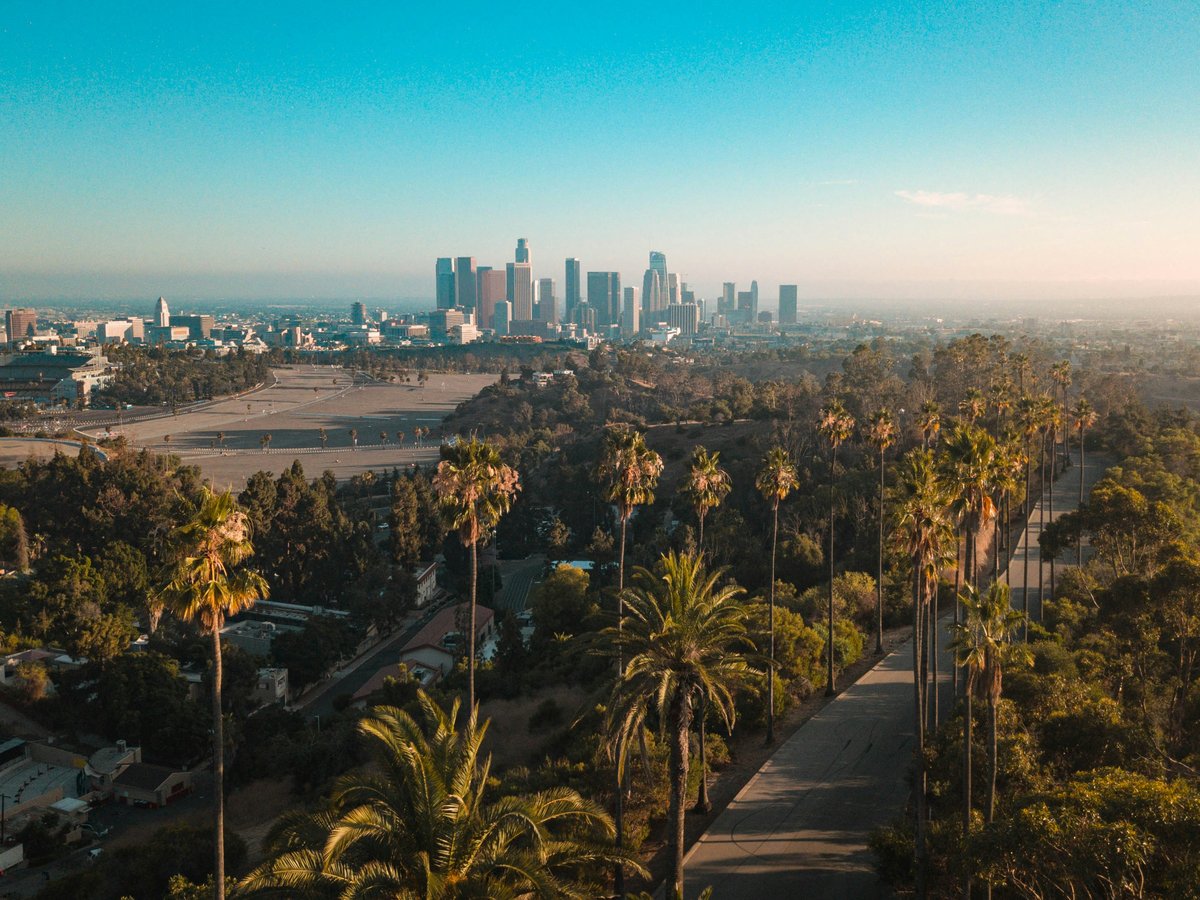
Los Angeles sprawls across roughly 500 square miles between the Santa Monica Mountains and the Pacific, connected by a freeway grid that doubles as the city's nervous system. There's no single center. Instead, you'll find a dozen or so distinct neighborhoods strung along the I-10, the 101, and the 405, each with its own tempo and food scene. Downtown sits east of center, Hollywood perches below the hills to the northwest, and the beach communities line 30 miles of coastline to the west. The distances are real. Getting from Silver Lake to Manhattan Beach can take 90 minutes in rush-hour traffic, so where you base yourself shapes what you'll see. The Metro system currently runs 6 rail lines and has been expanding since 2016, but LA remains a driving city at its core. Most visitors underestimate the geography and overestimate what they can fit in a day.
Neighborhoods
-
Downtown (DTLA)
DTLA has changed fast since about 2014, when the first wave of loft conversions started filling up the old garment district warehouses along Los Angeles Street. The architecture shifts block by block. You'll walk past Beaux-Arts bank buildings from the 1920s on Spring Street, turn a corner, and hit a 40-story glass residential tower finished in 2023. It still feels half-built in places. The sidewalks are busier than they used to be, but this is not Manhattan. After 9 PM on weekdays, stretches of 7th Street go quiet. The food scene tends toward the ambitious end. Grand Central Market on South Broadway has been open since 1917, and it now sits alongside newer spots along the Arts District stretch of East 3rd Street.
- Best for
- First-time visitors who want walkability and cultural anchors like The Broad museum (free general admission, timed entry) and Walt Disney Concert Hall on Grand Avenue
- Key streets
- Spring Street between 2nd and 9th for the historic core's restored theaters and ground-floor restaurants. East 3rd Street through the Arts District for coffee roasters, galleries, and Bestia at 2121 East 7th Place. Broadway for the old movie palaces, most of which still have their original marquees.
-
Silver Lake
Silver Lake sits in the hills northeast of Downtown, about a 15-minute drive without traffic. The streets wind and climb. Sunset Boulevard cuts through the middle, lined with small storefronts and restaurants that turn over every few years. The residential blocks above the boulevard are steep, quiet, and full of mid-century houses from the 1950s and 1960s, many designed by followers of Richard Neutra, who lived here on Silver Lake Boulevard. The reservoir that gives the neighborhood its name has a 2.2-mile walking path around it. On weekend mornings, the path fills with joggers and dog walkers. The pace is slower than Hollywood but more self-conscious about it.
- Best for
- Couples and solo travelers who care about independent coffee shops, natural wine bars, and walkable (if hilly) streets without the beach-town markup
- Key streets
- Sunset Boulevard between Sanborn Avenue and Fountain Avenue for the main commercial strip. Rowena Avenue near Hyperion for Cookbook, a restaurant-bookstore hybrid. The stairways off Descanso Drive, which connect hillside streets and feel like a secret the city forgot to pave over.
-
Hollywood
Hollywood Boulevard between La Brea and Vine can feel like a theme park of itself. The Walk of Fame stars, the costumed characters, the souvenir shops. It's loud. To be fair, that 12-block stretch is not really where locals spend time. Move a few blocks south to Melrose Avenue or north into the residential hills and the tone shifts. Franklin Avenue, one block above Hollywood Boulevard, has a row of quieter restaurants and a view corridor toward the Hollywood Sign. The area around Cahuenga Boulevard south of the boulevard has become a late-night pocket with bars like Good Times at Davey Wayne's and Harvard & Stone within walking distance of each other. The Hollywood & Highland complex (now called Ovation Hollywood since 2021) anchors the tourist zone.
- Best for
- Nightlife-focused visitors in their 20s and 30s, and anyone who wants to tick off the big landmarks quickly since the Hollywood/Highland Metro stop puts you right in the middle
- Key streets
- Cahuenga Boulevard between Selma and Yucca for the after-dark strip. Franklin Avenue for a calmer daytime walk. Beachwood Drive heading north toward the Beachwood Canyon neighborhood, which dead-ends near the Hollywood Sign trail access at the top.
-
Santa Monica
Santa Monica has its own city government, separate from LA, which partly explains why it feels more organized than most of the sprawl. The 3rd Street Promenade runs 3 blocks between Wilshire and Broadway, pedestrian-only and lined with chain stores and street performers. It's fine. The more interesting stretch is along Main Street south of Pico Boulevard, where you'll find smaller shops and restaurants like Tar & Roses. Ocean Avenue runs along the bluffs above Pacific Coast Highway, and you can hear the roller coaster on the Santa Monica Pier from the benches in Palisades Park. The beach itself is wide, flat, and backed by a concrete bike path that runs 22 miles from Will Rogers State Beach south to Torrance Beach.
- Best for
- Families and visitors who want the beach as their daily backdrop, with easy Metro access to Downtown via the E Line (formerly Expo Line, about 48 minutes end to end)
- Key streets
- Main Street south of Pico for local-leaning restaurants and the independent bookshop The Last Word. Montana Avenue between 7th and 17th for a quieter, more residential shopping strip. Ocean Avenue for the sunset views along the bluffs.
-
Venice
Venice sits directly south of Santa Monica, and the border is basically Rose Avenue. The Venice Boardwalk (officially Ocean Front Walk) still has its tattoo parlors, street vendors, and skate park, though the atmosphere has shifted over the past decade as tech companies like Google and Snap moved into the area around Abbot Kinney Boulevard. That stretch of Abbot Kinney between Venice Boulevard and Main Street has become one of the most expensive retail corridors in LA, with a mix of boutiques, restaurants like Gjelina at 1429 Abbot Kinney, and design shops. The Venice Canals, a few blocks inland from the beach, date to 1905 when Abbot Kinney originally built them as part of a planned resort. They're real canals with pedestrian bridges and houses on stilts. Quiet in a way that feels unlikely given how close the boardwalk is.
- Best for
- Travelers in their late 20s to 40s who want beach proximity with walkable dining and don't mind paying a premium for it. Venice Airbnb and hotel rates tend to run 20-30% above comparable DTLA spots.
- Key streets
- Abbot Kinney Boulevard for the concentrated restaurant and shopping stretch. Windward Avenue at the beach for the original 1905 colonnades (partially restored). The Venice Canal walkways, accessible from Venice Boulevard between Dell and Grand.
-
Los Feliz
Los Feliz (locals say "loss FEE-lus," not the Spanish pronunciation) sits at the base of Griffith Park, which at 4,310 acres is one of the largest urban parks in the country. The main commercial strip runs along Hillhurst Avenue and Vermont Avenue between Franklin and Prospect, with a cluster of restaurants, a revival cinema called the Vista Theatre (reopened in 2023 after Quentin Tarantino bought it), and a few bookshops. The residential streets climb into the hills toward the Griffith Observatory, and many of the houses date to the 1920s Spanish Colonial period. It feels settled. The trees are old. The noise level is low compared to Hollywood, which is about a mile south.
- Best for
- Culture-focused visitors who want hiking access, proximity to the Griffith Observatory (free admission, open Tuesday through Sunday), and a quieter residential base
- Key streets
- Vermont Avenue between Prospect and Franklin for restaurants like Little Dom's and Alcove Cafe. Hillhurst Avenue for the Vista Theatre and Skylight Books. Fern Dell Drive, the shaded entrance to Griffith Park that starts near Los Feliz Boulevard.
-
Koreatown
Koreatown, roughly bounded by Western Avenue to the east and Crenshaw Boulevard to the west, is one of the densest neighborhoods in LA. The architecture is mid-rise apartments from the 1920s mixed with newer developments. The food scene is the draw. You'll find Korean BBQ restaurants open past 2 AM on Western and 6th, dumpling spots on Olympic Boulevard, and some of the best late-night drinking in the city at places like Dan Sung Sa, a pojangmacha-style bar at 3317 West 6th Street that looks like a 1970s Korean film set. The neighborhood is noisy, especially on weekends. Car horns, neon, the smell of grilling meat drifting from restaurant exhaust fans.
- Best for
- Food-driven travelers and night owls who want to eat well for less. A full Korean BBQ dinner for two at a mid-range spot like Kang Ho-dong Baekjeong on Vermont tends to run $50-70 before drinks.
- Key streets
- Western Avenue between Wilshire and Olympic for the highest concentration of Korean BBQ spots. 6th Street between Vermont and Western for bars and late-night restaurants. Wilshire Boulevard for the art deco Wiltern Theatre (1931) and the Line Hotel, a converted 1960s medical building.
-
West Hollywood
West Hollywood ("WeHo") is another independent city within the LA sprawl, only about 1.9 square miles. It packs a lot into that space. The Sunset Strip, the stretch of Sunset Boulevard between Crescent Heights and Doheny Drive, still has its rock-and-roll legacy clubs like the Whisky a Go Go (open since 1964) and The Roxy, though the clientele has shifted younger and the comedy clubs (The Comedy Store at 8433 Sunset) now draw bigger names. Santa Monica Boulevard through WeHo is the center of one of the largest LGBTQ+ communities in the US, with bars, clubs, and community organizations lining the corridor. The Design District along Melrose Avenue and Robertson Boulevard leans toward high-end furniture showrooms and galleries.
- Best for
- Nightlife seekers, LGBTQ+ travelers, and anyone who wants a walkable commercial district that stays active until 2 AM most nights
- Key streets
- Sunset Boulevard between Crescent Heights and Doheny (the Strip) for live music and comedy. Santa Monica Boulevard between La Cienega and Robertson for the LGBTQ+ scene. Melrose Avenue west of Fairfax for vintage shops and restaurants like Craig's, a celebrity-frequent spot at 8826 Melrose.
-
Culver City
Culver City was a quiet, slightly dull suburb until about 2010. The Sony Pictures lot (originally MGM, where The Wizard of Oz was filmed in 1939) still dominates Washington Boulevard. But the blocks around the old downtown core have filled in with galleries, restaurants, and a weekend farmers market. The area along La Cienega Boulevard near Jefferson has become a gallery row, with spaces like Blum & Poe and Various Small Fires pulling foot traffic. The Expo Line (now the E Line) put Culver City within 25 minutes of Downtown, which changed the math for a lot of people. The food scene tends toward the $15-25 lunch range, with spots like Lukshon and Vespertine (the latter is more $300-per-person territory, in a building that looks like it landed from another planet).
- Best for
- Art-interested visitors who want lower hotel rates than the Westside beach cities, with good transit access and a growing restaurant scene
- Key streets
- Washington Boulevard between Ince and Watseka for the old downtown strip. La Cienega Boulevard near Jefferson for galleries. Culver Boulevard for the weekend farmers market near City Hall.
-
Highland Park
Highland Park sits northeast of Downtown along the Arroyo Seco, a seasonal river channel that runs from the San Gabriel Mountains to the LA River. Figueroa Street, the main drag, was a Craftsman-bungalow-and-taco-stand corridor for decades before a wave of coffee shops, natural wine bars, and vintage furniture stores arrived around 2015. The architecture on the residential streets is still mostly Craftsman and Spanish Revival houses from the 1910s-1930s, many with original woodwork. The Gold Line (now the A Line) stops at Highland Park station, which makes it one of the more transit-accessible neighborhoods on the eastside. The pace is unhurried. Weekend mornings on York Boulevard have a lazy, mid-morning feel.
- Best for
- Budget-conscious travelers and food explorers who want taco trucks, Salvadoran pupuserias on York Boulevard, and craft beer at spots like Highland Park Brewery (originally at 1220 North Spring, now with a taproom on Figueroa)
- Key streets
- Figueroa Street between Avenue 50 and Avenue 60 for the main commercial run. York Boulevard between Avenue 50 and Avenue 52 for a second strip with cheaper eats. The pedestrian bridge over the Arroyo Seco near the 134 freeway, which connects to trails leading toward the Rose Bowl in Pasadena.
FAQ
Is renting a car necessary in Los Angeles, or can visitors rely on public transit?
It depends on where you stay. If you base yourself along the Metro E Line corridor (Downtown to Santa Monica), you can cover a lot without a car. The A Line reaches Highland Park, Pasadena, and East LA. But neighborhoods like Malibu, the Getty Center, or anything in the hills will likely require a car or rideshare. Lyft and Uber rides across the basin typically run $15-40 depending on traffic. That said, rush hour on the 405 or the 10 can add 45 minutes to a 12-mile trip, so transit sometimes wins on pure time. The Metro day pass currently costs $3.50.
Which neighborhood in LA is best for first-time visitors who want to see the most in a short trip?
DTLA or Santa Monica, depending on your priorities. DTLA puts you within walking distance of The Broad, Grand Central Market, and Walt Disney Concert Hall, and the Metro connects you to Hollywood in about 20 minutes. Santa Monica works better if the beach matters to you, and the E Line still gets you to Downtown in under an hour. Hollywood itself is fine for a day visit but tends to feel thin for a multi-night base. The stretch between the landmarks is mostly fast food and souvenir shops.
How far apart are the neighborhoods in Los Angeles, and how long does it take to get between them?
The distances are larger than most visitors expect. Silver Lake to Santa Monica is about 14 miles, which can take 25 minutes on a Sunday morning or 75 minutes on a Friday at 5 PM. Highland Park to Venice is roughly 18 miles and consistently 40-60 minutes. Koreatown to Hollywood is only about 4 miles and 15 minutes outside of rush hour. A good rule of thumb is to plan no more than 2 neighborhoods per day, with the commute built in. Google Maps with the "depart at" feature gives you the most reliable time estimates.
Where should budget-conscious travelers stay in Los Angeles?
Koreatown and Highland Park currently offer the best value-to-experience ratio. Koreatown has hostels and budget hotels in the $80-120 per night range, with some of the best food in the city at accessible prices. Highland Park is similar, with Airbnb options that undercut Westside rates by 30-40%. Both neighborhoods sit on Metro lines. Santa Monica and Venice run the highest, with mid-range hotels starting around $200-250 per night in summer. DTLA falls in the middle and has more hotel inventory than the smaller neighborhoods.
What is the safest way to navigate Los Angeles at night?
Most of the neighborhoods listed here are fine for walking at night along the main commercial corridors. Koreatown and parts of Hollywood stay active past midnight, which helps. DTLA has improved over the past decade but still has blocks, particularly around Skid Row east of Main Street between 3rd and 7th, where visitors should be cautious after dark. Rideshares are the standard for getting between neighborhoods at night. The Metro runs until roughly midnight on weekdays and 2 AM on Friday and Saturday nights, though ridership drops noticeably after 10 PM on most lines.
Last verified by automated review (v1.7.2) on . What is automated review?