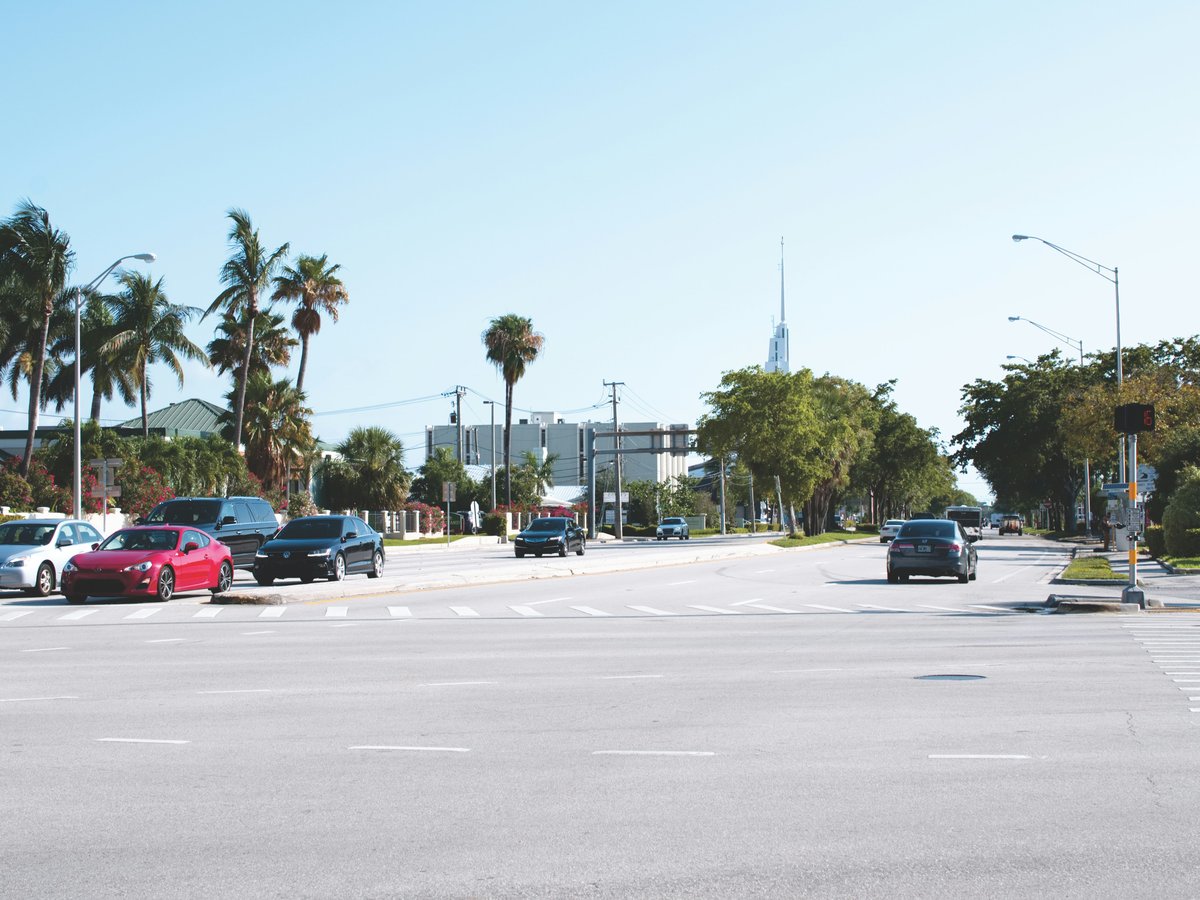
Fort Lauderdale sits on a grid that bends around canals. The city runs roughly north-south along US-1 (Federal Highway) and A1A (the beachfront road), with the Intracoastal Waterway splitting the mainland from the barrier island. Most of the action clusters within 4 miles of the coast, between the New River to the south and Commercial Boulevard to the north. The beach strip is narrow, rarely more than 3 blocks wide, and connected to the mainland by a handful of causeways. Las Olas Boulevard is the seam between downtown and the shore, crossing the Intracoastal on a drawbridge that still opens for sailboats 20-odd times a day. South of the New River, the older residential neighborhoods feel slower and more rooted. North of Sunrise Boulevard, the suburbs start to flatten out. Wilton Manors sits a couple miles inland as its own incorporated city within the metro. To the south, Hollywood and Dania Beach have their own personalities entirely. The whole area is laced with canals, so the smell of brackish water and boat diesel follows you through half of these neighborhoods. Mid-August temperatures tend to hover around 33°C, and the humidity currently sits at 75%, so your walking plans might need to account for afternoon thunderstorms that roll in off the Everglades most days between 3 and 5 PM.
Neighborhoods
-
Las Olas & Downtown
Las Olas Boulevard runs east from downtown's cluster of office towers toward the Intracoastal, lined with low-rise storefronts, galleries, and sidewalk restaurants. The architecture is a mix of 1920s Mediterranean Revival and newer glass-front buildings. Downtown proper has filled in over the past 15 years with condo towers and a Brightline station that connects to Miami in about 30 minutes and West Palm Beach in roughly an hour. The noise level picks up on weekend evenings when the restaurant patios fill. You'll catch the faint clank of sailboat rigging from the drawbridge if the wind is right. The NSU Art Museum, which opened as the Museum of Art Fort Lauderdale back in 1958, anchors the western end of the boulevard on SE 1st Street.
- Best for
- First-time visitors, couples, and anyone who wants walkable restaurants and nightlife without renting a car
- Key streets
- Las Olas Boulevard between SE 6th Avenue and SE 15th Avenue, SW 2nd Street for the Himmarshee entertainment district, SE 1st Street near the museum campus, Andrews Avenue for the Brightline station
-
Fort Lauderdale Beach
A1A runs along the beach with a wide brick promenade on the sand side and hotels, restaurants, and bars on the other. The beach itself is surprisingly clean, with coarse sand that's more tan than white. The wave wall (a low concrete barrier along the promenade) has been the default meeting spot since the city rebuilt the beachfront in the late 1990s. It gets loud near Las Olas Beach, where the boulevard meets A1A, but quieter if you walk 10 blocks north toward Hugh Taylor Birch State Park, which has been protecting 180 acres of coastal hammock since 1941. The park's freshwater lagoon feels like a different climate entirely, shaded and still, with the smell of sea grape leaves. South of the main strip, the beach thins near the Bahia Mar marina, where deep-sea charter boats line up along the docks.
- Best for
- Beach-focused stays, spring breakers (February through April), and anyone who wants to wake up and walk to the sand
- Key streets
- A1A (North Fort Lauderdale Beach Boulevard) from Sunrise Boulevard south to SE 17th Street, Alhambra Street for quieter beach access, Birch Road for the state park entrance
-
Victoria Park
A residential neighborhood of 1950s ranch houses and small mid-century bungalows sitting between downtown and the beach, about a 10-minute walk from each. The streets are quiet, lined with live oaks and banyans that form full canopies overhead. NE 4th Avenue is the informal main street. The pace here is slow, residential. You hear lawnmowers and parrots (Fort Lauderdale has several feral parrot flocks, likely descendants of escaped pets from the 1980s). No high-rises. The housing stock is modest but well-kept, and the neighborhood has a few small restaurants and cafes tucked into converted houses. It feels like a pre-war Florida town that the condo developers somehow missed.
- Best for
- Visitors who want a quiet base within walking distance of both downtown and the beach, especially those staying in vacation rentals
- Key streets
- NE 4th Avenue, NE 15th Street (connects to the Galleria mall area), Holiday Park Drive near the War Memorial Auditorium
-
Flagler Village
Immediately north of downtown, Flagler Village has gone from an overlooked warehouse district to Fort Lauderdale's gallery and mural neighborhood over the past decade. NE 2nd Avenue has a concentration of street art that changes every few months. FAT Village (Flagler Arts and Technology) hosts monthly art walks on the last Saturday of each month. The buildings are still low, mostly converted light-industrial spaces, and the restaurant scene leans toward small-plate and craft cocktail spots. The heat radiates off the asphalt here since there's less tree cover than the residential neighborhoods to the south. You'll smell roasting coffee from Wells Coffee on NE 1st Avenue most mornings.
- Best for
- Younger travelers, art-oriented visitors, and anyone looking for a neighborhood with new restaurants that locals frequent
- Key streets
- NE 2nd Avenue from Broward Boulevard to NE 4th Street, NE 3rd Avenue for the FAT Village galleries, NE 1st Avenue for coffee and breakfast spots
-
Wilton Manors
An independent city (population around 12,500) that sits about 2 miles inland from the beach, centered on Wilton Drive. It has been the center of LGBTQ+ life in South Florida for decades. Wilton Drive is a 1-mile commercial strip of bars, restaurants, thrift shops, and small businesses. The residential streets around it are older Florida homes, 1950s concrete-block construction with jalousie windows and small yards full of bromeliads. The Stonewall National Museum Archives and Library, which started in 1973 as one of the first LGBTQ+ archives in the country, is on N. Dixie Highway. The neighborhood feels like a small town that happens to be surrounded by a metro area of 2 million people. You hear music from the bars on weekend nights, but the side streets are genuinely quiet.
- Best for
- LGBTQ+ travelers, visitors who prefer a walkable neighborhood with independent businesses, and anyone tired of the beach-strip hotel scene
- Key streets
- Wilton Drive between NE 6th Avenue and NE 26th Street, N. Dixie Highway near the Stonewall museum, NE 15th Avenue for residential character
-
Coral Ridge
North of Sunrise Boulevard, Coral Ridge is the kind of neighborhood where ranch houses from the early 1960s sit on wide lots with boats in the side yards. The Coral Ridge Country Club anchors the western edge, and the Coral Ridge Presbyterian Church (designed by Richard Kemp in 1960) is still one of the area's architectural landmarks. The Galleria at Fort Lauderdale mall sits at the southeastern corner where Sunrise meets A1A. Bayview Drive, which runs along the Intracoastal, has some of the largest waterfront homes in the city. The feel is suburban and moneyed but without the gated-community isolation you find further west in Weston or Parkland.
- Best for
- Families, boaters, and visitors who want a quieter residential area with easy access to both the beach and the interstate
- Key streets
- Bayview Drive along the Intracoastal, Sunrise Boulevard for commercial errands, NE 33rd Street toward the Galleria, Middle River Drive for canal-side walks
-
Rio Vista
South of the New River, Rio Vista is one of Fort Lauderdale's oldest residential neighborhoods, with streets that curve along the canals. The houses range from 1930s Spanish Colonial Revival to newer waterfront mansions that replaced the originals. SE 10th Street is the main artery. The Riverwalk continues along the New River's south bank, connecting to Esplanade Park. It is quieter than Las Olas, with less foot traffic and fewer restaurants, though Southport Raw Bar on SE 17th Street Causeway has been serving peel-and-eat shrimp in the same dockside location since 1976. The air smells like frangipani in the residential blocks, and the afternoon light through the banyan trees along SE 7th Avenue is genuinely beautiful.
- Best for
- Visitors who prefer established residential neighborhoods, couples looking for a romantic base, and anyone who wants canal views without the Las Olas price premium
- Key streets
- SE 10th Street, SE 7th Avenue, Riverwalk along the south bank of the New River, SE 17th Street Causeway toward Port Everglades
-
Hollywood Beach
About 8 miles south of downtown Fort Lauderdale, Hollywood Beach has a 2.5-mile Broadwalk (yes, Broadwalk, not boardwalk, named for its width) that runs along the sand. The feel is more working-class and family-oriented than Fort Lauderdale Beach. You'll find pizza-by-the-slice shops, ice cream stands, and small motels from the 1960s that still rent rooms. The Art and Culture Center of Hollywood, which opened in 1975, sits on Hollywood Boulevard about a mile inland. Johnson Street and Harrison Street have the densest restaurant concentration along the Broadwalk. The crowd skews older than Fort Lauderdale Beach, with a noticeable French-Canadian contingent from November through April.
- Best for
- Budget travelers, families with small children, and visitors who want a mellower beach scene with more affordable dining
- Key streets
- Hollywood Beach Broadwalk (the full 2.5-mile stretch from Sheridan Street to Hallandale Beach Boulevard), Hollywood Boulevard from the beach inland to the art center, Johnson Street for beachside restaurants
-
Dania Beach
The smallest and often overlooked municipality between Fort Lauderdale and Hollywood. Dania Beach's main draw used to be its antique district along US-1, which has thinned out over the years but still has a handful of dealers. The Dania Beach Hurricane, a wooden roller coaster at the old Dania Beach amusement park site, was a local landmark for decades. Dania Pointe, a newer open-air shopping center off I-95 at Griffin Road, has brought in chain restaurants and retail. The fishing pier at Dania Beach is one of the less crowded options in Broward County, with a $3 entry fee and bait shop. The neighborhood is honest and unpretentious, with 1950s block houses and the smell of salt flats when the wind comes from the west.
- Best for
- Visitors on a budget who want proximity to Fort Lauderdale-Hollywood International Airport (about 3 miles away) and don't mind a short drive to the main attractions
- Key streets
- US-1 (Federal Highway) through the old antique district, Dania Beach Boulevard toward the ocean and fishing pier, Griffin Road for Dania Pointe shopping
FAQ
What is the best neighborhood in Fort Lauderdale for first-time visitors?
Las Olas and downtown put you within walking distance of restaurants, the Brightline rail connection to Miami, and the beachfront (about a 15-minute walk or short Uber east over the Intracoastal). You can explore on foot without renting a car for at least the first couple of days. Hotel rates along Las Olas tend to run $180 to $350 per night depending on season. The area around Himmarshee Street has the densest bar and restaurant concentration for evening plans.
Is Fort Lauderdale Beach or Hollywood Beach better for families?
Hollywood Beach tends to be calmer and more affordable, with the wide Broadwalk providing a safe path for strollers, bikes, and scooters. Fort Lauderdale Beach has better restaurants and a younger crowd, but the Broadwalk's flat, car-free surface is hard to beat with small children. Hotels on Hollywood Beach often run $50 to $100 less per night than equivalent options on Fort Lauderdale Beach.
How do you get between Fort Lauderdale neighborhoods without a car?
The Brightline commuter rail connects downtown to Miami and West Palm Beach. The Sun Trolley runs free routes through downtown and the beach strip. Ride-share apps are reliable, and most trips between neighborhoods cost $8 to $15. That said, anything west of I-95 or south into Hollywood effectively requires a car. The Water Taxi is genuinely useful for getting between Las Olas, the Galleria area in Coral Ridge, and several Intracoastal stops, running roughly every 30 minutes for about $30 for an all-day pass.
Which Fort Lauderdale neighborhood has the best food scene?
Las Olas has the most variety, but Flagler Village currently has the most interesting new openings. Wilton Manors has strong independent restaurants along Wilton Drive. For seafood specifically, the dockside places near the 17th Street Causeway in Rio Vista (south side) serve fish that was on a boat the same morning. Worth noting, the restaurant scene in Hollywood Beach is more casual and budget-friendly, with Broadwalk spots averaging $12 to $18 for a main course versus $25 to $45 along Las Olas.
Is it safe to walk around Fort Lauderdale at night?
The beach strip along A1A, Las Olas Boulevard, Flagler Village, and Wilton Drive all feel safe for evening walks. Downtown between Himmarshee and the Brightline station is well-lit and patrolled. The areas west of I-95 and some blocks north of Sunrise Boulevard inland are less walkable after dark, though violent crime against tourists is uncommon. Standard urban awareness applies. The Wikivoyage safety guidance at https://en.wikivoyage.org/wiki/Fort_Lauderdale#Stay_safe covers current advisories.
When is the best time to visit Fort Lauderdale?
November through April brings dry weather, lower humidity, and temperatures around 24 to 28°C. Hotel rates peak from mid-December through mid-April when the snowbird population arrives. May and June offer a shoulder-season window with reasonable rates and manageable heat. The current mid-August conditions (feels-like temperature above 40°C with 75% humidity) are typical for summer and make outdoor sightseeing best limited to mornings before 10 AM and evenings after 5 PM.
Last verified by automated review (v1.7.2) on . What is automated review?