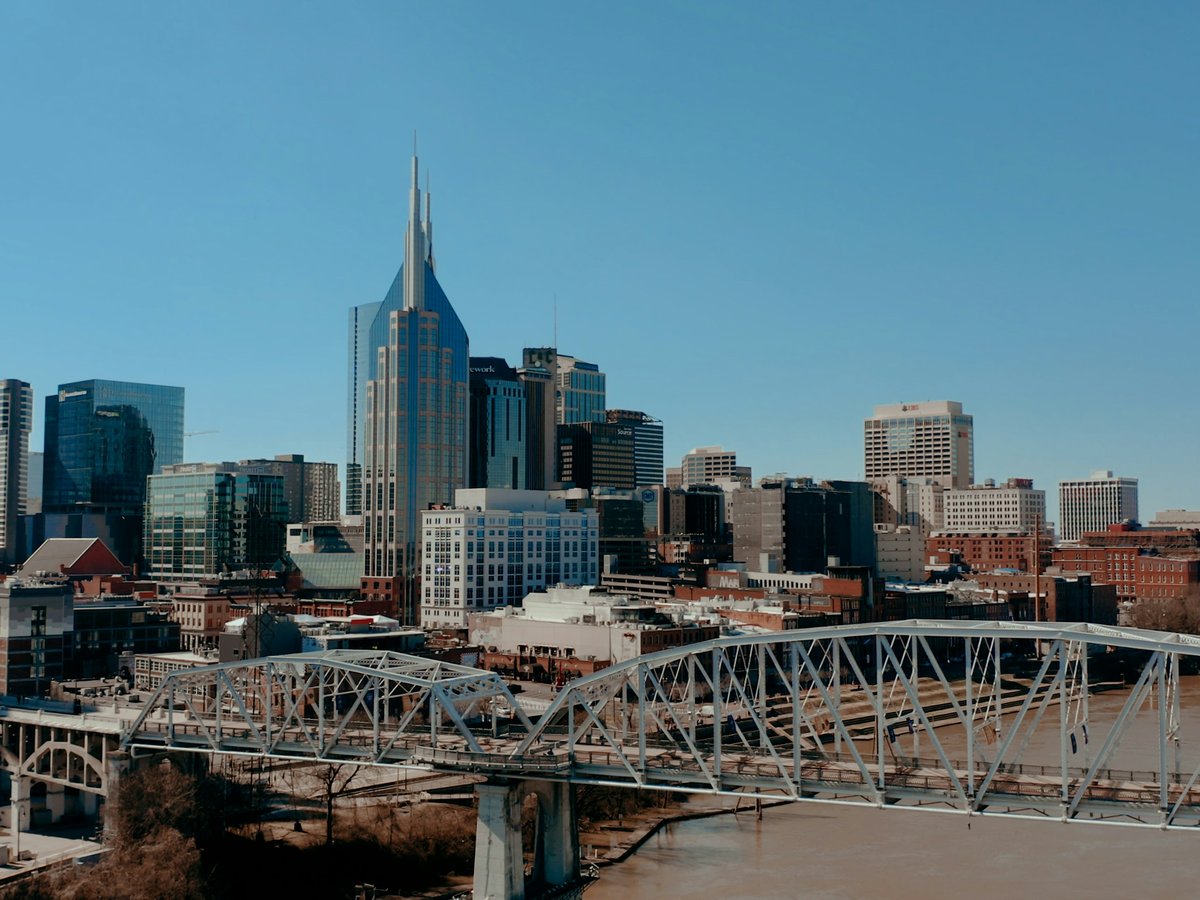
Nashville spreads outward from the Cumberland River in a loose wheel-spoke pattern, with interstates 40, 65, and 24 carving the city into rough wedges. Downtown sits in a bend of the river on the west bank, and most of the neighborhoods visitors care about fall within a 10-minute drive of Broadway. The trick is that Nashville has no real subway or light rail, so where you stay determines how much time you spend in traffic on I-440 or hunting for a $25 parking spot. The neighborhoods east of the river tend to feel younger and scrappier. West and south of downtown, you'll find more established residential areas with their own commercial strips. Broadway and the honky-tonks get all the attention, but most locals spend their weekends in places like 12South or East Nashville, where the food is better and the crowds are thinner.
Neighborhoods
-
Downtown & Lower Broadway
This is the Nashville most people picture. Lower Broadway between 1st and 5th Avenue runs 4 blocks of wall-to-wall honky-tonks, pedal taverns, and bachelorette parties in matching pink cowboy boots. The noise level on a Friday night is genuinely startling. Above 5th Avenue, the mood shifts to office towers, the Ryman Auditorium on 5th Avenue North, and the Tennessee State Capitol on Charlotte Avenue. The new Fifth + Broadway development added a food hall and observation deck in 2021. It's loud, it's commercial, and the boot stores outnumber the grocery stores by roughly 50 to zero.
- Best for
- First-time visitors who want to walk to honky-tonks, the Country Music Hall of Fame on Demonbreun Street, and the Ryman without needing a car or a rideshare
- Key streets
- Lower Broadway from 1st to 5th Avenue, Printer's Alley between 3rd and 4th Avenue North, 2nd Avenue North along the riverfront, and Demonbreun Street heading toward the Gulch
-
The Gulch
A former rail yard south of Broadway that got redeveloped into condos, boutique hotels, and restaurants starting around 2010. The architecture is all glass and steel, 5 to 12 stories, which makes it feel more like a pocket of Austin or Charlotte than old Nashville. The famous Biscuit Love on 11th Avenue South draws a 45-minute weekend line for their bonuts. Station Inn on 12th Avenue South is a low-ceiling bluegrass venue where you might catch a Grammy winner on a Tuesday for a $15 cover. The "What Lifts You" angel wings mural at the corner of 11th Avenue South draws a steady queue of people waiting to pose.
- Best for
- Couples and professionals who want walkable restaurants and a polished feel, with downtown a 10-minute walk north across Demonbreun Street
- Key streets
- 11th Avenue South, 12th Avenue South between Pine and Lea, and the Division Street corridor connecting to Midtown
-
East Nashville
Cross the Shelby Avenue pedestrian bridge from downtown and you land in East Nashville, which has been the city's creative hub for roughly 15 years. The housing stock is a patchwork of 1920s bungalows, some meticulously restored, some still rough around the edges with chain-link fences and old pickups in the yard. Five Points, where Woodland Street, 11th Street, and Clearwater Avenue intersect, is the social center. You'll find The Pharmacy Burger Parlor in a converted auto shop, Margot Cafe in an old gas station, and Fond Object Records crammed with vinyl. The crowd skews younger, tattooed, and slightly suspicious of anything too corporate. It has changed a lot since 2015, and median home prices have roughly tripled, but it still feels more lived-in than curated.
- Best for
- Independent travelers, musicians, people who'd rather eat at a converted gas station than a hotel restaurant, and anyone who wants walkable nightlife without the Broadway chaos
- Key streets
- Five Points intersection, Gallatin Avenue from Cahal to Eastland, Fatherland Street between 9th and 14th, and Shelby Avenue near the pedestrian bridge
-
Germantown
Nashville's oldest suburb, platted in the 1850s by German immigrants north of the Capitol. The streets are narrow, the houses are mostly brick Victorians from the 1880s and 1890s, and the whole neighborhood fits inside about 8 square blocks. Monell's at 1235 6th Avenue North serves communal-table Southern meals, all-you-can-eat style, and the line starts forming at 10:30am on Saturdays. 5th Avenue North has a short run of restaurants and shops, and the Bicentennial Capitol Mall State Park marks the southern edge with a 2,200-foot granite map of Tennessee set into the ground. It's quiet at night. The brewery scene is strong, with Bearded Iris and Southern Grist both within walking distance. The farmers market at the north end of the mall operates year-round on Saturdays and is noticeably less picked-over than the one in 12South.
- Best for
- Foodies, history-minded travelers, and anyone who wants to walk to downtown in 15 minutes but sleep on a quiet residential street
- Key streets
- 5th Avenue North from Jefferson to Monroe, 4th Avenue North near the restaurants, and the Bicentennial Mall corridor along James Robertson Parkway
-
12South
A 6-block commercial strip on 12th Avenue South between Kirkwood and Linden Avenues, surrounded by residential streets of 1930s and 1940s cottages. The corridor is walkable and compact. Draper James, Reese Witherspoon's lifestyle brand, has its flagship store here. Imogene + Willie sells handmade denim starting around $200 a pair. The food runs from Bartaco's street tacos to Edley's Bar-B-Que. The I Believe in Nashville mural on the side of a building near Linden draws a steady photo line, though it's gotten less novel over the years. On a Saturday afternoon, 12th Avenue has a farmers market vibe, with people walking dogs, carrying cold brew from Frothy Monkey, and browsing storefronts without much urgency. It's genuinely pleasant. Mind you, the parking situation on weekends is genuinely terrible.
- Best for
- Shoppers, brunch-oriented travelers, young families, and anyone who wants a neighborhood that feels residential but has good restaurants within a 5-minute walk
- Key streets
- 12th Avenue South between Kirkwood and Linden, Granny White Pike heading south toward Sevier Park, and Belmont Boulevard running parallel one block east
-
Hillsboro Village
Tucked between Belmont University's campus and the curve of 21st Avenue South, Hillsboro Village has been a student-and-faculty hangout for decades. The Belcourt Theatre at 2102 Belcourt Avenue is a 1925 movie house that screens independent and repertory films. Pancake Pantry on 21st Avenue has drawn weekend lines since 1961. The strip is maybe 4 blocks long, and it has a slightly collegiate, bookish energy. Bookman/Bookwoman used bookstore is a cramped warren of shelves on the second floor of a building on 21st. The crowd here tends to be a mix of Belmont and Vanderbilt students, professors, and neighborhood regulars. It's calmer than East Nashville and less commercial than 12South.
- Best for
- Book lovers, film fans, Vanderbilt and Belmont visitors, and travelers who want a low-key base near the universities with easy access to Midtown's bars on Division Street
- Key streets
- 21st Avenue South from Wedgewood to Blakemore, Belcourt Avenue between 21st and Hillsboro Pike, and the connector walk to Edgehill Village on Edgehill Avenue
-
Midtown & Music Row
Music Row runs along 16th and 17th Avenues South between Demonbreun and Grand, lined with converted houses that serve as recording studios, publishing offices, and management firms. RCA Studio B at 1611 Roy Acton Place is where Elvis recorded over 200 tracks between 1957 and 1971. The area has a strange, liminal feel during the day. Half the buildings look like ordinary Craftsman homes with small signs out front. You might walk past a house and hear a session happening through the walls. The eastern edge of Midtown bleeds into Division Street and Demonbreun, where the bar scene runs younger and louder. The Row, a mixed-use development on Music Row, replaced several historic studio houses and remains controversial with locals who see it as the beginning of the neighborhood's erasure.
- Best for
- Music industry visitors, Vanderbilt parents, and people who want to be centrally located between downtown, the Gulch, and the university corridor
- Key streets
- 16th and 17th Avenues South along Music Row, Division Street from I-40 to 17th Avenue, and Demonbreun Street between Midtown and the Gulch
-
Sylvan Park & The Nations
These two neighborhoods sit west of Centennial Park and have been changing fast since about 2016. Sylvan Park, centered on Murphy Road, has a settled, tree-canopy feel with 1940s ranch houses and a walkable stretch of restaurants. Park Cafe on Murphy Road does a branzino that locals have been ordering for 20-plus years. The Nations, further west past 51st Avenue, was industrial and working-class until developers started converting old factories into breweries and restaurants around 2018. Fat Bottom Brewing on 51st is in a converted warehouse. The western edge still has auto shops and concrete plants alongside new construction. It feels transitional in a way that East Nashville did around 2012. You'll find cheaper Airbnbs here than in 12South or Germantown, but you'll need a car or a good rideshare budget, because there's no direct transit line to downtown.
- Best for
- Budget-conscious travelers with a car, people who want to explore where locals eat and drink, and visitors who find downtown overwhelming
- Key streets
- Murphy Road between 46th and 48th in Sylvan Park, 51st Avenue in The Nations, Charlotte Avenue heading toward downtown, and Centennial Boulevard near the park entrance
-
Wedgewood-Houston
Known locally as WeHo, this neighborhood south of downtown between I-65 and Nolensville Pike has shifted from warehouses and auto lots to galleries and restaurants since roughly 2017. The former Houston Station rail depot is now a mixed-use complex. Fort Negley, a Civil War stone fortification built in 1862 largely by enslaved laborers, sits on a hill at the neighborhood's northern edge and has free admission. The gallery scene here is probably the strongest in the city. David Lusk Gallery and Julia Martin Gallery anchor a cluster along Humphreys Street. Bastion, a tasting-menu restaurant in a former metalworking shop on Merritt Avenue, typically runs about $125 per person. The streets still feel half-industrial, half-residential, with gravel lots and chain-link alongside new concrete buildings. It's not polished, and that's the draw.
- Best for
- Art collectors, adventurous diners, photographers, and travelers who want a neighborhood that still feels like it's becoming something rather than something that's already arrived
- Key streets
- Humphreys Street for galleries, Merritt Avenue for restaurants, Houston Street near the old depot, and the walking path up to Fort Negley Park
-
Marathon Village
A single city block at 1305 Clinton Street, centered on the old Marathon Motor Works factory from 1910. The building has been converted into a cluster of small businesses, including Corsair Distillery, Antique Archaeology (the American Pickers shop from the History Channel show), and Bang Candy Company. It's compact enough to cover in about 90 minutes. The surrounding blocks remain largely industrial and residential, without much else within walking distance. Nelson's Green Brier Distillery, a few doors down, does tours and tastings for about $18 per person. The factory architecture is worth seeing. The original sawtooth roofline and loading docks are intact, and the interior corridors still have the wide, sloping ramps that cars once drove down.
- Best for
- Whiskey and craft spirits fans, design-minded travelers, and American Pickers devotees who want to combine a distillery visit with a browse through the antique shop
- Key streets
- Clinton Street between 12th and 13th Avenues North, and the connecting walk south to Germantown along Jefferson Street
FAQ
What is the best neighborhood in Nashville to stay in without a car?
The Gulch and downtown are the most walkable areas. The Gulch puts you within a 15-minute walk of Broadway, the Ryman, and dozens of restaurants. East Nashville is also manageable on foot if you stay near Five Points, though crossing the river to downtown means a 20-minute walk over the Shelby Avenue pedestrian bridge or a $7 to $10 rideshare. Germantown works too, with downtown about a 12-minute walk south. The WeLink scooters scattered around these neighborhoods fill gaps, at roughly $1 to unlock plus $0.39 per minute.
Which Nashville neighborhood is quietest for families with young children?
12South and Sylvan Park are the strongest options. 12South has Sevier Park with a good playground, walkable restaurants, and a residential feel once you step off the main strip. Sylvan Park is slightly quieter with McCabe Park nearby and a handful of family-friendly restaurants on Murphy Road. Both neighborhoods are a 10 to 15 minute drive from downtown. Germantown works too, though it has fewer playgrounds.
Is East Nashville safe for tourists to walk around at night?
The Five Points area and the Fatherland Street corridor are well-trafficked in the evenings and feel comfortable. Further out on Gallatin Avenue past Eastland, the lighting gets thinner and the foot traffic drops off. Like most mid-size American cities, Nashville's street-level safety varies block by block. Sticking to the restaurant and bar clusters around Five Points, you'll likely feel fine at 11pm on a Saturday.
How far apart are Nashville's main neighborhoods from each other?
Nashville is compact at the center but spread out overall. Downtown to the Gulch is a 10-minute walk. Downtown to Germantown is 12 minutes on foot. Downtown to East Nashville is 20 minutes walking across the pedestrian bridge. Downtown to 12South is a 10-minute drive or $8 rideshare. Downtown to Sylvan Park or The Nations runs 15 to 20 minutes by car depending on traffic. The I-440 loop connects the southern neighborhoods but backs up badly during the 4pm to 6pm rush.
When is the best time of year to visit Nashville?
April and October tend to be the sweet spot. April temperatures sit around 15 to 24 degrees Celsius (60 to 75 Fahrenheit), the dogwoods bloom across the city, and the CMA Fest crowds haven't arrived yet (that's June). October brings similar temperatures, fall color in Percy Warner Park, and fewer bachelorette groups than the May-through-August peak. July and August are genuinely hot, regularly hitting 35 degrees Celsius (95 Fahrenheit) with thick humidity. December through February is quieter and cheaper, but some outdoor patios and rooftop bars close for the season.
Are Nashville neighborhoods walkable or do I need a car?
Downtown, the Gulch, Germantown, and Hillsboro Village are all internally walkable, meaning you can get around within each neighborhood on foot. The problem is connecting them. Nashville has a bus system (WeGo), but routes run infrequently outside rush hour, sometimes every 30 to 45 minutes. Most visitors end up relying on rideshares between neighborhoods, which run $7 to $15 per trip depending on distance and demand. If you plan to visit The Nations, Sylvan Park, or anywhere south of I-440, a rental car saves money over 3 to 4 days of rideshares.
Last verified by automated review (v1.7.2) on . What is automated review?