Brussels tends to surprise people who assume a European capital means expensive. The Grand-Place alone, consistently ranked among the most beautiful squares on the continent, costs nothing to stand in and stare at for as long as you like. Beyond that 110-by-68-metre rectangle of gilded guildhouses, the city keeps a remarkable amount of its cultural weight open to anyone willing to walk. Parks like the Bois de la Cambre stretch across 124 hectares of former Soignes forest. The Cathédrale des Saints-Michel-et-Gudule has welcomed visitors without a ticket since the 13th century. Several major museums open their doors free on the first Wednesday afternoon of each month, a policy the federal government has maintained since 2000. Street art across entire neighborhoods in Laeken and the Canal district turns a casual walk into an open-air gallery. Even the food scene has a free angle. The Sunday morning Marché du Midi, with roughly 450 stalls along the Gare du Midi rail tracks, costs nothing to browse. You'll smell roasting chicken fat and North African spice mixes from 200 metres out. Brussels rewards a zero budget because the city's best material, its architecture, its squares, its parks, its churches, was built to be public in the first place.
Free attractions
-
Grand-Place / Grote Markt
The central square dates to the 13th century, though most of the current facades were rebuilt after Louis XIV's bombardment in 1695. The Hôtel de Ville on the southwest side still functions as the city hall. At night, the guildhouse facades light up, and from mid-December through early January the square hosts a sound-and-light show projected onto the buildings. Always free, always open. The Flower Carpet, a 1,800-square-metre design made from roughly 500,000 begonias, appears every two years in August. The next one is currently scheduled for 2026.
Ilot SacréHistoric square -
Cathédrale des Saints-Michel-et-Gudule
This Brabantine Gothic cathedral sits on the Treurenberg hill between the upper and lower town. Construction began around 1226 and continued for roughly 300 years. The 16th-century stained glass windows in the transept, designed by Bernard van Orley, still catch afternoon light in a way that turns the interior amber. Entry is free. The treasury and archaeological crypt beneath the nave do charge a small fee, currently around 3 euros, but the main nave and side chapels cost nothing.
CentreCathedral -
Parc du Cinquantenaire / Jubelpark
Leopold II commissioned this 30-hectare park for the 50th anniversary of Belgian independence in 1880. The triumphal arch at its center, topped by a bronze quadriga, took until 1905 to finish. The park itself is always open and free. You can walk under the arches, sit on the wide lawns, and watch joggers loop the gravel paths. The Autoworld and military museum flanking the arch charge admission, but the park and the arch are public ground. On warm evenings, the south-facing lawn fills with picnic groups. The grass smells like it has been cut that morning, and it likely has been.
Etterbeek / European QuarterPark -
Manneken Pis
The 61-centimetre bronze statue at the corner of Rue de l'Étuve and Rue du Chêne is smaller than most visitors expect. The current figure dates to 1619, cast by Hiëronymus Duquesnoy the Elder, though the folklore goes back to the 14th century. He wears one of his 1,000-plus costumes on most days, changed by the city's official dresser. Free to view, always. The GardeRobe MannekenPis museum at Rue du Chêne 19 displays hundreds of the costumes for a fee, but seeing the statue itself costs nothing.
Ilot SacréLandmark -
Église Notre-Dame du Sablon
This 15th-century Flamboyant Gothic church on the Place du Grand Sablon has some of the finest stained glass in Brussels. The interior is darker than the cathedral, and quieter. The Chapelle de Tour et Taxis in the north aisle has polychrome stonework that tends to get overlooked. Free entry, though the church closes between 12:30 and 13:30 most weekdays. Worth noting, the small garden behind the church, the Square du Petit Sablon, has 48 bronze statuettes representing medieval guilds along its fence. Also free.
SablonChurch -
Palais de Justice
Joseph Poelaert's 1883 courthouse is one of the largest buildings constructed in the 19th century, covering 26,000 square metres. The main hall, the Salle des Pas Perdus, has a ceiling height of roughly 97 metres from the basement floor. You can walk into the main public halls during court hours on weekdays without charge. The building has been under renovation scaffolding since 1984, which at this point feels permanent. The terrace behind it, the Place Poelaert, gives a wide panoramic view over the lower town toward Koekelberg and the Atomium. Free, open, and on a clear day you can see the Basilique de Koekelberg dome 4 kilometres to the northwest.
MarollesViewpoint / Historic building -
Mont des Arts / Kunstberg
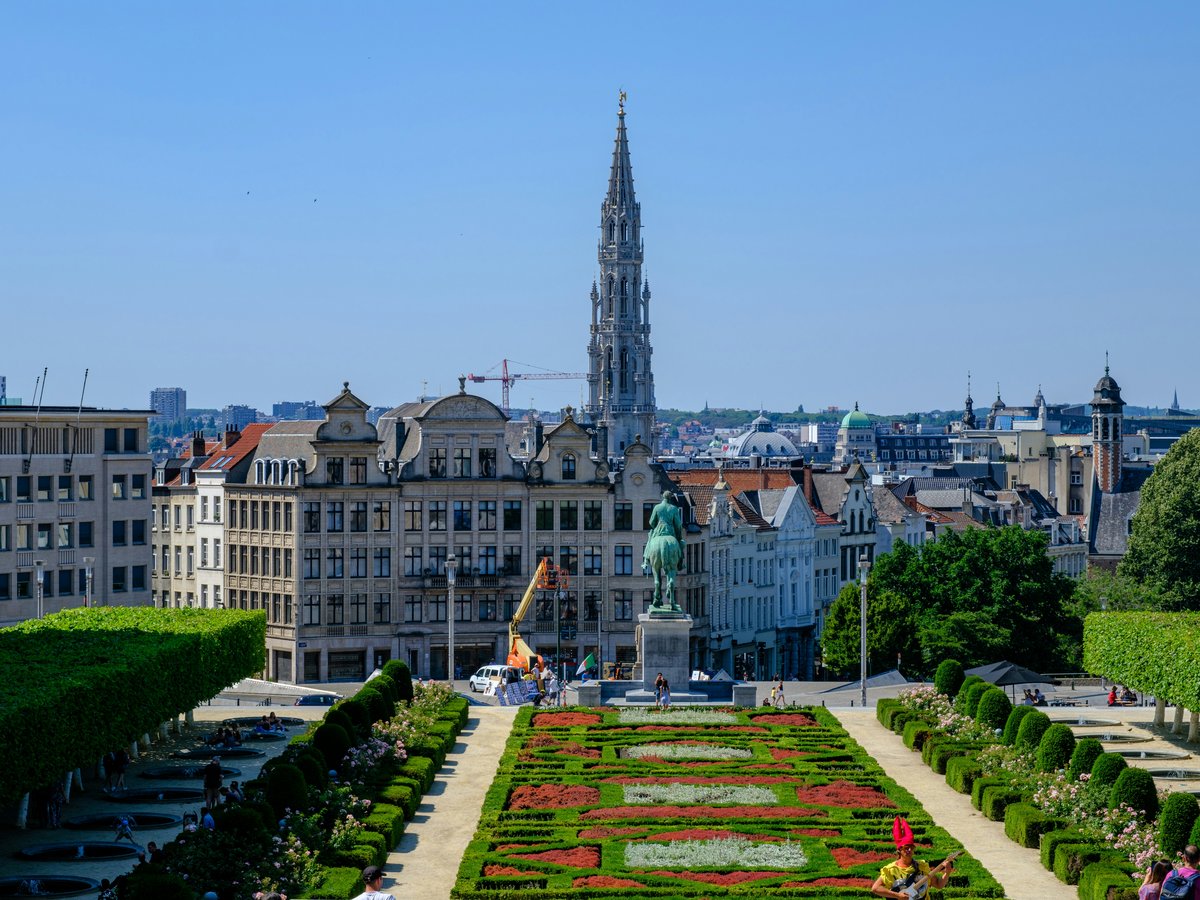
This terraced garden between the Place Royale and the Gare Centrale gives one of the best views of the lower town, with the Hôtel de Ville spire centered in the frame. The geometric garden, designed by René Pechère in the 1950s, is always open. In summer, the Bibliothèque royale at the top sometimes projects films onto its facade. The carillon in the clock tower plays every quarter hour. Free to walk, sit, and photograph at any time.
CentreGarden / Viewpoint -
Bois de la Cambre
The northernmost section of the Forêt de Soignes was carved out in 1861 as a public park and stretches across 124 hectares south of Avenue Louise. The lake at its center has a small island, the Île Robinson, accessible by a free electric ferry that runs on weekends in warmer months. Beech trees, some over 200 years old, form a canopy dense enough that even midday light filters down soft and green. On Sundays the main roads close to cars. The air smells different here. Damp earth, leaf litter, something faintly mushroom-like after rain.
Ixelles / UcclePark / Forest -
Parc de Bruxelles / Warandepark
This 13-hectare formal park between the Royal Palace and the Belgian Parliament follows an 18th-century design with symmetrical paths radiating from a central fountain. The mature horse chestnuts provide heavy shade in summer. The bandstand in the southeast corner occasionally hosts free concerts. The park closes at dusk and reopens at dawn, and the schedules are posted at the gates. To be fair, it is more manicured than wild, but the geometry itself is worth seeing, and the benches face the palace facade, which is open to visitors in summer.
CentrePark
Free activities
-
Comic Book Route (Parcours BD)
Brussels has painted over 60 comic-strip murals across the city center since 1991. The route connects them through alleys and side streets you would never find otherwise. A free map is available at the Visit Brussels office on Rue Royale, or you can download it from their site. Highlights include the Tintin mural on Rue de l'Étuve, the Broussaille mural on Plattesteen (the first one painted, in 1991), and a large Lucky Luke panel near Rue de la Buanderie. The full route is roughly 5 kilometres and takes about 2 hours at a browsing pace.
City-wideWalking route -
Marché du Midi (Sunday Market)
Roughly 450 stalls stretch along the railway viaduct near the Gare du Midi every Sunday morning from around 6:00 to 13:30. The market leans heavily toward the Moroccan, Turkish, and Congolese communities around Saint-Gilles and Anderlecht, so the food stalls carry spices, olives, dried fruits, and flatbreads you won't find in the tourist quarter. Browsing is free. The noise level is considerable. Haggling is expected on textiles and housewares. Get there before 9:00 if you want to move comfortably. By 10:30 it gets dense enough that you're shuffling.
Saint-Gilles / AnderlechtMarket -
Art Nouveau walking route (Saint-Gilles and Ixelles)
Victor Horta, Paul Hankar, and their contemporaries built dozens of Art Nouveau facades across Brussels between 1893 and 1910. The highest concentration sits in the streets around Avenue Louise, Rue Defacqz, and Rue Faider in Saint-Gilles. Horta's Hôtel Tassel at Rue Paul-Émile Janson 6, the 1893 building often credited as the first Art Nouveau house, is visible from the street. The Hôtel Hannon at Avenue de la Jonction 1 has a facade with ironwork balconies that curve like plant stems. You can photograph all of them from the pavement for free. Interior visits are limited, but the exteriors carry most of the architectural interest.
Saint-Gilles / IxellesWalking route -
Marolles flea market browsing (Place du Jeu de Balle)
The daily flea market at Place du Jeu de Balle has been running since 1873. It operates every morning, roughly 6:00 to 14:00, with the biggest selection on Saturdays and Sundays. Stalls sell vintage furniture, vinyl records, brass door handles, old lace, military surplus, and things that defy categorization. Browsing costs nothing. The surrounding streets in the Marolles are where you'll hear Brusseleir, the local dialect, still spoken by older residents. The square empties by 15:00, and the municipal trucks come through to clean up.
MarollesMarket -
European Parliament Parlamentarium
The Parlamentarium on Rue Wiertz in the European Quarter is the European Parliament's visitor center and has been free since it opened in 2011. Interactive exhibits cover the history of European integration, and the 360-degree cinema runs a 15-minute film. Available in all 24 official EU languages. Open Monday to Friday 9:00 to 18:00 and Saturday-Sunday 10:00 to 18:00. No reservation needed, though school groups can fill it on weekday mornings. The building itself is modern glass and steel, a contrast to the older Brussels, but the content inside is surprisingly engaging.
European QuarterMuseum / Visitor center -
Street art in the Canal district
The neighborhoods along the Brussels Canal between Molenbeek and Anderlecht have accumulated large-scale murals since around 2015. Many were painted during the Crystal Ship festival's Brussels editions or commissioned by the commune. The area around Rue de Manchester and Rue Heyvaert has several walls by international artists. The walk is free, unguided, and goes through a working-class neighborhood that still feels like actual Brussels rather than a tourist corridor. Mind you, the area is grittier than the center. That's part of what makes the art work.
Molenbeek / AnderlechtStreet art
Free events
-
Nocturnes des Musées de Bruxelles (Museum Night Fever)
Annually, late February or early MarchAn annual evening event, typically held in late February or early March, where roughly 30 museums and cultural spaces across Brussels open their doors from 19:00 to 01:00 with live music, performances, and DJ sets. The event itself requires a ticket (currently around 16 euros), but several participating venues offer free programming in their foyers and courtyards. Check the specific venue list each year, as the free portions vary.
Various museums city-wide -
Fête de la Musique
Annually, June 21Brussels participates in the pan-European Fête de la Musique every June 21, the summer solstice. Free concerts appear across the city, from the Place du Grand Sablon to the Parc de Bruxelles to small bars in Saint-Gilles. Genres range from jazz trios to electronic sets to West African percussion groups. The sound bleeds from one stage to the next in the tighter streets. The event runs roughly 14:00 to midnight, though some venues keep going later. Entirely free.
City-wide -
Ommegang
Annually, late June or early July (two evenings)This historical pageant reenacts the 1549 procession of Emperor Charles V through Brussels. The main parade crosses the Grand-Place with period costumes, flag-throwers, and mounted riders. The grandstand seats on the Grand-Place are ticketed, but you can watch the procession for free along its route through the surrounding streets. Held over two evenings, typically the first Thursday and the following Tuesday in late June or early July. The parade reaches the Grand-Place around 21:00.
Grand-Place and surrounding streets -
Brusselicious / Brussels Food Truck Festival
Several weekends, May through SeptemberFree-entry food festivals appear several times between May and September in parks like the Bois de la Cambre and the Parc du Cinquantenaire. The trucks charge for food, obviously, but entry to the event grounds is free, and several stages run live music throughout the afternoon. The Brussels Food Truck Festival at the Cinquantenaire typically draws 30 to 50 trucks over a weekend.
Parc du Cinquantenaire, Bois de la Cambre -
Bruxelles les Bains (Brussels Beach)
Annually, mid-July to mid-AugustEach summer, roughly from mid-July to mid-August, the city sets up a temporary urban beach along the Brussels Canal near the Place Sainctelette in Molenbeek. Sand, deckchairs, food stalls, and a shallow wading pool for children. Free entry, free deckchairs. Live music and DJ sets on weekend evenings. The canal water itself is not swimmable, but the atmosphere along the quay on a warm evening, with the smell of grilling merguez and the hum of conversations in French, Dutch, and Arabic, is distinctly Brussels.
Quai des Péniches, along the Brussels Canal -
First Wednesdays free museum afternoons
First Wednesday of each month, from 13:00Since 2000, most federal museums in Brussels have offered free entry on the first Wednesday of each month from 13:00. This includes the Musées royaux des Beaux-Arts (which houses Bruegel's Fall of Icarus and Magritte's Empire of Light), the Muséum des Sciences naturelles (home to the largest dinosaur gallery in Europe, with over 30 complete Iguanodon skeletons), and the Musée BELvue covering Belgian history since 1830. Lines can be long, especially at the Beaux-Arts. Arriving by 12:45 helps. The policy has held steady for over 25 years.
Musées royaux des Beaux-Arts, Muséum des Sciences naturelles, Musée BELvue, and others
Neighborhoods worth walking for free
The Marolles district south of the Palais de Justice has the roughest charm in the center. Narrow streets, dialect graffiti, and the perpetual flea market at Place du Jeu de Balle give it a texture that the tourist core around the Grand-Place has polished away. Walk down Rue Haute and Rue Blaes for vintage shops and African hair salons side by side. Saint-Gilles, a 15-minute walk south from the Bourse, has the densest Art Nouveau facade concentration per block in the city. The streets around Parvis de Saint-Gilles fill with cafe tables in the evenings, and the sound of French, Portuguese, and Spanish mixes in the air. Ixelles around Place Flagey and the Étangs d'Ixelles (two connected ponds fed by the Maelbeek) offers a quieter walk. The ponds are lined with willows and benches. Joggers circle them in the mornings. Schaerbeek, north of the Gare du Nord, is less visited but has a cluster of Art Deco buildings along Avenue Louis Bertrand and the ornate Halles de Schaerbeek, a restored 19th-century iron-and-glass market hall that hosts free-entry events several times a year.
Free viewpoints locals actually use
The Place Poelaert terrace behind the Palais de Justice is the most well-known, with a 180-degree sweep over the lower town rooftops toward the Basilique de Koekelberg. On clear days the Atomium's aluminum spheres catch the light 5 kilometres to the northwest. The Mont des Arts gives a tighter, more composed view centered on the Hôtel de Ville spire, best in late afternoon when the sun lights the lower town facades from the west. For something less visited, the Butte du Chapelier in the Parc du Cinquantenaire, a small rise near the south entrance, gives a straight-on view of the triumphal arch. And the elevated section of Rue des Minimes, between the Sablon and the Marolles, lets you look down over the Jardin de la Fontaine and across to the roofline of the lower town. None of these cost anything. None require climbing a tower. They are all at ground level or close to it, which might be why they get overlooked in guides that emphasize paid observation decks.
What used to be free but currently is not
The Atomium, built for the 1958 World Expo, has charged admission for decades. The current adult ticket is 16 euros. The view from the top sphere is good, but not dramatically different from the free terrace at Heysel nearby. The Magritte Museum, which occupies part of the Musées royaux des Beaux-Arts complex, charges separately on non-first-Wednesday days, currently 10 euros. The Horta Museum at Rue Américaine 25, Victor Horta's personal home and studio, charges 12 euros. The interior is worth it if Art Nouveau is your thing, but it's not free. Mini-Europe at Bruparck near the Atomium is 17.60 euros for adults. It appears in free-things lists occasionally by mistake, but it has never been free. Being clear about this matters. Nothing is more frustrating than showing up expecting free entry and finding a ticket desk.
FAQ
Are the Musées royaux des Beaux-Arts always free on the first Wednesday?
The first-Wednesday-free policy has been in place since 2000 and applies from 13:00 onward. It covers the Old Masters Museum, the Fin-de-Siècle Museum, and the modern art sections. The Magritte Museum within the same complex is also included. Temporary exhibitions sometimes carry a separate charge even on free Wednesdays, so check the specific exhibition before queuing. The policy is set by the federal government and has survived multiple budget cycles, but it is always worth confirming on the museum's website before your visit.
Is the European Parliament visitor center really free?
The Parlamentarium on Rue Wiertz has been free since it opened in October 2011. No ticket, no reservation needed for individuals. Group visits of 15 or more should book in advance. The Hemicycle, the actual parliamentary chamber, is also visitable for free but only on specific days, typically during open-door events or by booking a plenary session visit. The Parlamentarium is open 6 days a week and closes only on major holidays and during January maintenance.
What is the best day of the week for free activities in Brussels?
Sundays tend to concentrate the most free activity. The Marché du Midi runs from early morning to about 13:30. The Bois de la Cambre closes its main roads to cars, making the park feel twice as large. The Marolles flea market at Place du Jeu de Balle is at its fullest. If your visit falls on a first Wednesday, the museum afternoons add another free option. Saturdays are also strong for the flea market and for browsing the antique shops along Rue Blaes and Rue Haute, though the shops themselves are obviously not free.
Can you visit the Royal Palace for free?
The Palais Royal on Place des Palais opens to the public for free visits during a roughly 6-week period each summer, typically from late July to early September. The exact dates are announced each year by the Royal Household, usually in June. During the open period you can walk through the Throne Room, the Mirror Room (which artist Jan Fabre covered with 1.6 million iridescent beetle wing cases in 2002), and several reception halls. Outside this window, the palace is closed to visitors. The building is the King's official workplace, though the royal family lives at the Château de Laeken.
Is Brussels safe for walking around at night?
The center around the Grand-Place, Sablon, and Saint-Géry is generally busy and well-lit until midnight or later, especially on weekends. The European Quarter empties out after office hours and feels quiet but not unsafe. The Marolles and parts of Molenbeek and Anderlecht near the Canal require more awareness after dark, as with working-class neighborhoods in most European capitals. Public transport (STIB/MIVB) runs night buses on Friday and Saturday nights along major routes. Brussels is not notably more or less safe than Amsterdam or Paris for night walking, but sticking to well-trafficked streets is sensible advice anywhere.
Are there free guided walking tours in Brussels?
Several companies operate tip-based walking tours where the tour itself is free and you pay what you feel it was worth at the end. Brussels Free Walking Tour and Sandeman's New Europe both run daily departures from the Grand-Place, typically at 10:00 and 14:00. These are not truly free in the social sense, since a tip of 10 to 15 euros per person is the expected norm, but no one checks and there is no minimum. The tours cover the Grand-Place, Manneken Pis, the Galeries Royales Saint-Hubert, and usually the Mont des Arts, lasting about 2.5 hours.
Last verified by automated review (v1.7.2) on June 6, 2026. What is automated review?